Job Stock – Job Board Template
Job Stock Job Board Template Overview & Static Front-End Foundation
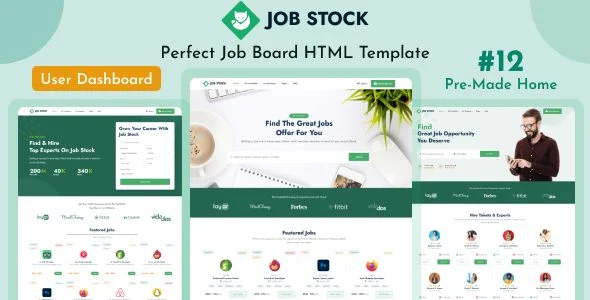
Job Stock is an HTML5 and CSS3 job board template built on Bootstrap 5.3, engineered for agencies and front-end developers who need to ship recruitment and freelancer marketplace interfaces without designing page layouts from scratch. The package addresses the structural bottleneck of assembling large-scale employment portals by shipping 84+ pre-built pages, 12 homepage variants, and dedicated candidate, employer, and freelancing sections as ready-to-wire static markup. Within agency delivery workflows, it operates as a presentation-layer foundation that a back-end team can connect to any server-side framework, headless API, or custom CMS pipeline after deployment scaffolding is complete.
Technical Specifications & Deployment Matrix
| Engineering Metric | Deployment Specification |
|---|---|
| Base Technology / Framework | HTML5, CSS3, Bootstrap 5.3 (Bootstrap 5.x / 4.x compatibility) |
| Runtime / Language Requirements | Static client-side rendering; standard web server hosting, no server-side language mandated |
| Browser Compatibility | IE9, IE10, IE11, Edge, Chrome, Firefox, Safari, Opera |
| Front-End Dependencies | FontAwesome 600+ icon set, Select2 components, consolidated 2-file CSS structure, bundled JS files |
| Database / Persistence Footprint | None — the deliverable contains HTML, CSS, and JS files only; data layers are developer-implemented |
Marketplace Layout Engine & Execution Pipeline
The core mechanism is a static Bootstrap 5.3 grid system rendering 84+ pre-structured pages. Because no server-side rendering engine exists in the package, every page arrives as semantic HTML5 markup: browsers parse the document tree, pull the consolidated CSS pair, and hydrate interactive behaviors (loaders, popups, Select2 dropdowns, map-based job browsing) through bundled JavaScript files executed after DOM construction. Layout composition follows the Bootstrap column model with 4+ column configurations, letting recruitment listings, resume grids, and employer profiles share a single responsive breakpoint system across tablet and mobile viewports.
The template separates its page inventory into functional domains: 12 homepage entry points, 50+ inner pages, 2 blog layouts, and specialized surfaces for premium job listings, ads management slots, and freelancing workflows. Candidate and employer dashboards ship as pre-marked HTML panels with statistics cards, application tables, and profile forms — all static until a developer binds them to an API layer. Map-integrated job browsing appears in both grid and list arrangements, and job alert plus login modals are dispatched as client-side overlay components rather than separate route loads.
Architectural & Functional Highlights
- Twelve homepage variants: Each homepage reuses the shared Bootstrap 5.3 grid and icon library, allowing a project to switch market positioning (general job board, freelancer hub, premium listing portal) without rebuilding the underlying CSS structure.
- Candidate and employer dashboards: Pre-built dashboard pages cover both marketplace roles, including employer review sections added on employer profile pages, giving back-end integrators a complete DOM contract to bind against.
- Eight color scheme options: Theming is handled through swappable CSS color definitions, so a deployment can rebrand the entire 84-page inventory by replacing stylesheet variables instead of editing markup page by page.
- Map-driven search layouts: Job and resume browsing render in grid or list modes with map companions, implemented as front-end layout states that a data layer can populate with geo-tagged listing payloads.
- Freelancing and monetization surfaces: Dedicated freelancing pages, ads management sections, payment method pages, and premium candidate detail pages support marketplace monetization flows directly in markup.
For teams evaluating independent dashboard implementations outside static Bootstrap markup, Dashboi represents a separate Tailwind CSS and Vue.js 3 administration path that does not share this codebase.
Production Implementation & Operational Resilience
Deployment requires only a static file host: the download contains HTML, CSS, and JS assets with no database schema, migration scripts, or server runtime prerequisites. The consolidated two-file CSS architecture reduces request overhead and simplifies cache invalidation during client staging cycles, while responsive fixes applied in the December 2024 and August 2023 revisions addressed mobile font rendering and cross-device layout regressions. Because the December 2024 changelog explicitly corrected font behavior on mobile devices, QA passes should verify typography rendering on small viewports after any customization pass.
Customization boundaries are stylesheet-and-markup scoped. Rebranding runs through the eight color options; structural changes require editing HTML files directly, since no template hierarchy, hook system, or child-theme override mechanism exists in a static deliverable. All form elements — job applications, registrations, alerts — render client-side only and remain non-functional until a developer attaches validation and submission handlers pointing at a back-end endpoint. Demo imagery shown in the preview is not part of the download, so production rollouts must source licensed replacements before client handover.
Error handling is correspondingly front-end bound: loaders, popup states, and map fallbacks are defined in JavaScript, and any CORS-sensitive data integration (for example, pulling live job feeds into the map layouts) must be configured on the API host serving the payload. The included written documentation maps file structure and page inventory, which shortens onboarding for developers inheriting the codebase mid-project. For studios that prefer a WordPress-native assembly route instead of wiring PHP or REST endpoints into static pages by hand, Jobget exists as a standalone Elementor Template Kit occupying a parallel, non-mergeable technology stack; agencies pre-launching a recruitment domain before content completion can likewise stage a separate static placeholder using a dedicated coming-soon template such as MAGiC.
Frequently Asked Questions
Is Job Stock a WordPress theme or plugin?
No. The package is a static HTML template containing HTML, CSS, and JS files. It runs on any web server without WordPress, PHP execution, or a database, and all dynamic behavior must be added through custom back-end integration.
Are the demo images shown in the preview included in the download?
No. Demo images serve preview purposes only and are excluded from the deliverable. Production deployments must supply their own licensed photography and illustration assets before launching client-facing or public-facing job portal instances.
Does the template include dashboards for both candidates and employers?
Yes. Dedicated candidate and employer dashboard pages ship in the package, alongside premium candidate detail pages, payment method pages, and employer review sections, giving integrators pre-structured markup for both marketplace roles.