Jampack – Powerful React-Bootstrap SaaS App Template
Jampack Overview & React-Bootstrap SaaS Application Foundation
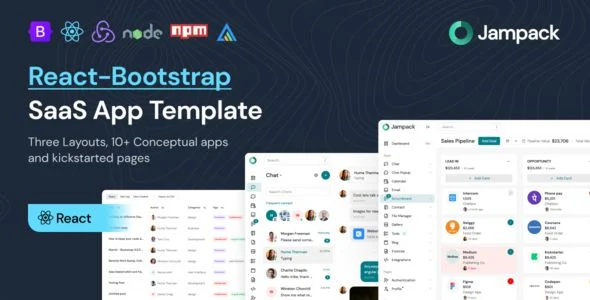
Jampack is a React-Bootstrap SaaS app template engineered for development teams and agencies that must ship operational, analytical, and collaborative dashboard products without assembling a UI layer from scratch. The package resolves the recurring bottleneck of rebuilding layout shells, navigation, charting, and form validation for every internal tool or client portal by supplying 1000+ UI elements and 10+ conceptual applications on a single component foundation. Within production workflows it operates as the presentation layer of a SaaS build: teams wire their own APIs into prebuilt Redux-connected views, CRM screens, calendar modules, and chat interfaces rather than writing markup and styling by hand.
Technical Specifications & Deployment Matrix
| Engineering Metric | Deployment Specification |
|---|---|
| Base Framework | React 19.x, React-Bootstrap 2.10.x, Bootstrap 5.3.x |
| Build Toolchain | Vite 7.x (migrated from Create React App), configured via vite.config.js |
| State Management | Redux 5 with React-Redux bindings; React-Router-Dom for view routing |
| Styling Layer | Sass/SCSS with semantic CSS custom properties (e.g., –hk-bg-primary) |
| Data Visualization | ApexCharts 5.x, react-apexcharts, AmCharts 5, Vector Maps, Google Maps |
| Persistence Footprint | Client-side only; no server database layer ships with the package |
| Browser Compatibility | IE11, Firefox, Safari, Opera, Chrome, Edge; responsive across screen sizes |
Component-Driven Architecture & Execution Pipeline
The rendering pipeline runs on React function components built with Hooks, React-Router-Dom handling navigation, and Redux plus React-Redux dispatching shared state into views. Vite compiles the source tree into optimized static bundles, replacing the original Create React App toolchain entirely. Because presentation logic lives inside component-scoped Hooks instead of class lifecycles, state updates propagate predictably from the store into screens such as the CRM dashboard, email client, or scrumboard without manual DOM reconciliation.
More than ten conceptual applications ship as working reference implementations: Calendar, Chat, Chatbot, Email, Scrumboard, Contacts, File Manager, Todo, Blog, and Invoices. Each module demonstrates a distinct interaction pattern — drag-and-drop ordering through React Beautiful Dnd, tabular data through the custom hk-data-table component (which replaced the deprecated react-bootstrap-table-next), and rich text editing through an integrated Wysiwyg editor. Authentication flows cover login, sign-up, and reset-password screens in three layout options each, complemented by lock-screen, 404, and 503 error states, plus Profile, Account, Gallery, and Changelog pages.
Architectural & Functional Highlights
- SCSS variable theming engine: Semantic custom properties such as –hk-bg-primary are generated through automated SCSS loops, while dark mode rides on Bootstrap 5’s native data-bs-theme attribute so cards, modals, and dropdowns render high-contrast surfaces without duplicated stylesheets.
- Theme-aware data visualization: ApexCharts and AmCharts adapt dynamically when the Light/Dark/System switcher fires, and both Google Maps and Vector Maps expose dark skins for geospatial views.
- Form and table infrastructure: Validated form elements, multi-file upload via react-dropzone, React Table grids, Bootstrap-Daterangepicker, and Select2 wrappers supply the input layer for data-heavy screens.
- No jQuery dependency: All interactivity — modals, carousels, lightbox galleries, Sweet Alert2 notifications — is executed through React components and Redux dispatch cycles, keeping the bundle free of dual DOM manipulation paradigms.
Agencies benchmarking component density against parallel codebases can study Webmin as a comparable React JS admin dashboard implementation with its own routing and layout conventions.
Production Implementation & Operational Resilience
Because Vite emits static assets, the compiled output deploys to any static hosting target — the public demonstration build runs on Vercel, and equivalent output can be served from Nginx, CDN edge storage, or any container that serves HTML, CSS, and JS files. No Node runtime is required at serving time; Node is only needed on the build machine to resolve dependencies and run the Vite pipeline.
Since no server-side persistence layer ships with the package, session and application state live in the Redux store, and teams must connect their own API layer for authentication tokens, invoice records, and file storage. The documented error surfaces — 404 and 503 routes, lock-screen states, and form validation messaging — provide graceful fallbacks for failed navigations and rejected input payloads.
Customization boundaries are defined by the SCSS layer: modifying variables.scss recolors the entire theme, and the refactored soft-UI classes (e.g., .bg-soft-primary) use solid-mix logic so tinted surfaces remain legible in dark mode. Dependency hygiene deserves attention during upgrades — react-dropzone-component was replaced with react-dropzone because the original library is incompatible with React 19, so version pinning against the documented package.json prevents build failures. Teams building payment-oriented portals on a separate codebase path can evaluate MOPHY as a Redux-based dashboard alternative. Note that preview imagery is excluded from the download, so production deployments require licensed replacement media.
Frequently Asked Questions
Does Jampack include full dark mode support?
Yes. Version 1.2.1 introduced a redesigned dark UI, a dynamic switcher covering Light, Dark, and System modes, theme-adaptive ApexCharts and AmCharts, dark skins for both map libraries, and a documented dark-mode implementation guide.
Is jQuery used anywhere in the codebase?
No. The template is explicitly jQuery-free; all interaction logic — modals, carousels, galleries, alerts, and drag-and-drop ordering — executes through React components, React-Bootstrap primitives, and Redux dispatch cycles.
Are the demo images bundled with the download package?
No. The documentation states that images used in the preview are not included in the download version, so teams deploying to client environments must supply their own licensed photography and illustration assets.
Can the project still be built with Create React App?
No. The codebase migrated from CRA to Vite, with configuration now handled through vite.config.js instead of CRA’s default setup, and the build process documented against the Vite pipeline exclusively.