ItsMyKit – Dark Creative Portfolio Elementor Template Kit
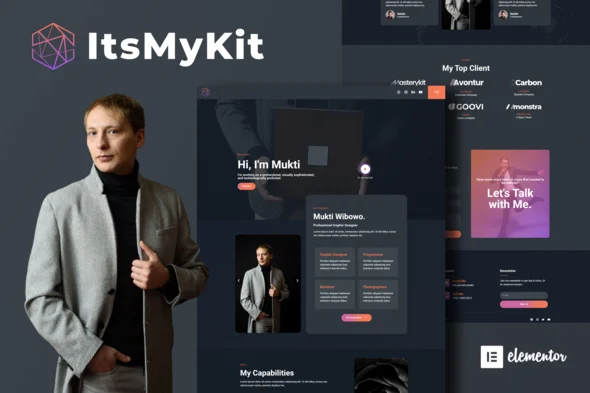
ItsMyKit Dark Creative Portfolio Template Kit Overview & Portfolio Delivery Role
ItsMyKit is a dark-styled creative portfolio Elementor Template Kit, engineered for freelancers, agencies, and independent designers to launch showcase websites without constructing page layouts from a blank canvas. The package ships twelve pre-built templates as portable Elementor design data, eliminating the repetitive wireframing, typography scaling, and section composition work that dominates personal-brand website projects. Within an agency delivery pipeline, it operates as a drop-in layout layer for the Elementor Hello Theme, letting production teams assemble homepage variants, case-study views, and editorial structures in a fraction of a standard build cycle.
Technical Specifications & Deployment Matrix
| Engineering Metric | Deployment Specification |
|---|---|
| Base Technology / Framework | Envato Template Kit (Elementor design data), built for the Elementor Hello Theme |
| Runtime Requirements | WordPress running Elementor 3.8.x or Elementor 3.10.x |
| Premium Dependencies | Elementor Pro upgrade required for select templates and features |
| Data Exchange / Import Protocol | JSON layout payloads installed via the Envato Template Kit Import plugin or direct Elementor kit import |
| Database / Persistence Footprint | None at kit level — no custom tables; layouts persist as standard Elementor page data |
JSON Layout Architecture & Template Execution Pipeline
The core mechanism is a JSON design-data pipeline consumed entirely by the Elementor editor runtime. Each of the twelve templates is stored as a structured layout payload — a hierarchy of container, widget, and style nodes — rather than as executable theme code. When an import is triggered, the Envato Template Kit Import plugin (or Elementor’s native kit-import flow) parses that payload, validates each widget definition against the installed Elementor and Elementor Pro instance, and materializes the validated structure as editable pages inside the WordPress editor. No PHP template files execute during this process and no database schema is created; the kit functions strictly at the page-builder presentation layer.
Layout composition follows the Flexbox container model, so nested containers govern alignment, spacing, and stacking behavior across desktop, tablet, and mobile breakpoints rather than relying on legacy section-and-column wrappers. Color palettes and type scales are wired into global design tokens, which means a single adjustment to a token in Site Settings propagates across headers, body copy, and accent elements throughout every imported template. Where portfolio grids, dynamic single-item views, and loop-driven blog listings appear, those regions are powered by Elementor Pro widget classes, which is why the Pro upgrade is a hard prerequisite for parts of the kit.
Architectural & Functional Highlights
- Twelve-template sitemap coverage: Two homepage variants, About Me, Portfolio, Single Portfolio, Service, Team, Blog, Single Post, Archive, Contact, and Error 404 templates form a complete personal-brand information architecture, including a Menu Slide navigation pattern for overlay-style navigation.
- Flexbox container architecture: Layouts resolve responsive behavior through container-level direction, gap, and wrap properties, so breakpoint reflow is handled structurally instead of through per-element CSS overrides.
- Global design token system: Dark palette values and typography scales are centralized at kit level, enabling site-wide restyling through a single editing surface without touching individual widgets.
- Elementor Pro widget dependency: Portfolio showcases, single-project views, and archive structures rely on Pro widget classes, keeping dynamic content rendering inside the page builder rather than in external code.
- Hello Theme host baseline: The kit targets the lightweight Elementor Hello Theme, minimizing host-theme CSS conflicts and keeping the rendered DOM footprint predictable across templates.
Production Implementation & Operational Resilience
Before importing, verify the WordPress memory allocation — raising wp_memory_limit to at least 256 MB prevents payload parsing interruptions when several large templates are processed in a single staging session. For agency client work, importing first into a staging environment allows token overrides and content swaps to be validated before pushing pages to production. Because the kit is design data rather than a theme, it cannot be activated from the Appearance screen; attempting to treat it as a theme will fail silently in the themes loader. Error 404 and Archive templates cover failed-route and date/category listing rendering, closing the gaps a bare homepage import would leave open. For product-led landing pages that sit outside a portfolio sitemap, importing Viasun into the same Elementor Pro installation works cleanly, since both kits share the identical page-builder runtime and Hello Theme baseline.
Customization boundaries are explicit: style adjustments should happen through token overrides and direct container edits inside the Elementor editor, while structural changes stay confined to widget-level swaps. Demo imagery is sourced from Envato Elements, so every preview image must be licensed from that library or replaced with owned assets before a client site goes live — the image references themselves carry no usage rights. For decoupled implementations outside the Elementor page-builder runtime entirely, Copr exists as an independent theme-based portfolio path that renders through the native WordPress template hierarchy instead of imported layout data.
Frequently Asked Questions
Is ItsMyKit a standalone WordPress theme that can be activated from the Appearance menu?
No, it is an Envato Template Kit containing Elementor design data only. The layouts must be imported through the Envato Template Kit Import plugin or Elementor’s import flow onto a WordPress site running the Elementor Hello Theme.
Can all twelve templates function with the free version of Elementor alone?
No, the documentation specifies that the kit requires the Elementor Pro upgrade for some templates and features. Dynamic portfolio views, loop-driven listings, and several structural components depend on Pro widget classes that the free build does not include.
Are the demo images bundled and cleared for production use?
No, all preview imagery is sourced from Envato Elements and ships without usage rights. Each image must be licensed directly from that library or substituted with owned assets before the deployed website receives live traffic.