Iqra Quran – The Full Holy Quran Read And Listen Android Application
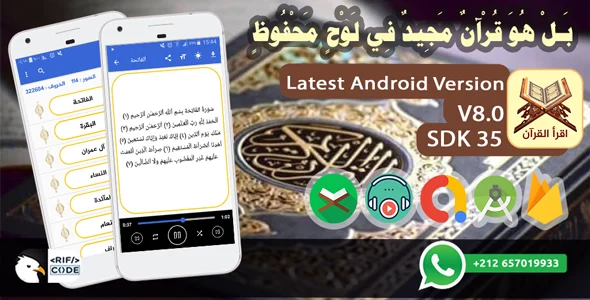
Iqra Quran Android Application Overview & Mobile Architecture Role
Iqra Quran is a native Android application source code built in Java and XML, engineered for mobile developers and app-publishing agencies to deploy a complete 114-surah Quran reading and audio playback product. The project targets Android Studio with SDK 35 and resolves the core bottleneck of delivering a paper-identical mushaf layout, recitation audio, and surah downloads inside a single APK with a small on-device footprint. Within agency delivery pipelines, it functions as a ready-to-reskin, store-ready asset: developers compile the Java/XML package, configure AdMob identifiers, rename branding assets, and submit a production build to Google Play.
Technical Specifications & Deployment Matrix
| Engineering Metric | Deployment Specification |
|---|---|
| Base Technology / Framework | Native Android, Android Studio, SDK 35, Java + XML |
| Runtime / Language Requirements | Android 9.0 through Android 15.0 (plus additional device targets) |
| Data Exchange / Communication Protocols | Local asset storage for offline mushaf text; network retrieval for audio streaming and surah downloads |
| Front-End / Engine Dependencies | Native Android View hierarchy (XML layouts), foreground notification media player |
| Database / Persistence Footprint | On-device downloaded surah audio cache; no server-side database required for reading mode |
Offline-First Mushaf Engine & Execution Pipeline
The application operates as an offline-first reading engine with an online-audio extension layer. Quran text for all 114 surahs ships inside the package, so the reading surface renders without any network connection; audio playback and surah download routines activate only when connectivity exists. Navigation events dispatch through a simple screen-flow model, letting users locate a surah via search, adjust text size for readability, or switch to a night-reading palette that lowers luminance for low-light sessions. The audio subsystem decouples playback from the foreground Activity: recitation continues through a notification-bar player, so audio persists while the user exits the app shell, and downloaded surahs persist to local storage for later offline listening. Localization spans 18 language sets, including Arabic, English, French, Urdu, Hindi, Indonesian, Malay, Bengali, Persian, Uzbek, Azerbaijani, Tajik, Kyrgyz, Uyghur, Spanish, Mandarin Chinese (Simplified), and Traditional Chinese variants for Taiwan and Hong Kong, plus a Pinyin edition. Developers extending an Islamic app portfolio around prayer and scripture workflows often pair this engine with Qibla Compass, which covers the Qibla-direction and Namaz-locating half of that product category.
Core Technical Capabilities of Iqra Quran
- Complete Offline Mushaf Rendering: All 114 surahs render from bundled assets with zero network dependency for reading, matching the printed paper Quran layout while keeping the installed APK size small enough to conserve device storage.
- Persistent Background Audio Pipeline: Recitation playback runs through a notification-bar media player that survives app exit, and surah audio files download to local storage, enabling offline listening sessions after a one-time fetch.
- AdMob Monetization Layer: Banner and Interstitial ad units are wired into the Java codebase, so publishers only substitute their own AdMob unit IDs before generating a signed release build.
- Interactive Scripture Sharing & Analytics: Users can share individual ayahs to social channels, share the app itself, trigger the store rating flow, and inspect ayah and letter counts per surah, all handled through native Android intent dispatch.
- Multi-Locale Text Scaling: The settings layer exposes text-size adjustment and night mode, while the string resources cover 18 language variants, letting one codebase serve global Muslim-speaking markets without recompiling layouts.
Production Implementation & Operational Resilience
Deployment begins in Android Studio: import the Java/XML source package, verify the SDK 35 toolchain is installed, resolve Gradle dependencies, replace application IDs and AdMob unit identifiers, then produce a signed release APK for store submission. The included step-by-step documentation with screenshots walks through each configuration checkpoint, which reduces onboarding friction for teams unfamiliar with the codebase. Version 8 specifically hardened the build for Android 15 compatibility, corrected the notification player behavior, and repaired the surah download routine, so publishers inheriting the code receive a bug-corrected baseline rather than an unpatched legacy branch. Operational boundaries are explicit: reading mode works fully offline, while audio streaming and surah downloads require an active network connection, and the notification player operates within Android foreground-service constraints on newer OS versions. Reskin scope covers asset replacement, string localization, package renaming, and AdMob configuration, all within the native project structure. Agencies shipping multiple vertical Android products on parallel schedules, such as an education deployment built on School Management Mobile App for Android, can standardize on this same Java/XML toolchain to keep build pipelines and review workflows consistent across client accounts.
Frequently Asked Questions
Does Iqra Quran read the full Quran text without an internet connection?
Yes, all 114 surahs are bundled inside the application package, so the complete reading surface functions in airplane mode. Only audio streaming and surah downloads require an active network connection to fetch recitation files.
Is the source code compatible with the latest Android 15 platform target?
Yes, version 8 rebuilt the project against SDK 35 and validated behavior on Android 15 devices, including the corrected notification-bar player, which previously required fixes under stricter foreground-service rules.
Can audio playback continue after the user closes the app screen?
Yes, recitation runs through a notification-bar media player that operates outside the visible app shell. This lets listeners keep audio active while navigating other applications on the device.
Do I need a backend server or admin panel to operate this application?
No, the architecture contains no server-side admin dashboard or remote content management requirement. Quran text is packaged locally, downloaded surah audio persists on-device, and configuration happens directly in the Android Studio project before compilation.
Are AdMob ads already integrated, or must I wire the SDK myself?
Yes, both Banner and Interstitial formats are integrated into the Java codebase. As the publisher, you substitute your own AdMob unit identifiers and application ID in the configuration files, then rebuild before submitting a release binary.