InHype – Blog & Magazine WordPress Theme
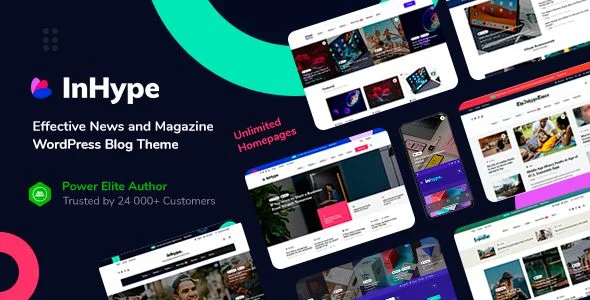
InHype Blog & Magazine WordPress Theme Overview & Editorial Rendering Architecture
InHype is a PHP-driven blog and magazine WordPress theme built for publishers, editorial teams, and agencies that need to deploy content-heavy sites without authoring CSS or HTML. The package targets a specific presentation bottleneck in high-volume publishing: generic themes cannot distribute posts into grouped, reusable layout blocks, cannot vary single-post headers per article, and ship no native mechanism for converting reader engagement into advertising inventory. In production delivery it operates as a self-hosted presentation layer that renders editorial taxonomies, author metadata, and WooCommerce shop data through WordPress template hierarchy overrides.
Technical Specifications & Deployment Matrix
| Engineering Metric | Deployment Specification |
|---|---|
| Base Technology / Framework | WordPress theme (PHP templates), Bootstrap 3 responsive grid, CSS3/HTML5 output, retina and responsive image handling |
| Runtime / Language Requirements | WordPress 5.0.x through 7.0.x; PHP 8.3 supported as of v1.5.2 |
| Data Exchange / Communication Protocols | Ajax post fetching, Google AMP output, WPML multilingual data flow, MailChimp and Instagram feed integration |
| Front-End / Engine Dependencies | Gutenberg editor with enhanced theme styles; WooCommerce 6.x through 10.x; 10 bundled plugins |
| Database / Persistence Footprint | Standard WordPress schema; settings persisted via the Customizer API; 5 widget sidebar areas |
Drag-and-Drop Homepage Builder & Execution Pipeline
The core mechanism is a Customizer-embedded homepage builder with live preview and 38 reusable blocks. An administrator positions post grids, sliders, content sections, Instagram feeds, subscribe forms, category lists, and WooCommerce product blocks, and each instance persists its own settings object, so the same block type can repeat at any position with distinct configurations. Because every block is also exposed as a shortcode, the identical rendering components can be injected into arbitrary posts and pages, keeping DOM output consistent across the site.
Content distribution runs through a post-grouping mechanism: editors assign articles to named groups, and individual blocks query those groups instead of raw categories, which decouples presentation from taxonomy. Single-post rendering offers more than 20 header variations, while the site header supports unlimited layout combinations, an advanced mega menu, and three menu positions (top, header, footer) that can each be switched off.
Core Technical Capabilities of InHype
- Customizer Block Engine: 38 homepage block types with per-instance settings, repeatable placement, and shortcode availability on any page or post, removing external page-builder dependencies from the render path.
- Post Grouping Pipeline: group assignment queried per block, extended by related posts and a per-article Worth Reading block that editors curate manually.
- Ajax Load More Layer: XHR-based pagination for both homepage blocks and blog listings, fetching subsequent post payloads without full document reloads and preserving scroll context.
- Review, Rating & Monetization Stack: a post review and rating engine stores structured scores on articles, an advertising banner management system injects ad slots, and WooCommerce integration supplies a header mini cart plus dedicated shop blocks and widgets.
- Engagement & Identity Layer: fixed social share block, social follow, MailChimp subscribe, Instagram feeds, dark and light menu styles, 10 predefined color skins, and 650+ integrated Google Fonts.
For publishers benchmarking parallel editorial architectures before committing to a vertical-specific stack, UniDark addresses the same magazine and news publishing workload as an independent theme implementation.
Production Implementation & Operational Resilience
Deployment starts with a 1-click demo data importer that replicates the preview site’s pages, posts, and demo widgets, after which structural changes run through the Customizer with live preview. A video installation guide and step-by-step configuration documentation accompany the package, and version 1.5.3 extends the compatibility envelope to WordPress 7.0.x on top of the PHP 8.3 support introduced in v1.5.2.
The changelog demonstrates a sustained patch cadence, including targeted corrections for Gutenberg quote display and the WordPress 5.8 widget regression, alongside plugin alignment and WooCommerce 7.x through 9.9.x support milestones. Cross-browser verification spans Chrome, Firefox, Edge, Safari, and Opera, while Google Page Speed optimization is documented with scores reaching up to 100/100.
Feature gaps that sit outside the presentation layer, such as structured reader polls and scored quizzes, are addressed by attaching an independent plugin rather than modifying theme templates; Modal Survey occupies that slot as a standalone survey engine. Native widget coverage already includes social share, post lists, recent comments, a posts slider, content blocks, and category widgets distributed across five sidebar areas.
Pre-deployment prerequisites remain modest: WooCommerce version alignment for the mini cart, WPML when multilingual output is required, and optional slider plugins where existing carousel assets must be reused. Dedicated sidebar management per page or post (left, right, fullwidth) lets agencies differentiate client layouts without template forks.
Agencies serving travel-focused clients whose brief emphasizes adventure storytelling over broad magazine layout variety can evaluate Wanderic as a separate theme implementation outside this package’s scope.
Frequently Asked Questions
Does the theme support third-party sliders such as Slider Revolution and Master Slider?
Yes, custom slider support is documented for Slider Revolution, Master Slider, and comparable engines, so existing carousel assets can be dropped into headers and homepage positions instead of being rebuilt inside the native featured-post slider component.
Can visitors register, log in, and publish posts without custom authentication code?
Yes, user registration and login run natively with social sign-up and sign-in integration, and multi-author support allows registered users to add posts directly, turning the site into a community publishing platform without custom authentication development.
Is a full reinstallation required when moving to a newer theme version?
No, the documented release history defines an upgrade path that adds new files and replaces only changed files, a procedure applied across releases from v1.2.x through v1.5.3, including the WordPress 7.x compatibility update.
-
v1.5.3 LatestOct 23, 2026