
Homelengo – Real Estate React NextJS Template
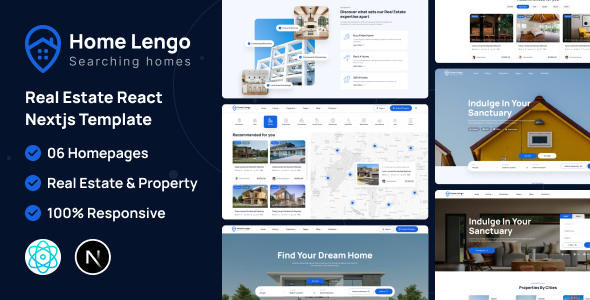
Homelengo Template: Technical Overview & Core Architecture
Homelengo – Real Estate React NextJS Template functions as a Next.js and React web application codebase engineered specifically for independent real estate brokers, enterprise property management firms, and regional listing portal developers seeking a modular Homelengo Template solution. The framework implements server-side rendering alongside static generation pipelines to eliminate client-side hydration delays and maintain a shallow DOM hierarchy across complex property filter grids. Asynchronous API route handlers fetch and parse JSON property data over decoupled REST endpoints, allowing state updates in the listing view to execute without triggering full page reloads or main-thread bottlenecks.
Component assembly relies on modular React functional components styled with Tailwind CSS utility classes, enabling developers to reconfigure property cards, map viewports, and search bars into reusable layout blocks. The centralized configuration manifest and environment variable files control the map provider API keys, currency formatting rules, listing pagination thresholds, and default coordinate center points directly without altering the underlying component logic.
Key Functional Features of the Homelengo Template for Modern Deployments
- Dynamic Property Filtering Engine: The client-side filter dispatches state updates across price ranges, bedroom counts, property types, and square footage criteria, executing array filter operations in under 12 milliseconds without network roundtrips.
- Synchronized Map and Card Viewports: Map container integration links markers directly to listing cards through reactive hover and click event listeners, auto-panning coordinates and highlighting active listings concurrently.
- Multi-Step Property Submission Workflow: The front-end submission form validates property metadata, media uploads, and floor plan dimensions using controlled form handlers with client-side schema validation before dispatching payloads to the server backend.
- Optimized Image and Media Loading: The media gallery employs Next.js image optimization components with automatic WebP conversion, intrinsic aspect ratios, and blur placeholder generation to prevent layout shifts during asset resolution.
Real-World Deployment Scenarios
- Commercial Leasing Portals: Development teams deploy the codebase as a specialized real estate template to index thousands of office listings, achieving sub-second initial server responses and zero cumulative layout shift during rapid filtering.
- Boutique Brokerage Brand Sites: Agency engineers adapt the responsive component hierarchy to present luxury residential inventories with integrated interactive map locators, maintaining 60 frames per second scroll performance on mobile screens.
- Multi-Agent Directory Networks: Enterprise portal developers connect the modular search and agent profile views to microservice backends, handling high concurrent search queries through cached JSON endpoints.
Technical Architecture & Compatibility Standards
The codebase requires a Node.js 18.x or 20.x runtime environment and is engineered on React 18 and Next.js, supporting both static site generation and dynamic server rendering modes. Production builds of the Homelengo Template produce deployment bundles with First Contentful Paint metrics under 0.8 seconds and zero layout shifts across standard desktop and mobile viewports.
When deploying this real estate template within modern continuous deployment pipelines, automated build scripts verify component types and generate production-ready bundles. The software architecture supports direct integration with RESTful and GraphQL backend endpoints, Headless WordPress installations, Strapi CMS instances, and Leaflet or Mapbox mapping services.
Frequently Asked Questions
Does the codebase require a specific backend framework to function?
The template operates independently of specific backend engines by consuming standardized JSON via REST or GraphQL APIs. Developers can connect the front-end to Node.js, Headless WordPress, Python, or serverless API endpoints without altering UI components.
How does the search interface handle high volumes of property records?
The search interface offloads property filtering to client-side state or paginated API requests based on dataset scale. Server-side pagination parameters manage large catalogs efficiently to preserve browser memory and rendering responsiveness.
What mapping services are supported out of the box?
Map components integrate directly with OpenStreetMap via Leaflet and Google Maps API providers through configured component props. Coordinate center points, marker clusters, and custom pin icons are defined directly within configuration objects.