Hind – Multi-Concept Portfolio & Photography WordPress Theme
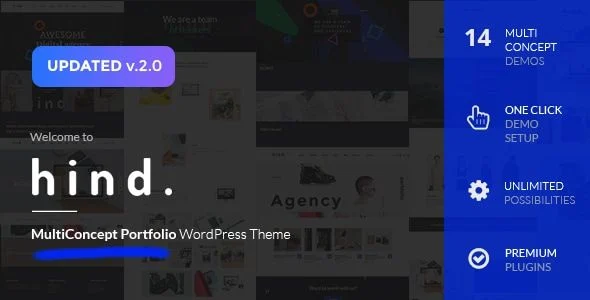
Hind Portfolio & Photography WordPress Theme Overview & Multi-Concept Presentation Architecture
Hind Portfolio & Photography WordPress Theme is a multi-concept WordPress front-end framework engineered for photographers, design studios, and creative agencies to publish showcase-driven websites without writing CSS or HTML. The package addresses the bottleneck of repetitive layout construction by shipping 14 prebuilt homepages, 14 portfolio layout variations, and a bundled WPBakery-based page builder, reducing per-project composition work to content replacement. Within agency delivery pipelines it functions as a drop-in presentation layer: a one-click demo data importer provisions the preview site’s pages and settings, after which teams override copy, imagery, and color schemes through the Hind Control Panel rather than editing template files directly.
Technical Specifications & Deployment Matrix
| Engineering Metric | Deployment Specification |
|---|---|
| Base Technology / Framework | WordPress theme built on Bootstrap 3, responsive layout with retina display support |
| Runtime / Language Requirements | WordPress 5.0.x through 6.9.x, PHP 7.x and PHP 8.3, PHP/CSS/JS file payload |
| Front-End / Engine Dependencies | WPBakery-based Visual Page Builder (13 custom theme elements) and Revolution Slider with 11 prebuilt sliders |
| Data Exchange / Communication Protocols | WooCommerce 6.x–9.x commerce integration and WPML multilingual support |
| Browser / Persistence Footprint | Cross-browser rendering across Chrome, Firefox, Edge, Safari, Opera, and IE9–IE11; 5 widget sidebar regions plus per-page sidebar assignment |
Rendering Pipeline, Control Panel & Portfolio Engine
The core mechanism is a Control Panel–driven options layer that feeds WordPress template hierarchy rendering with globally stored configuration. Administrative settings—color skins, typography selections from 650+ Google font families, header behavior, and layout mode—are persisted in the options store and consumed during page assembly by the theme’s template files. On the presentation tier, WPBakery shortcodes are parsed into DOM structures, while 13 custom-built visual composer elements extend the builder’s native vocabulary with portfolio-specific blocks such as photo galleries, carousels, and animated sliders.
Portfolio output is governed by a composable layout system: engineers select fullwidth or boxed containers, spaced or regular grids, three column-count settings, and one of eight item hover animations applied via CSS state transitions on grid cells. Category filtering dispatches through 18 distinct animation variants, and 20+ header style combinations—including transparent header assignments set per page, post, or portfolio item—allow template-level differentiation without code edits. Navigation states include sticky headers, an offcanvas menu that floats in from the right, and a configurable site preloader that can be swapped for a custom image. Content types span WordPress post formats (Gallery, Video, Audio, Quote, Link, Status), with lightbox and lightbox gallery bindings attachable to any in-post image, plus social share and social follow integrations.
Architectural & Functional Highlights
- One-Click Demo Data Import: Provisions the full preview site—pages, portfolio entries, and slider configurations—into a fresh WordPress install, collapsing environment bootstrap time and giving teams a working baseline to mutate rather than build from zero.
- Bundled Page Builder with 13 Custom Elements: The WPBakery-based builder operates in both frontend and backend editing modes, with theme-authored elements (portfolio grids, photo sliders, parallax rows) mapped to shortcode handlers rendered server-side within the template hierarchy.
- Parallax & Video Row Engine: Advanced parallax settings and parallax video rows shift background layer positioning during scroll events, with parameters managed per row through the builder interface.
- Operational Mode Switching: A built-in coming soon / maintenance mode and dedicated maintenance page allow staging-to-production transitions without a separate plugin, while WooCommerce support enables product sales inside the same portfolio install.
- Typography & Color Token System: Ten predefined color skins and unrestricted custom palette creation, combined with 650+ integrated Google font families, form the theme’s design token layer addressable from the Control Panel.
For creative teams evaluating parallel presentation stacks, Airtifact exists as an independent portfolio-oriented theme option for case-study-focused builds outside this package’s layout system.
Production Implementation & Operational Resilience
Deployment begins with the documented one-minute installation path: a video guide and step-by-step documentation accompany the package, and the demo importer mirrors the preview environment into staging. Because the codebase targets PHP 8.3 and WordPress versions up to 6.9.x, hosting stacks running legacy PHP 5.x runtimes require an interpreter upgrade before activation. The vendor-documented 90/100 Google Page Speed score reflects the theme’s asset profile, though real-world LCP and CLS outcomes depend on image payload discipline, slider count, and parallax video usage on any given page.
Asset fragmentation follows the theme’s enqueue architecture: CSS and JS files ship uncompressed in the bundle, so engineers operating high-traffic client deployments typically layer a caching or minification layer at the server or plugin tier. Resilience behaviors include the preloader’s disable-or-replace switch, per-page transparent header overrides that prevent global layout regressions, and dedicated sidebar management (Left/Right/Fullwidth) that isolates widget region changes to individual posts or pages. WPML compatibility establishes the multilingual data path, and WooCommerce 6.x–9.x support keeps commerce endpoints aligned with current plugin releases.
Secondary development stays within standard WordPress extension boundaries—child themes, Control Panel options, and the builder’s element set—rather than requiring core file modification. No CSS/HTML knowledge is needed for configuration-level work. As an alternative creative-stack path, Nicex operates as a separate Elementor-based portfolio theme, and for decoupled gallery implementations outside this theme’s builder, Fast Gallery for Elementor WordPress Plugin provides standalone filterable gallery construction.
Frequently Asked Questions
Is Hind optimized for native Gutenberg block editing?
No. The package is not flagged as Gutenberg-optimized; page composition and layout control route through the bundled WPBakery-based visual page builder operating in frontend and backend editing modes rather than the block editor.
Are the demo photographs and portfolio works included in the download?
No. All images and photographed works shown in the preview are used for demonstration purposes only and are not distributed with the theme files; production deployments must supply their own licensed visual assets.
Can products be sold directly inside a Hind-based portfolio site?
Yes. The theme carries WooCommerce 6.x through 9.x compatibility, allowing storefront product listings and checkout flows to operate within the same WordPress install alongside portfolio and photography content.
-
2.4.5 LatestOct 26, 2026