Hetch – Windows and Doors WordPress Theme
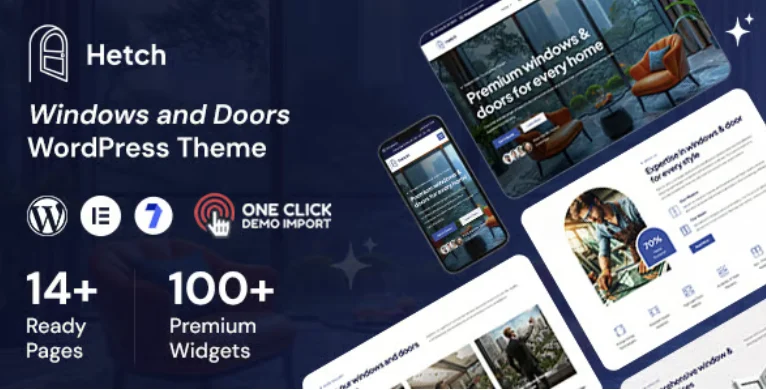
Hetch Windows and Doors WordPress Theme Overview & Industry-Specific Presentation Layer
Hetch is a WordPress theme engineered for manufacturers, suppliers, and designers in the windows and doors industry to publish product catalogs and service pages without hand-coding presentation templates. The package addresses a recurring bottleneck in home-improvement delivery: generic multipurpose themes force contractors to retrofit industrial imagery, project galleries, and specification tables into layouts never modeled for fenestration businesses. Within agency workflows, the theme functions as a drop-in front-end layer that installs over a standard WordPress runtime, ships with pre-built page structures for services, projects, and galleries, and renders responsively across desktop, tablet, and mobile viewports.
Technical Specifications & Deployment Matrix
| Engineering Metric | Deployment Specification |
|---|---|
| Base Technology / Framework | WordPress theme (PHP, CSS, and JS source files included), version 1.0.6 |
| Runtime / Language Requirements | WordPress 6.6.x through 7.1.x; server-side PHP execution |
| Front-End / Engine Dependencies | Elementor and Elementor Pro page builders; Gutenberg-optimized markup; widget-ready sidebars |
| Plugin Interoperability | Contact Form 7, WooCommerce 10.x.x, WPML multilingual stack |
| Browser Coverage | Firefox, Safari, Opera, Chrome, and Edge, at high-resolution rendering |
Template Hierarchy & Visual Composition Pipeline
Request handling follows the native WordPress template hierarchy, with theme-level PHP templates intercepting rendering for every bundled page type. The delivery package includes fifteen distinct template contexts: multiple home layouts, About Us, Services and Service Details, Projects and Project Details, Blog and Blog Details, team and team member pages, Testimonials, Image Gallery, Video Gallery, FAQs, Contact Us, and a 404 error view. Because each context ships as a pre-composed layout, agencies skip the wireframing phase and move directly into content injection. For firms evaluating parallel offerings in the same vertical before committing to a codebase, Windazo exists as a separate plastic-windows-and-doors theme serving contractors and installers through an independent template set.
Core Technical Capabilities of Hetch
- Drag-and-drop visual editing via Elementor: Layout composition happens inside the Elementor canvas rather than in PHP template files, so sections, columns, and widgets are repositioned in real time without deploying code changes through FTP or version control.
- One-click demo content import: The full demo data payload, including page structures and placeholder media, is injected into the WordPress database in a single operation, collapsing initial setup from hours of manual page assembly to minutes.
- WooCommerce 10.x.x storefront compatibility: Product archives and single-product views inherit the theme’s visual system, allowing window and door SKUs, variation pricing, and cart flows to operate without template rewrites.
- WPML multilingual alignment: String translation and localized content duplication are handled through the WPML stack, extending the same template hierarchy across multiple language territories from one install.
- Responsive, high-resolution rendering: CSS breakpoints adapt the DOM across smartphone, tablet, and desktop widths, while high-resolution asset handling preserves image clarity on retina-class displays in all five supported browsers.
Production Implementation & Operational Resilience
Deployment begins with theme upload through the WordPress admin or via direct placement in the wp-content/themes directory, followed by the one-click demo import that populates database content. The codebase carries a documented reference manual, which reduces onboarding friction when multiple developers rotate across a client engagement. Gutenberg optimization means block-based content authored outside Elementor still renders coherently, an important fallback when non-technical editors publish blog posts or FAQs through the native editor rather than the page builder. Contact Form 7 interoperability covers lead-capture flows on the Contact Us template without custom form handlers. For storefront operations running at catalog scale, the WooCommerce layer pairs with Basel as an independent responsive commerce theme with AJAX filtering, relevant when a fenestration distributor outgrows a vertical theme and needs a general-purpose shop architecture instead. On the customization boundary, secondary development stays inside Elementor’s visual layer for most layout adjustments; deeper structural changes follow standard WordPress child-theme practices, since the package ships editable PHP, CSS, and JS source rather than compiled artifacts. Gutenberg coexistence also protects editorial workflows when plugin updates shift the editor landscape, because block markup remains portable across the 6.6 through 7.1 WordPress range.
Frequently Asked Questions
Does the theme package include editable source files for PHP, CSS, and JavaScript?
Yes, the ThemeForest deliverable includes the full PHP, CSS, and JS file set, so developers can audit, minify, or override assets directly rather than working against compiled or obfuscated output during staging and deployment.
Can contact forms be handled without writing a custom form-processing module?
Yes, the theme is verified compatible with Contact Form 7, meaning the bundled Contact Us template accepts standard CF7 shortcodes and form field definitions without additional PHP glue code.
Is a dedicated 404 error template included in the package?
Yes, a purpose-built 404 page ships among the fifteen included templates, replacing the default WordPress error view and keeping navigation accessible when visitors land on removed or mistyped URLs.