Happy Kids Pro – Children WordPress Theme
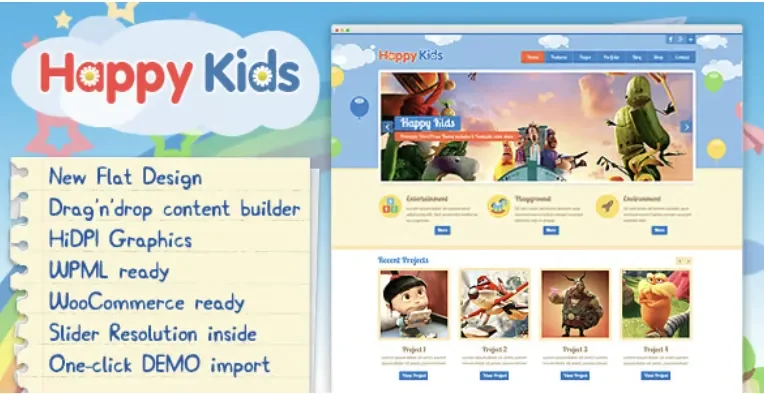
Happy Kids Pro Children WordPress Theme Overview & Front-End Foundation
Happy Kids Pro is a responsive children WordPress theme engineered for kindergartens, daycares, preschools, and education operators who need to publish programs, staff, gallery, and enrollment content without bespoke front-end coding. The theme removes the layout bottleneck of hand-built page templates by pairing an Elementor-based rendering pipeline — migrated from the legacy CWS Builder in v4.0.0 — with an advanced Theme Options panel, unlimited color schemes, and nine background patterns. Within agency delivery pipelines, it functions as a deployable presentation layer that imports demo content in one click and renders across IE10, IE11, Edge, Chrome, Firefox, Safari, and Opera at high resolution.
Technical Specifications & Deployment Matrix
| Engineering Metric | Deployment Specification |
|---|---|
| Base Technology / Framework | WordPress 6.7.x theme built on HTML5 and CSS3 markup |
| Runtime / Language Requirements | PHP 8 compatible server environment behind WordPress core |
| Page Builder Engine | Elementor, replacing CWS Builder as of v4.0.0 |
| Compatible Plugin Layer | WooCommerce 9.x.x, WPML, Contact Form 7, Revolution Slider |
| Deliverable Files | PHP, CSS, and JS source files plus layered PSD documents |
| Layout & Rendering Profile | Responsive, high-resolution, three-column layouts with widget-ready sidebars |
Elementor Rendering Pipeline & Theme Execution Flow
Happy Kids Pro resolves page requests through the standard WordPress template hierarchy while Elementor governs layout composition. When a visitor requests a front-page or archive route, the theme locates the matching template file, pulls the Elementor layout data bound to that post, and renders the resulting DOM server-side before shipping the HTML document to the browser. Homepage hero regions dispatch through Revolution Slider, which can also attach to interior pages through a per-page slider option introduced at v3.3.8. A bundled shortcode generator emits reusable components — carousels, pricing tables, progress bars, vertical tabs, and callout blocks — that embed directly into the content stream, while the multi-gallery system branches between photo albums and video collections with native YouTube and Vimeo post-format support.
Sidebar allocation is dynamic rather than fixed: the sidebar generator produces an unlimited number of widget areas, and each page context binds its own column, keeping program pages, staff pages, and shop pages decoupled from a single global layout region. For merchandise operators evaluating a storefront on a runtime outside WordPress and PHP, Kutty Kids exists as an independent Shopify Liquid alternative rather than an attachable module of this theme.
Core Technical Capabilities of Happy Kids Pro
- One-Click Demo Import: The importer seeds sample pages, sliders, and widget assignments in a single execution, collapsing initial build time from manual template assembly to a configuration pass on a clean database.
- Elementor Visual Content Management: The v4.0.0 release rebuilt all demo content on Elementor, so layout mutations occur through visual editing of stored page data instead of direct PHP template modification.
- WooCommerce 9.x Storefront Layer: Theme-level WooCommerce templates track each plugin release, with the v4.0.4 update synchronizing templates for WooCommerce 9.7 so shop routes inherit current markup.
- WPML Multilingual Pipeline: Declared WPML compatibility, reinforced by translation and widget fixes logged through v3.5.2, allows parallel-language content trees, and a bundled custom translator covers remaining theme strings.
- Unlimited Sidebars & Custom Widgets: Dynamically registered widget areas plus purpose-built widgets let each template region carry page-specific content without duplicating template files.
Production Implementation & Operational Resilience
Deployment should begin on a clean staging database: the one-click importer seeds demo structures, and running it against a populated installation risks permalink and media collisions. The server environment must satisfy WordPress 6.7.x requirements on PHP 8, a compatibility threshold the codebase reached at v3.5.3 after targeted PHP 8 corrections. RTL deployments inherit corrected stylesheet logic from the v3.4.0 release, which resolved RTL carousel and layout defects.
The maintenance record documents a sustained synchronization cadence between theme templates and each major WooCommerce release, with refreshes logged from v3.3.9 through the v4.0.4 update. Security posture is equally traceable: a prettyPhoto XSS vulnerability was patched at v3.2.4, and an additional security defect was closed at v3.2, so teams inheriting installations older than those milestones should treat an upgrade as a pre-deployment gate. Style overrides remain inside the Theme Options panel — color schemes, Google font bindings, and the nine background patterns — while structural changes happen through Elementor editing rather than template file surgery, and the bundled PSD documents give design teams editable references for client-specific mockups. Teams comparing parallel children-focused options on the same WordPress runtime can benchmark Peggi, a multipurpose children theme occupying an adjacent niche, without altering this theme’s dependency chain.
Frequently Asked Questions
Does Happy Kids Pro build its demo pages with Elementor?
Yes, since the v4.0.0 release the entire demo content set was rebuilt on Elementor, replacing the legacy CWS Builder; agencies inheriting older CWS Builder layouts should verify page data before migrating production sites toward the current v4.0.4 package.
Are the demo images bundled in the package?
No, the distribution package ships without the photography used across the demo; the credits section attributes stock sources such as Fotolia and DeviantArt, so operators must independently source, clear rights for, and upload replacement imagery before a public launch.
Can the theme power a multilingual childcare site?
Yes, the theme is listed as WPML compatible, with changelog entries documenting widget and translation compatibility fixes through v3.5.2; multilingual deployments still require the WPML plugin family to be installed and configured separately from the theme package.
Is there a one-click demo import routine?
Yes, demo content deploys through a one-click importer accessible after theme activation; the import seeds sample pages, sliders, and widget configurations, and it should be executed on a clean database to avoid permalink and content collisions.
Do PSD source documents ship with the download?
Yes, layered PSD documents ship inside the package alongside the PHP, CSS, and JS source files, giving design teams editable references for adjusting layout mockups, header compositions, and marketing imagery prior to front-end reimplementation.