GroceryShop, Grocery, Food, E-commerce Application with Node.js Backend
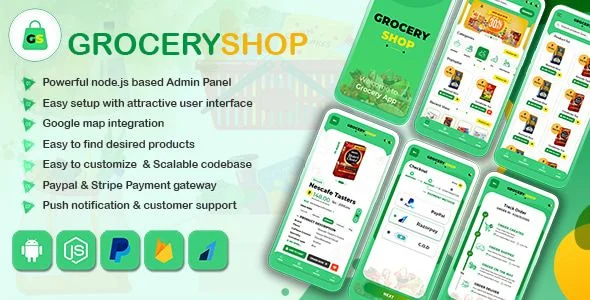
GroceryShop Overview & Full-Cycle Delivery Architecture
GroceryShop is a native Android grocery, food, and pharmacy delivery application paired with a Node.js backend and a browser-based admin panel, engineered for agencies and store owners launching product-delivery businesses. The package resolves the fragmented-store problem, where customer ordering, catalog browsing, and merchant order handling sit in disconnected systems, by consolidating an end-user APK and an owner-side dashboard into a single deployable stack. In production workflows, it operates as the complete commerce layer: shoppers place product orders through the Android client, while store owners accept, track, and manage those orders from the admin panel to grow their operations.
Technical Specifications & Deployment Matrix
| Engineering Metric | Deployment Specification |
|---|---|
| Base Technology / Framework | Native Android client built from Java sources with XML layout definitions, targeting Android 9.0 |
| Runtime / Language Requirements | Node.js server runtime powering the backend API layer |
| Data Exchange / Communication Protocols | HTTP request/response cycles between the Android client, backend services, and admin panel |
| Front-End / Engine Dependencies | Compiled .apk binary for the shopper application; web dashboard for administration |
| Database / Persistence Footprint | Ships with a .db database file covering catalog, user, and order persistence |
Order Execution Pipeline & Admin Orchestration
The core mechanism is a two-sided delivery pipeline: an Android ordering client synchronized with a Node.js-administered data layer.
Inbound activity begins when the shopper application contacts the backend over HTTP to pull category trees and product listings. A documented guest-login capability allows unregistered visitors to traverse categories and inspect products before any account record exists, which widens the acquisition funnel and reduces early-session abandonment. Once a user commits to purchase, authentication flows through the documented credential system, the cart is assembled client-side, and the order payload is transmitted to the Node.js backend for persistence in the database tier. Coupon handling follows a list-driven model: rather than requiring shoppers to recall promotional codes from memory, the application surfaces an available coupon list from which a discount can be selected and applied during checkout. On the merchant side, the admin panel subscribes to the same datastore, so every accepted order, catalog edit, or status change performed by the store owner is reflected back to the customer application on the next synchronization cycle. For teams evaluating a separate, rewards-oriented Android deployment on an independent codebase, KingEarn exists as an unrelated parallel source package rather than an extension of this stack.
Core Technical Capabilities of GroceryShop
- Guest Login Catalog Access: Category and product browsing is decoupled from registration, letting anonymous sessions evaluate inventory before an account write is triggered on the backend.
- Selectable Coupon List: Promotional codes are aggregated into an in-app list retrieved from the server, allowing shoppers to apply a discount at checkout without manual code entry.
- Dual-Interface Commerce Stack: The deliverable couples an end-user Android APK with a web admin panel, so order acceptance, management, and catalog operations execute from one shared datastore.
- Recompilable Native Source: Java source files and XML layouts ship alongside the compiled binary, giving developers full read-and-modify access to the presentation layer and business logic before store release builds are generated.
Production Implementation & Operational Resilience
Deployment begins on the server side: the Node.js application is provisioned on a hosting environment, the included .db file is attached or imported so catalog and order schemas exist from the first boot, and the admin panel is exposed to store operators. The Android client is then either distributed as the compiled .apk or rebuilt from the .java and .xml sources after branding, endpoint, and configuration changes are applied. A public demonstration environment, including documented admin and demo-user credentials, allows implementation teams to validate the full order lifecycle, from guest browsing through coupon application to order acceptance, before committing to a production rollout. Operationally, the guest-login path acts as a graceful fallback for session failures: catalog data remains reachable even when authentication is skipped, so storefront downtime does not necessarily equal discovery downtime. Because the persistence layer is a discrete .db artifact, staging environments can snapshot and restore state during pre-release testing without touching live order histories. Development teams adapting the client for adjacent verticals, such as pharmacy or general store delivery, work directly in the Java/XML layer, while teams pursuing an unrelated monetized Android product line can examine Shayari & Quotes App Source code as a decoupled alternative outside this delivery architecture. Bug-fix revisions published by the original development cycle, including the coupon-list and guest-access additions, indicate an actively maintained defect pipeline that integrators should track when planning upgrade windows.
Frequently Asked Questions
Does the deliverable include a web-based admin panel for store owners?
Yes. The package ships with an admin panel through which store owners accept and manage orders, maintain the catalog, and monitor business activity, accessible via documented administrator credentials on the demonstration environment.
Can shoppers browse categories and products without creating an account?
Yes. A guest-login capability permits unregistered visitors to view different categories and products directly inside the app, removing registration as a prerequisite for catalog discovery before checkout.
Is the coupon functionality limited to manually entered codes?
No. The application presents an available coupon list from which shoppers can select a discount during checkout, rather than requiring them to type promotional codes from external sources.
Are editable source files included alongside the compiled application binary?
Yes. The deliverable contains .java source files, .xml layout definitions, a .db database file, and the compiled .apk, giving developers both a runnable build and the underlying code for customization.
Dalvroodoo – Online Food Ordering App for your Restaurant
15 App Template| Food Ordering| Multi Restaurant App| Food Delivery| Restaurant POS| Ionic 8 Hungerz
eGrocery – (Grocery, Pharmacy, eCommerce, Store) App and Web with Laravel Admin Panel + DeliveryApp