GRD – Gardening and Landscaping WordPress Theme
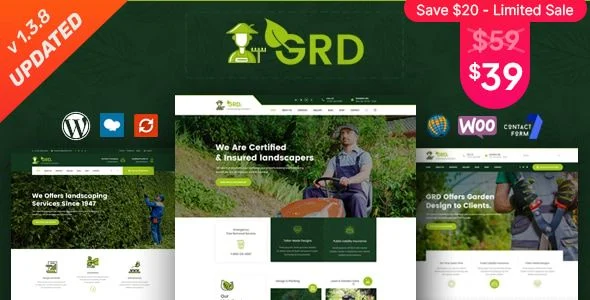
GRD Gardening and Landscaping WordPress Theme Overview & Service-Business Site Architecture
GRD Gardening and Landscaping WordPress Theme is a PHP, HTML5, and CSS3 theme package engineered for landscaping companies, lawn care operators, groundskeepers, landscape architects, gardeners, and florists to publish service catalogs, appointment-oriented contact workflows, and portfolio pages on a self-hosted WordPress installation. The package resolves the bottleneck of assembling a trade-services website from blank templates by shipping prebuilt homepage layouts, a one-click demo content importer, and a Redux-backed administrative panel that governs typography, color, and layout parameters from a single options surface. Within agency delivery pipelines, it functions as a deployment-ready foundation that can be rebranded through child-theme overrides, extended with a WooCommerce storefront, and localized through WPML for multilingual client rollouts.
Technical Specifications & Deployment Matrix
| Engineering Metric | Deployment Specification |
|---|---|
| Base Technology / Framework | WordPress theme (PHP, HTML, CSS, JS files), Bootstrap 4.x grid, Redux options framework |
| Runtime / Language Requirements | WordPress 4.9.x through 7.0.x; Gutenberg-optimized; widget-ready; multisite tested |
| Data Exchange / Communication Protocols | WooCommerce 6.x through 10.x storefront layer, Contact Form 7 handlers, WPML translation pipeline, .pot localisation files |
| Front-End / Engine Dependencies | WPBakery Page Builder, Slider Revolution 6.7.x, Google Fonts library (600+ families) |
| Database / Persistence Footprint | Standard WordPress MySQL schema; theme options persisted through the Redux framework; no external datastore required |
Rendering Pipeline & Service-Business Feature Execution
The theme renders pages through the standard WordPress template hierarchy, with WPBakery Page Builder shortcodes expanding into structured DOM sections at request time.
Inbound requests resolve against the template hierarchy, where page-builder components are parsed and expanded into the column-based layouts the package defines. Slider Revolution consumes the imported demo slider configurations and dispatches layered animation sequences on the front end, while the Redux options panel reads persisted values to inject typography selections, unlimited color assignments, and wide or boxed layout states into the rendered output. The one-click installer registers demo posts, widgets, sliders, and menu structures, allowing a staging site to mirror the reference demo before content replacement begins. Because this pipeline targets a specific niche, teams evaluating parallel foundations for the same trade vertical can weigh Greenaura as an alternative gardening and landscaping implementation with its own booking and estimate flow.
Architectural & Functional Highlights
- WPBakery Page Builder integration: Content construction happens through drag-and-drop shortcode composition rendered server-side into template output, letting editors restructure sections without touching PHP template files.
- Redux-driven options engine: Color palettes, Google Fonts selections, custom font support, and background types (color, image, video, parallax) are stored as theme options, so a rebrand executes without stylesheet edits.
- Multi-location Google Maps with customizable map colors: Branch offices and service coverage areas render through map widgets and an interactive slider option, addressing multi-branch operators directly.
- Four header variants and multiple homepage layouts: Header structure switches per layout selection, giving distinct navigation architectures without re-coding template parts.
- Child theme override mechanism: Default template files can be overridden in a child theme, keeping parent-package updates isolated from customization layers.
Production Implementation & Operational Resilience
Deployment follows the standard WordPress pathway: upload via FTP or the admin installer, activate, then run the demo importer to populate content and slider data. Cross-browser rendering is verified across IE10, IE11, Firefox, Safari, Opera, Chrome, and Edge, and the layout is fluid-responsive with retina-optimized imagery, which constrains Core Web Vitals risk on mobile viewports when images are properly compressed during content replacement. Localization operates through .pot translation files under WPML, and Contact Form 7 supplies validated form handling for appointment and quote request workflows without custom endpoint development. Unlimited sidebars, footer widgets, social links, and custom CSS fields provide an override surface for agencies that need site-specific styling beyond the options panel. For studios running multiple trade-sector builds in parallel, Landscop exists as a separate landscaping and gardening theme with service pages and quote-request patterns, suitable as a second implementation track rather than a merge into this codebase. Known boundaries: demo images are not distributed inside the download archive, and layered PSD sources are supplied separately from the main package after purchase.
Frequently Asked Questions
Are the demo images distributed inside the downloadable theme archive?
No, the demo imagery is used for presentation only and is excluded from the distributed zip package; production sites should replace placeholder media with licensed assets during content population.
Has the package been verified under WordPress multisite network installations?
Yes, the theme is explicitly tested under WordPress multisite, so a single codebase can serve multiple sites from one network installation.
Can default template files be modified without altering the parent package?
Yes, a child theme is included and enables template file overrides, keeping customizations isolated so the parent package can be updated without overwriting site-specific changes.
-
1.2.5 LatestSeptember 27, 2026