Girl Run Adventure – Runner Game Android Studio Project with AdMob Ads + Ready to Publish
Girl Run Adventure Overview & Native Runner Architecture
Girl Run Adventure is a Java-based Android Studio game project engineered for mobile studios and indie publishers to ship an endless arcade runner on Google Play. The codebase removes the groundwork of engine scaffolding, monetization wiring, and release-build configuration that typically slows casual-game production. Within a delivery workflow, it functions as a deployable foundation: developers import the source, swap graphics and audio, bind their own AdMob identifiers, and produce a signed store-ready binary.
Technical Specifications & Deployment Matrix
| Engineering Metric | Deployment Specification |
|---|---|
| Base Technology / Framework | Native Android development in Java, compiled through Android Studio |
| Runtime / Language Requirements | Android 9.0 through Android 12.0 device runtimes; project updated to API 35 |
| Data Exchange / Communication Protocols | Google AdMob SDK ad-request and fill lifecycle for in-game monetization |
| Front-End / Engine Dependencies | XML screen definitions and layered PNG artwork supporting layer-level asset editing |
| Database / Persistence Footprint | No external database; session state (hearts, distance score, power-up timers) held in client memory |
Endless Runner Mechanics & Execution Pipeline
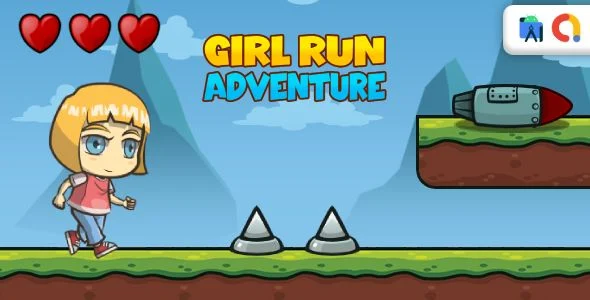
The engine drives an auto-advancing run loop in which obstacle collisions decrement a three-heart health state. Each session begins with full health; when the character strikes an obstacle, the collision handler removes one heart and the run continues until the counter is exhausted. Accumulated distance acts as the primary score metric, so survival duration translates directly into a higher result. Pickups travel the same event path: collecting a jetpack or a shield registers a timed state change that alters how subsequent collisions are interpreted — the shield absorbs incoming hits while active, and the jetpack lifts the character clear of ground-level hazards for its duration window.
Monetization runs parallel to gameplay through the AdMob SDK, whose identifiers are exposed as configuration points so a publisher can register personal ad unit IDs without touching game logic. Audio assets — background music and effect layers — route through dedicated playback channels, each mapped to its own on/off control so players can mute one stream without silencing the other. This channel separation keeps behavioral settings local to the player and independent of the scoring loop.
Core Technical Capabilities of Girl Run Adventure
- Heart-Based Damage Model: Collision events decrement a three-heart counter rather than ending the run on first contact, lengthening sessions and lifting average distance scores.
- Jetpack & Shield Power-Ups: Collectible pickups write timed state flags that modify collision resolution — absorbing hits or bypassing obstacle lanes entirely while active.
- AdMob Integration: SDK-driven ad requests are pre-wired into the project, letting publishers swap in their own ad unit identifiers during the reskin pass instead of implementing mediation from scratch.
- Independent Audio Toggles: Separate on/off switches for music and sound effects provide channel-level mute control at runtime without restarting the session.
- Endless Progression: The run loop generates continuous distance scoring with no fixed level cap, sustaining the replay-driven engagement pattern typical of arcade runners.
For studios scaling a casual-games catalogue beyond this single Java codebase, 25 Simple Unity Games For Android And iOS exists as an independent Unity-authored collection — a parallel acquisition path, not a module that merges into the Android project.
Production Implementation & Operational Resilience
Deployment begins with an Android Studio import rather than a from-scratch scaffold. The included documentation file walks through the build chain, and a compiled demo APK lets a team verify runner mechanics on physical hardware before committing to customization. Reskin boundaries are structural and clearly defined: the game icon, splash screen, display name, Android package name, visual assets, and the music and effect layers are all replaceable without refactoring the core loop. Because the source ships as .java, .xml, and layered PNG files, designers can edit artwork at layer level rather than flattening static images.
Compliance is addressed at the SDK level: the April 2025 update raised the project target to API 35, aligning the build with current Play Console target-API policy and reducing a common review rejection vector. Operational boundaries are equally explicit — validated runtimes span Android 9.0 through 12.0, and no server backend or external persistence layer is involved. All game state lives in client memory, which removes network failure modes and backend maintenance but confines scores to the active session unless a developer deliberately extends persistence. For teams weighing a decoupled design path outside the Android SDK entirely, Knight Adventure – Construct 2/3 Game covers the 2D platformer niche as a standalone Construct template with its own export pipeline.
Frequently Asked Questions
Is a compiled demo APK included so the game can be tested before building the project?
Yes. The deliverables contain a runnable APK alongside the Android Studio source and documentation file, allowing verification of the runner mechanics, power-ups, and audio toggles on a physical device before any customization work begins.
Can the Android package name and displayed game name be changed without modifying engine logic?
Yes. Both identifiers sit within the standard reskin scope alongside the icon, splash screen, and assets, so a publisher can establish a distinct store identity through configuration-level edits rather than code refactoring.
Does the compiled build satisfy Google Play’s 64-bit device architecture requirement?
Yes. The project explicitly lists 64-bit support, meaning the release binary meets the architecture mandate Google Play enforces for new app submissions, removing a frequent rejection cause during first-time publishing.
Is the layout universal across both phone and tablet form factors?
Yes. The project is designated universal for phones and tablets, meaning a single build adapts its interface to both device classes without maintaining separate variants or publishing separate store listings.