Giglink – Vue NFT Marketplace + Admin Dashboard Template
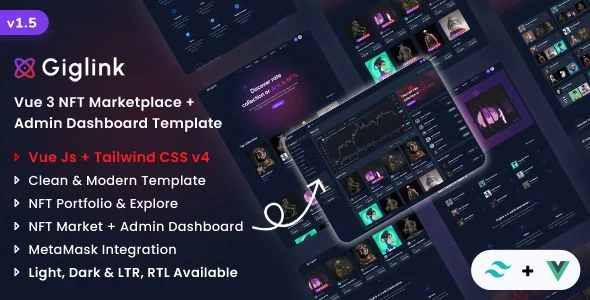
Giglink Vue NFT Marketplace Template Overview & Front-End Architecture Role
Giglink is a Vue 3 NFT marketplace and admin dashboard template engineered for front-end developers and Web3 agencies to ship crypto-collectible storefronts without assembling component systems from scratch. The package resolves the operational bottleneck of constructing a production-grade NFT interface — wallet connectivity, marketplace exploration views, and an analytics back-office — by consolidating 40+ valid pages into one componentized codebase running on Vue 3.5.21 and Tailwind CSS 4.1.13. Within agency delivery pipelines it operates as the presentational layer for NFT, digital-art, and non-fungible token platforms, leaving backend services and chain data to whatever API layer a team attaches.
Technical Specifications & Deployment Matrix
| Engineering Metric | Deployment Specification |
|---|---|
| Base Technology / Framework | Vue 3.5.21 (Composition API), Vue Router 4.5.1, Tailwind CSS 4.1.13 with @tailwindcss/postcss 4.1.13 |
| Runtime / Language Requirements | Node.js build toolchain; pure JavaScript with zero jQuery dependency |
| Data Exchange / Communication Protocols | MetaMask wallet bridge via vue-metamask v3.0.6 |
| Front-End / Engine Dependencies | Swiper 11.1.12, Vue Countup 1.4.2, Vue Simplebar 6.3.2, Feather Icons 4.29.2 |
| Database / Persistence Footprint | None — client-side template package; no server-side persistence or database layer shipped |
Componentized SPA Rendering & Wallet Integration Pipeline
Giglink renders every route through a Vue 3 single-page application in which Vue Router 4.5.1 maps marketplace URLs to component trees authored in the Composition API. Utility styling compiles through @tailwindcss/postcss 4.1.13, and the codebase exposes a single primary color token — migrated from violet-600 in version 1.5.0 — so a recolor is a one-variable change rather than a class-by-class sweep. Height and width utilities follow the current size-* convention, shadows map to shadow-sm, and form inputs, checkboxes, and radio controls align with Tailwind’s modern form primitives after the @tailwindcss/forms dependency was removed. Because the Options API was converted to Composition API, state within marketplace and dashboard components is declared through reactive primitives, which shortens the path for teams wiring live NFT listing data into placeholder views.
Wallet connectivity flows through vue-metamask v3.0.6, which wraps MetaMask’s injected provider so components can react to connection and account events without touching browser-extension internals directly. Directional and tonal rendering is handled through built-in RTL/LTR and light/dark variants — the RTL build ships in both dark and light modes — meaning bi-directional locales require no stylesheet fork. The admin dashboard occupies its own route surface inside the same package, using Vue Countup 1.4.2 for animated metric readouts and Vue Simplebar 6.3.2 for scroll regions. For studios weighing decoupled back-office implementations outside the Vue runtime, Isomorphic exists as an independent React-based admin alternative with its own pre-built app layouts.
Architectural & Functional Highlights
- MetaMask Wallet Bridge: vue-metamask v3.0.6 abstracts the injected Ethereum provider, letting buy-NFT and wallet views subscribe to connection state instead of hand-rolling extension detection logic.
- Dual-Surface Page Architecture: More than 40 validated pages split between the public marketplace (explore, item detail, wallet) and the admin dashboard, giving teams both storefront and back-office deliverables from one codebase.
- Directional & Theme Variants: Four rendering combinations — RTL/LTR crossed with light/dark — are compiled from the same component tree, eliminating parallel template maintenance for Arabic or Hebrew locales.
- Icon and Typography Layer: Material Design Icons, Unicons, and Feather Icons 4.29.2 ship alongside free Google Fonts and illustration assets, so no icon subscription or external font licensing is required at build time.
Production Implementation & Operational Resilience
Deployment begins with a Node.js install-and-build cycle; the output is a static asset bundle hostable on any CDN or static web server, since no server runtime, database, or cron process ships with the template. Cross-browser behavior is validated across Chrome, Firefox, Safari, Opera, Edge, and IE11, and markup passes W3C validation — a property worth re-verifying after teams inject real listing markup or third-party embed scripts. Retina-ready image handling and responsive breakpoints carry the layout from mobile viewports through 4+ column desktop grids without horizontal overflow.
When live blockchain or marketplace APIs replace the bundled placeholder data, teams own the surrounding infrastructure concerns: CORS headers must be configured on the upstream API host, and wallet-adjacent error states — rejected connection prompts, network mismatches — surface through the vue-metamask event chain for component-level handling. Secondary development is deliberately low-friction: the primary color token, Google Font references, and Tailwind utility classes form the theming surface, while Sass/SCSS and CSS files in the deliverable support teams that prefer a preprocessor workflow. No jQuery exists anywhere in the dependency graph, which removes an entire class of DOM-sync conflicts during customization. Where a server-rendered backend with Laravel is the actual requirement rather than a static front end, WowDash stands as a separate multipurpose admin path built on that stack.
Frequently Asked Questions
Does Giglink depend on jQuery for any of its interactions?
No. The template carries zero jQuery dependency; all routing, animation, and UI behavior runs through Vue 3.5.21, Vue Router 4.5.1, Swiper 11.1.12, Vue Countup, and Vue Simplebar, which removes DOM-sync conflicts during customization.
Are both the NFT marketplace landing pages and the admin dashboard included in one package?
Yes. The deliverable bundles 40+ valid pages spanning the public marketplace (explore, wallet, item views) and a dedicated admin dashboard for NFT marketplace management, all sharing one componentized codebase.
Which source file formats are included in the download?
Yes — the package contains CSS files, Sass files, SCSS files, and JS files. This lets teams either consume compiled output directly or extend styling through a preprocessor workflow when deeper theming is required.
Is developer documentation provided for setting up and customizing the template?
Yes. The item is documented, covering the Node.js build process, Tailwind CSS 4.1.13 configuration, the primary color token introduced in v1.5.0, and the Composition API structure used across marketplace and dashboard components.