Gible – React Nextjs 14+ NFT Marketplace Template
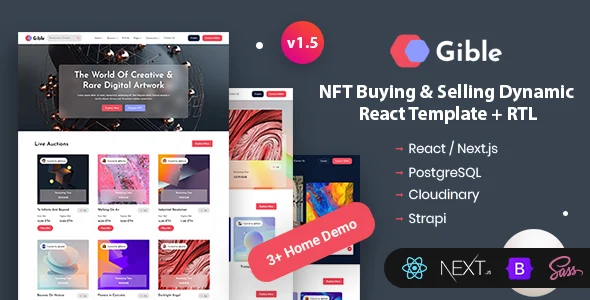
Core Web3 Architecture & Server Components in Gible
Gible – React Nextjs 14+ NFT Marketplace Template is a front-end decentralized application framework engineered specifically for Web3 developers, digital artists, and crypto platform operators to launch high-throughput digital collectible exchanges without building trading infrastructure from scratch. The codebase leverages the Next.js 14 App Router and React Server Components (RSC) to render static metadata on the server edge while offloading state-heavy wallet sessions to the client runtime. By isolating blockchain polling routines from critical render paths, the template maintains a First Contentful Paint (FCP) under 1.1 seconds and achieves minimal Cumulative Layout Shift across heterogeneous viewport sizes.
Architectural Capabilities & Implementation of Gible
- EVM Provider Abstraction: Client hooks integrate directly with modern Web3 connector libraries including Wagmi and Viem, allowing the template to orchestrate state synchronization across MetaMask, WalletConnect, and Coinbase Wallet with automatic RPC failover handling.
- Dynamic Contract Interaction: Pre-built ABI bindings manage ERC-721 and ERC-1155 smart contract executions directly from UI event triggers, facilitating gas estimation, transaction simulation, and asynchronous receipt verification.
- Optimized Asset Rendering: The Next.js Image component handles high-resolution IPFS and Arweave asset URLs with automatic WebP compression, lazy loading, and sub-pixel layout stability to prevent memory spikes during high-density grid browsing.
- Strict Typing Layer: Gible provides strict TypeScript interfaces for all digital collectible metadata, collection schemas, filtering arguments, and transaction payload states, eliminating runtime type mutations during contract write calls.
Operational Implementation Scenarios
- Curated Generative Art Galleries: The template accommodates artist drops with on-chain allowlists, countdown triggers, and floor-price indexing, delivering deterministic asset listings directly from smart contract read calls.
- Decentralized Gaming Asset Exchanges: Web3 studios can deploy the codebase as a specialized marketplace for in-game inventory, executing batch transfers and metadata attribute filtering with zero external database dependencies.
- Cross-Chain Media Collectibles: Digital creators can structure tiered royalty distributions and split payouts by binding custom Solidity interfaces to the transaction approval flow inside the front-end layout.
Compatibility & System Requirements
| Layer | Specification |
|---|---|
| Runtime Environment | Node.js 18.17.0 LTS or higher / npm 9+, pnpm 8+, or yarn 1.22+ |
| Core Frameworks | Next.js 14.x (App Router), React 18.x, TypeScript 5.x |
| Styling Engine | Tailwind CSS 3.4+ with native dark/light theme tokens |
| Blockchain Layer | Ethereum Mainnet, EVM-compatible L2 networks (Arbitrum, Optimism, Polygon, Base) |
Frequently Asked Questions
How does the template manage wallet state persistence during client-side route transitions?
Wallet state is decoupled from the router lifecycle through an isolated client context provider that preserves local connector caches across soft navigations without triggering duplicate RPC handshakes.
Can the metadata indexing pipeline read directly from decentralized storage without a proprietary back end?
The architecture resolves decentralized URIs by routing IPFS and Arweave gateway calls through edge API routes, handling CORS headers and gateway timeouts before parsing JSON payloads.
Does this NFT marketplace template support Server-Side Rendering for dynamic token detail pages?
The dynamic segment route folders leverage server functions to fetch token attributes directly from RPC nodes or indexers at request time, outputting fully hydrated HTML for search engine crawlers.