Gat – Gun & Weapon Store WordPress Theme
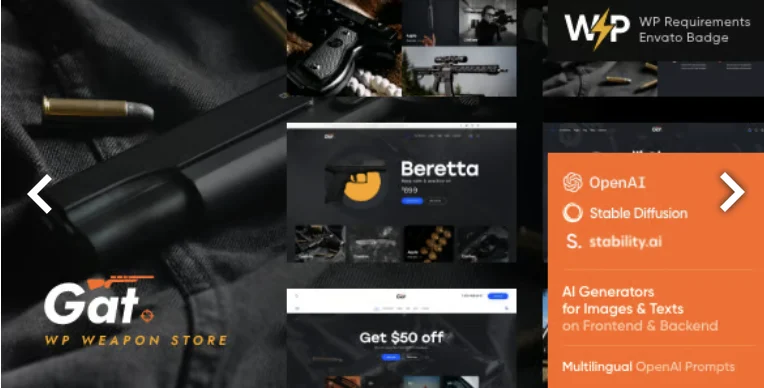
Gat Gun & Weapon Store WordPress Theme Overview & WooCommerce Retail Architecture
The Gat Gun & Weapon Store WordPress Theme is a WooCommerce-native WordPress theme, engineered for firearm retailers and web agencies to launch gun shops, shooting schools, and training-range sites without hand-coding storefront layouts. The package addresses a structural bottleneck specific to this vertical: a single build must simultaneously operate a high-SKU product catalog (firearms, ammunition, hunting and military accessories) and a content layer for classes, events, and training schedules. Within agency delivery pipelines, it functions as a deployable commerce foundation where demo data, Elementor page composition, and WooCommerce storefront logic arrive pre-wired, letting teams move from staging to production through configuration rather than custom development.
Technical Specifications & Deployment Matrix
| Engineering Metric | Deployment Specification |
|---|---|
| Base Technology / Framework | WordPress theme built with HTML5 and CSS3; Gutenberg-optimized with full Elementor builder integration |
| Runtime / Version Requirements | WordPress 4.9.x through 7.0.x; WooCommerce 5.x.x and 6.x.x commerce layer |
| Browser / Client Compatibility | Firefox, Safari, Opera, Chrome, and Edge; retina-ready image rendering at high resolution |
| Front-End Engine Dependencies | Elementor, Slider Revolution, Swiper slider, ThemeREX Addons, Quickcal, Advanced Popups, Contact Form 7, TI WooCommerce Wishlist, Smash Balloon Instagram Feed |
| Data Exchange / Persistence | WordPress MySQL schema extended by custom post types, custom widget sets, and WooCommerce product tables; WPML-compatible content translation |
| Layout & Direction Support | 100% responsive layout with boxed and fullwidth modes; RTL (right-to-left) rendering |
Rendering Pipeline & Commerce Execution Flow
Gat routes every page request through a layered rendering pipeline: the theme framework first resolves inherited settings, then Elementor takes over DOM composition for any page, header, or footer built in the visual editor. The framework’s setting inheritance and override system works by letting global options cascade downward through the hierarchy—individual pages, posts, or custom post types can then override any inherited value locally, which keeps multi-section storefronts consistent while permitting per-page divergence. Product listing and detail templates bind directly to WooCommerce template tags and hooks, so catalog queries, cart state, and checkout flow execute through WooCommerce’s native request cycle rather than duplicated logic. Interactive Ajax search intercepts query input client-side and dispatches partial requests that return filtered results without full page reloads, reducing perceived latency on large accessory catalogs. For agencies evaluating parallel retail builds outside this niche, TrackStore exists as an independent sport-shop WordPress theme covering adjacent athletic merchandise verticals.
Core Technical Capabilities of Gat
- One-Click Demo Installation: Imports pre-built demo content, widgets, and template structures in a single operation, collapsing multi-day layout scaffolding into a configuration step.
- Elementor Header & Footer Composition: Both global layout regions are editable directly in the page builder, so navigation, cart widgets, and user-menu markup remain versioned alongside page content.
- Advanced Blog & Events Engine: Multiple blog styles, 20+ post animations, post views, likes, sharing buttons, and related-post sections support the gun-classes and training-content side of the business.
- 750+ Customizer Options: Colors, typography (Google Fonts, Fontello and image icons), and layout parameters are exposed through the native WordPress Customizer with live preview.
- WooCommerce Product Filtering: Attribute-based filter widgets include search fields for long lists and scrollable attribute panels in the sidebar, a measurable UX gain for catalogs with many specifications.
Production Implementation & Operational Resilience
In production and staging environments, deployment follows standard WordPress theme installation: upload the PHP, CSS, and JS file bundle, activate the theme, then install bundled plugins (ThemeREX Addons, Slider Revolution, QW Extension) through the admin prompt. The changelog documents continuous compatibility hardening—PHP 8.5 fixes, WordPress 7.0 admin-style adjustments, security patches covering stored XSS vectors in Elementor background-text fields, SSRF vectors in URL-loaded SVG assets, and object-injection risks during settings decoding—evidence of an actively maintained codebase rather than an abandoned package. Asset delivery is managed through CSS/JS minification with safely separated merged JavaScript files, and the theme allows style loading in the Gutenberg editor to be switched between add_editor_style and enqueue_style modes, which matters on hosts that restrict output buffering (an explicit grab_output_allowed option exists for WordPress.com-class environments). Memory and hosting prerequisites remain those of a standard WooCommerce stack; no proprietary runtime is required. Header and footer layouts can be rebuilt in Elementor without touching PHP, and the ThemeREX Updater component handles versioned delivery of theme and addon updates. For focused single-product launches outside multi-catalog retail, Riven stands as a separate WordPress theme targeting app, game, and single-product landing builds.
Frequently Asked Questions
Are the images shown in the live demo preview included in the downloaded package?
No. All preview imagery is copyrighted to its respective owners (sourced from depositphotos.com, peopleimages.com, and flaticon.com), and the documentation explicitly states that demo images are not shipped with the template files.
Does Gat support right-to-left (RTL) language storefronts?
Yes. RTL support is listed among the key features, and changelog entries confirm style-level RTL handling was extended to navigation-menu widgets, enabling Arabic and Hebrew locale deployments without a separate child build.
Can the storefront be operated in multiple languages?
Yes. The theme is compatible with WPML, and changelog records show translation support was expanded to Elementor extensions such as Background Text, so builder-generated strings are registerable for multilingual output.
-
1.11.0 LatestNov 2, 2026