Friday Night Battle. Html5. Mobile (adMob). Construct 3
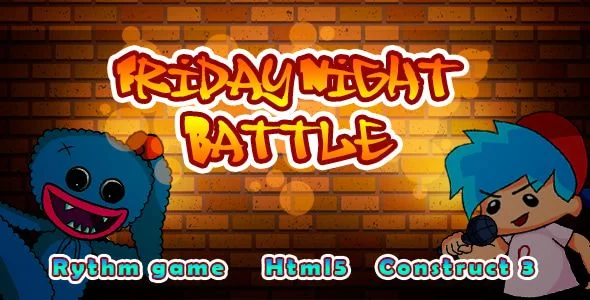
Friday Night Battle Overview & Mobile Rhythm Game Architecture
Friday Night Battle is a Construct 3 HTML5 rhythm game engineered for casual game studios and web publishers to deploy a beat-synced, tap-timed battle experience across desktop browsers and mobile WebView containers. The product addresses a specific production bottleneck: shipping a monetized, landscape-optimized music reaction title without authoring a custom JavaScript game engine, since the full editable .c3p project ships alongside a prebuilt HTML5 export. In agency and publisher workflows, it functions as a drop-in web asset for game portals, WebView-wrapped mobile builds with adMob monetization, and rapid reskin pipelines built on the Construct 3 event system.
Technical Specifications & Deployment Matrix
| Engineering Metric | Deployment Specification |
|---|---|
| Base Technology / Framework | Construct 3 event-system engine; editable project delivered as a .c3p source file |
| Runtime / Language Requirements | HTML5 export; compatible with IE11, Firefox, Safari, Opera, Chrome, and Edge |
| Rendering Target | High-resolution 2400×1080 output in landscape orientation |
| Responsive Coverage | Aspect ratio adaptation for 3:2, 5:3, 16:10, 16:9, 2:1, and 22:9 screens |
| Monetization Layer | adMob integration for mobile deployment |
| Persistence / Deliverables Footprint | Client-side HTML5 runtime; package includes .c3p project, HTML5 build, 512×512 icon, and documentation |
Beat-Synced Input Pipeline & Character State Execution
The core mechanism is a rhythm input pipeline: players press the correct button at the correct time to outperform the opposing monster. Construct 3 executes this through its event sheet architecture, where incoming key and touch events are evaluated against timed note patterns aligned to the exclusive in-game soundtrack. Each successful or missed input drives the active character’s state machine, accumulating performance results that determine whether the player defeats the blue monster and advances to the next Friday stage. The roster exposes four selectable combatants: the boy and the red monster on the human side, plus two monster opponents, Hugy Wugy and Kisy Misy. Because every note window is bound to the audio timeline rather than frame-count approximations, timing judgment stays anchored to music playback, which is the load-bearing mechanic for a reaction-based title. The 2400×1080 render target feeds a scaling layer that adapts the scene to six landscape aspect ratios, so a single build covers both wide phone screens and desktop viewports. Studios assembling multi-title HTML5 catalogs can position this rhythm release alongside Domino Puzzle (HTML5 Game – Construct 3) as a parallel Construct 3 asset within the same deployment channel, since both operate on the same engine runtime.
Core Technical Capabilities of Friday Night Battle
- Editable Construct 3 source project: The .c3p file opens directly in the Construct 3 editor, giving developers native access to event sheets, layouts, and object definitions for reskinning characters, retiming note patterns, or adjusting difficulty curves without reverse-engineering compiled JavaScript.
- adMob monetization layer: The mobile build ships with adMob hooks, allowing WebView-based wrappers to attach ad units and generate revenue from play sessions on Android and iOS distribution channels.
- Multi-ratio landscape rendering: A single 2400×1080 high-resolution scene scales across 3:2, 5:3, 16:10, 16:9, 2:1, and 22:9 aspect ratios, eliminating per-device layout variants during QA.
- Four-character battle roster: Two human characters and two monster opponents (Hugy Wugy and Kisy Misy) provide selectable matchups, each expressed as separate event-driven states within the battle flow.
- Exclusive soundtrack binding: Music produced specifically for this game anchors the note-timing system, keeping input windows synchronized to composed tracks rather than generic licensed loops.
Production Implementation & Operational Resilience
Deployment starts by hosting the exported HTML5 folder on any static web server or CDN edge; the runtime executes client-side in the browser, with verified compatibility spanning IE11, Firefox, Safari, Opera, Chrome, and Edge, which covers legacy enterprise browsers that still constrain some publisher networks. For mobile distribution, the HTML5 build is placed inside a native WebView container where the adMob layer becomes active, and the landscape scaling system keeps the 2400×1080 stage correctly letterboxed across the six supported ratios. Resilience in this architecture comes from engine-level boundaries rather than application code: Construct 3 abstracts browser API differences, so input handling, audio scheduling, and canvas rendering degrade predictably across the supported browser matrix. Modification work happens in the Construct 3 editor through the .c3p project, where event sheets, sprites, and audio objects are the primary extension surfaces; the documented roadmap lists additional music tracks and a tutorial level as planned next-update content, so current-version deployments should treat onboarding guidance as an out-of-scope item. Asset replacement boundaries are straightforward: the 512×512 icon and in-game sprite sets can be swapped without touching the timing logic, provided new audio keeps the same playback duration contract that note windows reference. Publishers expanding a casual games vertical beyond rhythm mechanics can also evaluate Geometry Rash HTML5 Game as a separate genre offering under the same static-hosting delivery model.
Frequently Asked Questions
Does the package include the editable Construct 3 project file?
Yes. The deliverables contain the full .c3p Construct 3 project, the exported HTML5 build, a 512×512 icon, and documentation, so developers can modify event sheets and assets directly inside the Construct 3 editor.
Is a tutorial level included in the current version?
No. The documentation identifies this as the first release, and a tutorial level is explicitly listed as planned content for a next update, so onboarding currently relies on the core gameplay loop itself.
Was the soundtrack produced exclusively for this game?
Yes. The audio consists of exclusive music created specifically for this title, which matters technically because note-timing windows are synchronized to these original tracks rather than adapted from generic loops.
Does the game require a server-side backend to run?
No. The HTML5 build executes client-side in supported browsers and WebView containers, and no server-side database or persistence layer is part of the documented deliverables or runtime requirements.