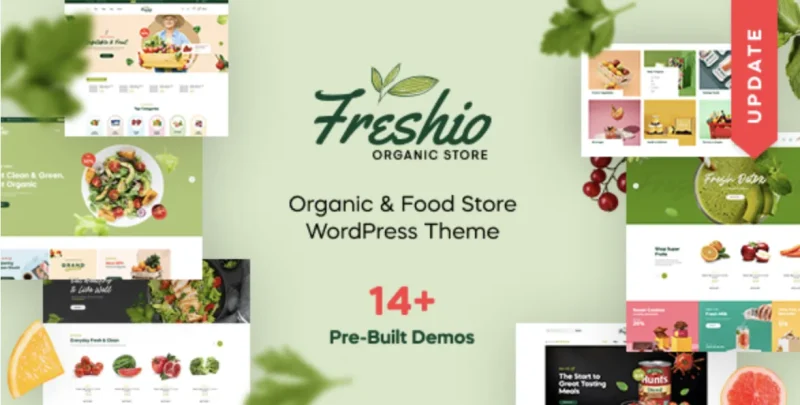
Freshio Pro – Organic & Food Store WordPress Theme
Freshio Pro Overview & Organic Commerce Architecture
Freshio Pro is an Elementor-driven WooCommerce WordPress theme engineered for grocers, organic farms, bakeries, and natural product retailers to launch production storefronts without writing custom PHP. Its architectural purpose is to compress the food eCommerce build cycle: eight prebuilt homepage demos import through a one-click pipeline, and shop, cart, checkout, and account templates ship as pre-overridden WooCommerce markup so product data renders through a configured template hierarchy from first activation. In agency delivery workflows it functions as a drop-in storefront foundation where layout variation is handled at the Elementor layer rather than in server-side code.
Technical Specifications & Deployment Matrix
| Engineering Metric | Deployment Specification |
|---|---|
| Base Platform | WordPress 6.2.x through 6.8.x; distributed as PHP, CSS, and JS source files |
| Page Builder Engine | Elementor drag-and-drop builder (Gutenberg optimization not implemented) |
| Commerce Runtime | WooCommerce 5.x – 9.x compatibility with versioned template overrides maintained through WooCommerce 11.1.0 |
| Browser Matrix | Chrome, Firefox, Safari, Opera, Edge |
| Layout System | Responsive, mobile-first, high-resolution with retina vector icons; 4+ column grids |
| Bundled Dependencies | Contact Form 7, MailChimp, Slider Revolution; widget-ready sidebars and Google Reviews widget compatibility |
Elementor Rendering Pipeline & Storefront Execution Flow
Freshio Pro routes all page composition through Elementor’s widget-based rendering pipeline. When a visitor requests a storefront URL, WordPress resolves the template hierarchy to a theme template, which delegates content assembly to Elementor widgets that query WooCommerce product objects and render them into prebuilt grids, carousels, and category modules. The theme ships dedicated Elementor widgets for product categories, brands, and testimonials, each with column controls for desktop, tablet, and mobile breakpoints.
The shop layer operates through two synchronized mechanisms. First, a filtering system exposes price, category, and tag filters that translate visitor input into refined product queries, so result accuracy is handled at the query level rather than by client-side guessing. Second, the shop loading layer added in version 2.4.2 lets deployments choose between infinite scroll and a load-more button, controlling how product payloads are appended to the DOM as shoppers descend through catalogs. Version 3.0.0 rebuilt the core codebase around this pipeline, refactoring template files and asset registration so pages render with less fragmentation across the supported WooCommerce range, while version 3.0.4 extended the override layer to cover the WooCommerce Product Media Gallery and updated accessibility markup for variations, mini-cart, and grouped products.
Navigation and typography are handled by the same execution path: a megamenu system added in 2.4.2 renders deep category trees, and the Plus Jakarta Sans font family is registered as the primary typeface across all demo configurations. For agencies juggling mixed retail clients, Goya occupies a parallel position as a generalist WooCommerce storefront foundation where the vertical is not food-specific, letting teams standardize on one delivery process across sectors.
Core Technical Capabilities of Freshio Pro
- One-Click Demo Import: The import pipeline installs demo content, widget assignments, and slider configurations in a single operation, replacing manual XML and widget-by-widget configuration with a scripted payload.
- WooCommerce Template Override Layer: Cart, checkout, and product templates are overridden at the theme level and re-versioned per WooCommerce release, keeping store markup aligned with the plugin’s evolving template signatures.
- Shop Sidebar and Loading Modes: Menu, offcanvas, dropdown, and drawing-filter sidebars combine with infinite scroll or load-more pagination to control catalog navigation density on long product lists.
- Header and Footer Builder: Prebuilt header and footer variants are editable through a builder interface, with handheld footer bar configuration available for mobile storefronts.
- Sidebar Generator and Color Controls: Unlimited sidebars can be generated per template region, and main/secondary color selection propagates globally without editing stylesheets.
Production Implementation & Operational Resilience
Deployment follows a predictable sequence: install the theme, activate the required plugin set (quick view, wishlist, and compare modules are listed as required dependencies), then execute the demo import on a staging environment before pointing production traffic at it. The import writes a substantial payload of media, product data, and slider content, so validating it on staging first isolates any environment-specific failure, such as PHP execution limits during media transfer, from live operations.
Customization boundaries are well defined. The WordPress Customizer exposes main options, social links, post list settings, portfolio options, styling, layout, header, and footer sections, and additional CSS rules extend button shapes and heights beyond the builder’s manual controls. Site width switches between full-width and boxed layouts, and parallax backgrounds attach to rows, menus, headers, or client-logo regions. Because the theme is Elementor-first and not Gutenberg-optimized, editorial teams should plan content production around Elementor editing rather than block-based workflows. The changelog cadence, including fixes for Select2 scrolling under Lenis smooth scrolling and repeated WooCommerce compatibility patches, signals that the override layer demands periodic re-validation whenever WooCommerce is upgraded on a client site. For decoupled organic storefront requirements such as RTL-native farm retail outside this package’s configuration scope, Food Fruit stands as an independent WordPress theme addressing that specific deployment profile.
Frequently Asked Questions
Does Freshio Pro support Gutenberg block-based editing?
No, the theme is explicitly documented as not Gutenberg-optimized; all page composition, layout control, and content assembly run through the Elementor page builder and its widget library instead.
Is the theme compatible with WooCommerce 9.x stores?
Yes, compatibility spans WooCommerce 5.x through 9.x, and template overrides continue to be re-versioned against newer releases, with version 3.0.4 aligning markup with WooCommerce 11.1.0 including the Product Media Gallery.
Can shop pages use infinite scroll instead of standard pagination?
Yes, version 2.4.2 introduced configurable shop loading options, letting deployments select infinite scroll or a load-more button, alongside sidebar variants such as offcanvas and dropdown filter modes.
Are header and footer layouts locked to the demo designs?
No, headers and footers are editable through a dedicated builder function, with multiple prebuilt variants adjustable via the WordPress Customizer, including header background color and handheld footer bar configuration.
Do product filters support attributes beyond product categories?
Yes, the predefined filtering system includes price, category, and tag filters, and a megamenu added in 2.4.2 exposes deep category navigation for large organic catalogs.
-
v3.0.1 Latest