Frameflow – Multipurpose WordPress Theme
Frameflow Overview & Multipurpose WordPress Architecture
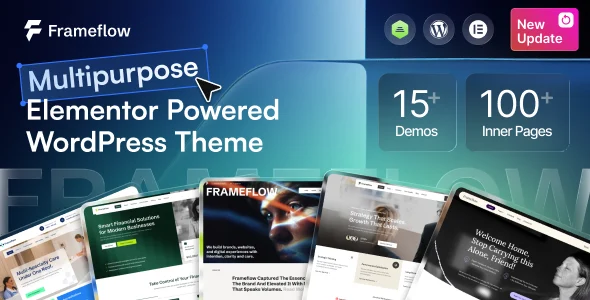
Frameflow is an Elementor-powered multipurpose WordPress theme, engineered for agencies, freelancers, and in-house web teams to launch industry-specific business websites without writing custom theme code. The package resolves the recurring bottleneck of rebuilding design systems for every client vertical by shipping 15+ pre-built niche demos and more than 150 professionally structured inner pages covering Business, SaaS, Finance, Medical, Construction, Law, Logistics, Architecture, Restaurant, Real Estate, and fashion storefronts. In production agency workflows, it functions as a reusable delivery foundation: one codebase, one options panel, and one widget library serving corporate, portfolio, and e-commerce client engagements from the same install.
Technical Specifications & Deployment Matrix
| Engineering Metric | Deployment Specification |
|---|---|
| Base Technology / Framework | WordPress theme package (PHP, SCSS, JS source files) on WordPress 6.0.x through 7.0.x |
| Page Builder Engine | Elementor drag-and-drop editor with 100+ custom widgets and multiple layout variations |
| E-commerce Runtime | WooCommerce 7.x.x through 10.x.x, including wishlist, quick view, product compare, and AJAX cart modules |
| Localization Layer | WPML and Polylang compatibility with full RTL language support |
| Form & Marketing Protocols | Contact Form 7 integration plus Mailchimp (MC4WP) subscription handling |
| Rendering Surface | Responsive layout, retina-ready output, AJAX lazy loading; verified on Chrome, Edge, Firefox, Safari, Opera, IE10, IE11 |
Elementor Rendering Pipeline & Design System Mechanics
Frameflow routes every page render through the Elementor widget engine, where modular content blocks are stored as structured page data and assembled at runtime instead of hard-coded PHP templates. The bundled Theme Builder extends this pipeline past singular pages: custom templates for posts, archives, search results, headers, and footers are registered through the builder, overriding segments of the native WordPress template hierarchy while remaining editable visually. One-click demo import loads a chosen niche package, and selective content import lets teams pull only the page sets a project actually needs, which keeps the database footprint proportional to the deliverable rather than to the full demo catalog.
Navigation follows the same visual pipeline. The mega menu builder composes multi-column menus with icons, images, and custom content blocks inside the Elementor editor, while onepage navigation bindings handle anchor-linked scrolling for landing pages. For teams whose SaaS client work demands a narrower, launch-oriented design system rather than a cross-industry one, Framer operates as a separate startup-focused WordPress alternative within the same Elementor ecosystem.
Core Technical Capabilities of Frameflow
- Header, Footer & Mega Menu Builders: 15+ header layouts and 15+ footer layouts are assembled visually in Elementor, with sticky-header-on-scroll and sticky mobile header states managed at the layout level rather than through custom JavaScript injection.
- 100+ Custom Elementor Widgets: Accordion, pricing tables, countdown timers, counters, pie charts, process steps, history timelines, portfolio and team carousels, and popup modals expose per-widget styling controls, reducing external plugin dependencies for common UI patterns.
- WooCommerce Commerce Layer: Multiple shop and product layouts support varied product types, with wishlist, quick view, product compare, variation swatches, and AJAX cart interactions wired into the storefront templates.
- Advanced Page & Post Settings: Each page or post can declare its own layout, header, and styling parameters, overriding global theme options for granular per-template control across large sites.
Production Implementation & Operational Resilience
Deployment starts with a standard WordPress install running a supported core version, the Elementor plugin, and the bundled Case Addons and Case User components, which supply the custom widget library and account management layer. Demo import is the heaviest single operation in the setup sequence: media attachment migration and content payload insertion are memory-intensive, so staging or production environments should carry an adequately raised PHP memory allocation and reasonable max_execution_time before import begins, otherwise partial imports can occur on constrained shared hosting.
Per-page settings decouple client deliverables from global configuration, meaning a single microsite section, landing page, or archive can carry independent headers and layouts without forking the theme. Agencies delivering finance-sector engagements can also evaluate Gudfin as a standalone accounting and consulting alternative when a client’s brand direction favors a vertical-specific system over Frameflow’s multipurpose design tokens.
Secondary development is explicitly supported through a bundled child theme, which isolates SCSS overrides, template adjustments, and function-level customizations from the parent package so version upgrades do not overwrite client modifications. Multilingual delivery is handled through WPML or Polylang with RTL stylesheets for right-to-left locales, and newsletter endpoints connect to Mailchimp via MC4WP. When styling requirements exceed what a widget’s native controls expose, WordPress Widget Style Editor Elementor Addon provides a parallel styling pathway that operates at the widget level without touching theme source files.
Frequently Asked Questions
Does Frameflow include pre-built demos for more than fifteen industries?
Yes. The current release documents 15+ niche demos spanning Business, Creative, SaaS, Finance, Medical, Construction, AI Agency, Law, Logistics, Architecture, Restaurant, Real Estate, Psychologist, and Clothing Shop categories, backed by 150+ inner pages.
Is the theme optimized for native Gutenberg block editing?
No. The documented Gutenberg Optimized flag is negative; Frameflow’s page assembly, widget library, and header, footer, and mega menu builders are all built around the Elementor engine, so block-editor workflows are not the intended authoring path.
Can Frameflow run a store on WooCommerce 8.x through 10.x?
Yes. Compatibility is documented across WooCommerce 7.x.x, 8.x.x, 9.x.x, and 10.x.x, including wishlist, quick view, product compare, variation swatches, and AJAX shopping cart features plus multiple shop and product layout options.
Are headers and footers editable per individual page?
Yes. The theme ships 15+ header and 15+ footer layouts built through the Elementor-based header and footer builders, and advanced page and post settings allow each page to override global theme options with its own layout and navigation configuration.
Will one-click demo import succeed on a low-memory shared hosting plan?
No. Importing a full demo pushes media and content payloads through WordPress in a single operation, and hosting with restrictive PHP memory or execution-time ceilings can terminate the process mid-import, leaving incomplete data that requires manual cleanup or re-import.
-
28 September 2026 LatestOct 18, 2026