Foodymat – Restaurant WordPress Theme
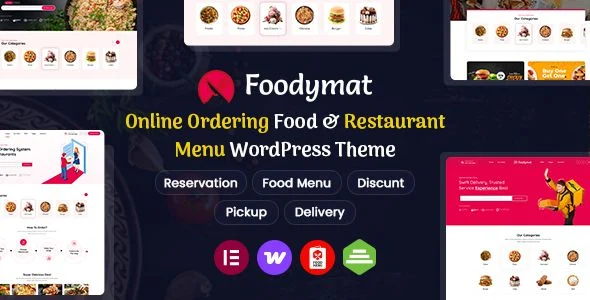
Foodymat Restaurant WordPress Theme Overview & Food Commerce Front-End Architecture
Foodymat Restaurant WordPress Theme is a WordPress front-end package engineered for restaurant operators, cafes, and agency delivery teams to publish food menus and accept WooCommerce-based online orders. It addresses the recurring bottleneck of wiring pickup and delivery logic, configurable product add-ons for dishes, and table reservation handling into a single theme layer without custom PHP development. In production workflows, the package functions as a drop-in deliverable: agencies import one of six prebuilt homepages, restyle everything through the WordPress Live Customizer, and hand the client an editable Elementor or Gutenberg page set.
Technical Specifications & Deployment Matrix
| Engineering Metric | Deployment Specification |
|---|---|
| Base Technology / Framework | WordPress theme built on RT Framework with the Foodymat Core module; PHP, CSS, and JS source files included |
| Runtime / CMS Requirements | WordPress 4.9.x through 7.0.x; WooCommerce 5.x through 9.x for ordering features |
| Front-End / Engine Dependencies | Elementor page builder and Gutenberg editor; Font Awesome and Flat icon sets; Google Fonts (Oswald, Open Sans) |
| Communication / Compatibility Layer | Cross-browser rendering across IE11, Firefox, Safari, Opera, and Chrome; WPML support with included .pot catalog |
| Persistence / Data Footprint | Widget-ready sidebars; menu and reservation data handled through the bundled Food Menu plugin stack |
WooCommerce Ordering & Template Rendering Pipeline
Foodymat routes all commerce through WooCommerce, with page assembly delegated to Elementor and the WordPress template hierarchy. Inbound front-end requests resolve through the standard template selection chain, where the theme’s PHP templates hand rendering control to Elementor widgets for drag-and-drop composition or to Gutenberg blocks for block-native editing. A dynamic page header system injects per-page banner content, while six homepage variants, three header styles yielding more than six header combinations, and two footer styles give the front-end structural range without duplicating templates.
The ordering layer is where the engineering value concentrates. WooCommerce drives the cart and checkout, and a dedicated Food Menu module surfaces restaurant menus as WooCommerce-backed products rendered in four display modes: grid, slider, and isotope layouts with client-side filtering. A product add-on subsystem attaches configurable options—topping sets for pizza, patty counts for burgers—to individual products, with thousand and decimal separator handling corrected in the 1.0.2 revision. Pickup and delivery flows expose time-slot selection whose start time is validated to sit later than the current moment, a constraint patched after an earlier JavaScript defect. Operators running subscription meal plans on the same store can layer Custom Start Date for WooCommerce Subscriptions to defer billing start dates for scheduled customer cohorts.
Reservation handling runs on a bundled form subsystem that dispatches booking mail and supports data export; the form was redesigned during the 1.0.2 cycle after submit-button and export defects were traced and corrected. The result is a single theme activation that ships ordering, menu presentation, and table booking together rather than requiring three separate plugin hunts.
Core Technical Capabilities of Foodymat
- Four food-menu layout engines: Grid, slider, and isotope rendering with functional filter ordering, including responsive isotope behavior patched in 1.0.2 for mobile breakpoints.
- Product add-on configuration: Option groups attach to WooCommerce items for pizza and burger customization, with separator and popup-gallery defects resolved across the 1.0.2 and 1.0.3 releases.
- Pickup and delivery scheduling: Time-slot start values are validated against the current time so orders cannot select windows that have already elapsed.
- One-click demo importer: Complete page sets, widgets, and menu structures migrate into a fresh install in a single action, removing manual page scaffolding.
- Reservation subsystem: Booking submissions dispatch mail and export records to the admin side, rebuilt for functional reliability in the 1.0.2 revision.
Production Implementation & Operational Resilience
Deployment rests on a child theme shipped inside the package, which isolates template and function overrides from the parent so future version releases do not erase custom work. Styling operates through the WordPress Live Customizer, exposing unlimited color combinations and hundreds of Google Font pairings—Oswald and Open Sans ship as defaults—applied in real time without leaving the page. Theme options consolidate into the Customizer-based admin panel, and custom cursor controls were added in the 1.0.2 cycle for pointer-level presentation behavior. Delivery teams comparing a second restaurant front-end within the same WordPress stack can evaluate PatioTime as an alternate theme candidate before committing to a codebase.
The 1.0.7 revision resolved PHP sanitization issues and refreshed the Foodymat Core, RT Framework, and Food Menu dependencies, which signals a maintained codebase receiving continued engineering passes. Browser coverage spans IE11, Firefox, Safari, Opera, and Chrome, while WPML compatibility plus the included .pot file covers multilingual deployments. Version 1.0.3 also expanded the homepage set from four to six, so late adopters receive the larger template inventory from the start.
Operational boundaries deserve attention before launch. Demo photography sourced from Freepik appears in previews only and does not ship in the download, so production sites must supply original imagery. Iconography depends on the bundled Font Awesome and Flat icon sets. For decoupled design paths outside a full PHP theme, TastyMeals exists as a standalone Elementor Pro template kit covering comparable restaurant territory without theme-level server execution.
Frequently Asked Questions
Are the demo photographs included in the downloadable package?
No, all preview imagery is sourced from Freepik and used strictly for demonstration purposes, so nothing ships inside the download and every production deployment must supply its own licensed restaurant photography.
Does the package ship with translation catalog files for multilingual builds?
Yes, the codebase is WPML-ready and includes a .pot translation file, allowing localization teams to generate language catalogs without extracting strings manually from the PHP templates.
Can pickup and delivery start times be constrained to future slots?
Yes, validation logic added and corrected in the 1.0.2 release requires pickup and delivery start times to be later than the current time, after an earlier JavaScript error broke slot selection entirely.