Food Mobile App | UberEats Clone | Food Delivery App | Restaurant Delivery App | FoodLakh
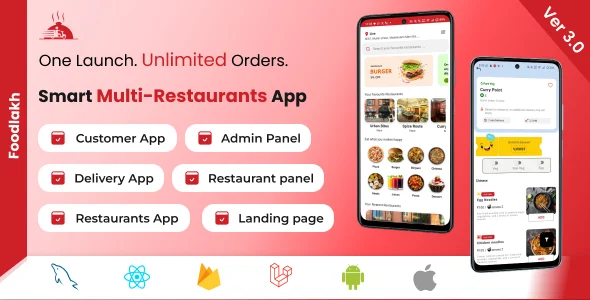
FoodLakh Food Delivery App Overview & Multi-Vendor Marketplace Architecture
FoodLakh is a React Native multi-vendor food delivery application package, engineered for development agencies and startup teams to launch on-demand restaurant ordering and courier dispatch platforms across Android and iOS. The package resolves the coordination bottleneck of managing three distinct actors — customers, restaurant operators, and delivery personnel — by shipping a single Laravel REST API over a MySQL persistence layer that synchronizes order state across all three native clients. In production workflows it functions as the deployable source codebase for an UberEats-style marketplace, with a Laravel admin console governing vendor onboarding, menus, drivers, and order routing.
Technical Specifications & Deployment Matrix
| Engineering Metric | Deployment Specification |
|---|---|
| Base Technology / Framework | React Native front-end clients (v0.73.1), Laravel admin panel, Laravel REST API |
| Runtime / Language Requirements | PHP 7.x–8.x (including 8.0.x), Android 9.0–12.0, iOS 13–15 |
| Data Exchange / Communication Protocols | REST/JSON over HTTP between mobile clients and Laravel API; Twilio SMS gateway for verification and notification dispatch |
| Front-End / Engine Dependencies | JavaScript JSON bundles, .java native Android modules, CSS, HTML, PHP |
| Database / Persistence Footprint | MySQL 5.x–8.x relational schema managed through Laravel |
Multi-Vendor Order Pipeline & Execution Flow
The order pipeline routes every transaction through one Laravel REST API that arbitrates state across three native clients. When a customer opens the React Native application, vendor catalogs, menus, and pricing records are fetched as JSON payloads from the API, parsed into client-side state, and rendered through components compiled separately for Android and iOS. Order submission passes through server-side validation in the Laravel layer before a record is committed to MySQL, and the corresponding restaurant client receives the incoming order through the same API surface.
Once a restaurant accepts and prepares an order, the pipeline dispatches the delivery assignment to the driver application, which reports position updates back to the API for live tracking within the customer’s map view. Twilio handles SMS dispatch at critical checkpoints — verification codes during registration and status notifications during fulfillment — so messaging runs through a managed gateway instead of device-local logic. For commerce operators who also need a parallel web storefront on a separate runtime, Milano – Multipurpose Shopify Theme OS 2.0 operates as an independent Shopify track that shares no codebase with this React Native pipeline.
Core Technical Capabilities of FoodLakh
- Multi-vendor marketplace engine: The Laravel admin panel registers more than one restaurant and multiple delivery partners concurrently, letting a single deployment absorb a growing order volume without re-architecting the API contract between vendors and drivers.
- Tri-client state synchronization: Customer, restaurant, and delivery applications consume one shared Laravel API, so an order status change committed to MySQL propagates to every connected client on the next request cycle rather than through duplicated logic.
- Twilio SMS gateway integration: Phone-number verification and transactional messages dispatch through Twilio’s API, moving OTP handling server-side and reducing spoofing exposure compared to client-only validation.
- Live delivery tracking: The driver client streams location updates to the API, which serves them to the customer application for real-time order visibility during the fulfillment window.
- Cross-platform React Native delivery: One JavaScript codebase targets Android 9.0–12.0 and iOS 13–15, cutting the maintenance cost of maintaining separate native codepaths for each operating system.
Production Implementation & Operational Resilience
Server-side deployment targets a PHP 7.x or 8.x host paired with MySQL 5.x or 8.x, and the Laravel API should sit behind TLS with CORS headers restricted to the three mobile client origins to prevent cross-origin abuse of order endpoints. Twilio account credentials must be configured at install time, because OTP verification and status messaging depend on a live gateway connection; a missing configuration surfaces as failed verification rather than silent degradation. The 13 November 2024 patch cycle added SQL injection protections to the query layer, alongside a refreshed UI design, an app version upgrade, and bug fixes, so deployments should build from the latest revision rather than earlier tagged archives.
The public admin demonstration intentionally restricts write operations — add, edit, and delete are disabled — which means administrators validating workflows must verify full CRUD behavior on a self-hosted staging instance instead of the shared demo. Store release builds require standard Android keystore signing for the 9.0–12.0 target band and Xcode provisioning for iOS 13–15, with both clients compiling against React Native 0.73.1 tooling. For teams evaluating separate standalone shopping-app design paths outside this React Native codebase, BarDeal functions as an independent Ionic UI kit for online shopping applications rather than an extension of this pipeline.
Frequently Asked Questions
Does FoodLakh support simultaneous operation of multiple restaurants and delivery partners?
Yes, the platform is built as an online multi-vendor module where multiple restaurants and multiple delivery partners operate concurrently, with the Laravel admin panel governing vendor onboarding, menu publication, and order routing across the network.
Is SQL injection protection included in the current build?
Yes, the 13 November 2024 update shipped SQL injection protections across the query layer, alongside a refreshed UI design, an app version upgrade, and general bug fixes, so always deploy from this latest revision rather than earlier archives.
Will the customer application install and run on Android 9.0 devices?
Yes, documented Android compatibility spans versions 9.0 through 12.0, so Android 9.0 hardware falls inside the supported target band; verify Google Play services availability and sufficient device memory during staging tests.
Can the applications target iOS 16 or later devices out of the box?
No, the documented iOS compatibility range tops out at iOS 15, covering iOS 13, 14, and 15; targeting iOS 16 requires upgrading Xcode build settings and retesting native modules, which sits outside the verified specification.
Do the public admin panel demo credentials permit full write operations?
No, the public admin demonstration deliberately disables add, edit, and delete operations to protect the shared instance; full write-operation behavior must be validated on a self-hosted staging deployment after installation completes.