Food Alfa – Restaurant & Cafe Elementor Pro Template Kit
Food Alfa Overview & Layout Delivery Architecture
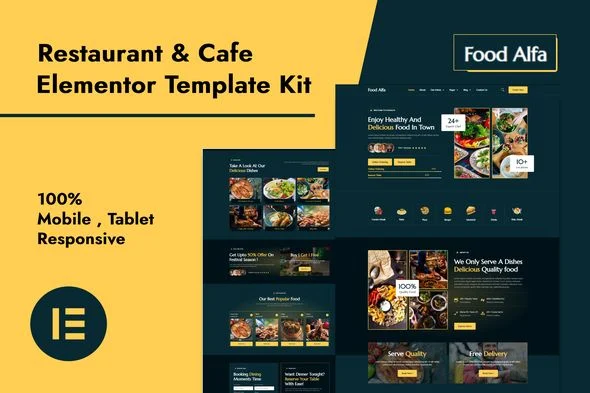
Food Alfa is an Elementor Pro Template Kit engineered for restaurant owners, cafe operators, caterers, and food-delivery brands that need a complete page system without writing a single line of code. The package removes the bottleneck of manually assembling hospitality-critical layouts — menus, reservation forms, chef profiles, offer blocks — by delivering pre-built design data that imports directly into the Elementor editor. Within agency delivery pipelines, it functions as a drop-in layout library installed through the Envato Elements plugin or native Elementor import, and it has been optimized to run on the free Hello Elementor theme.
Technical Specifications & Deployment Matrix
| Engineering Metric | Deployment Specification |
|---|---|
| Base Technology / Framework | Elementor Pro page builder (Elementor 3.10.x), Envato Template Kit distribution format |
| Runtime / Environment Requirements | WordPress instance with Elementor, the ElementsKit Lite companion plugin, and an Elementor Pro upgrade for select templates and features |
| Data Exchange / Import Protocol | Layout payloads imported via the Envato Elements plugin for WordPress or through direct Elementor template upload |
| Front-End / Engine Dependencies | Hello Elementor theme (free), cross-browser compatible rendering, retina-ready visuals, fully responsive breakpoints |
| Execution / Persistence Footprint | Design data only — templates render entirely through the Elementor engine with no independent server-side code path |
JSON Layout Pipeline & Design Token System
The core mechanism is a structured import pipeline that converts packaged layout data into an editable Elementor document tree. On import, each template — Home, About Us, Services, Food Menu, Booking, Our Chef, Testimonials, Offers, Gallery, FAQ, Blog, Blog Details, Contact, and a 404 page — is parsed into container and widget nodes that map onto Flexbox and Grid structures, preserving responsive behavior across viewport widths. A paired Header and Footer set completes the inventory, giving the kit more than fourteen production-ready page templates. For delivery teams evaluating dining-sector starting points at the same technical layer, Odette – Restaurant Elementor Template Kit occupies a parallel fine-dining position, while this kit leans toward broad food-service coverage spanning pubs, resorts, coffee shops, catering, and delivery concepts.
Architectural & Functional Highlights
- Global Kit Style tokens: Typography and color values are defined once at kit level and propagate across every imported template, so a single token change re-skins the entire page inventory without per-page edits.
- Container-based responsive architecture: Layouts rely on Flexbox and Grid containers rather than fixed pixel dimensions, keeping rendering mobile-friendly and retina-ready across devices and browser engines.
- Reservation-ready page inventory: Dedicated Booking, Food Menu, and Our Chef templates cover the operational surfaces a hospitality site needs, reducing assembly work to content substitution.
- Zero-code customization boundary: Every structural and stylistic adjustment happens inside the visual editor; no coding knowledge is required at any point in the delivery cycle.
Production Implementation & Operational Resilience
Deployment follows a defined sequence: install the Hello Elementor theme, activate Elementor with the Pro upgrade, then import templates through the Envato Elements plugin or a direct Elementor upload. Because the package carries layout data rather than executable logic, the principal operational boundaries are environmental rather than behavioral. Import operations that process large template payloads benefit from a raised wp_memory_limit on the host, and staging-first imports let teams validate header, footer, and page wiring before pushing to the live domain. Demo images originate from Envato Elements, so production rollouts must either license those assets or substitute original photography before launch — a standard pre-deployment checkpoint for client handovers. Cross-browser compatibility is built into the layout layer, which reduces device-specific QA cycles during acceptance testing. Teams sourcing an alternate cafe-direction visual language as an independent comparison path can evaluate Cafert – Cafe and Restaurant Elementor Template Kit, which runs on the identical import mechanism with a different design direction. Should import or editing issues surface, the documented recovery channel is the Elementor Get Help section inside the WordPress admin menu.
Frequently Asked Questions
Can the kit be installed without using the Envato Elements plugin?
Yes. Direct upload through the Elementor interface is a documented alternative to the Envato Elements plugin route, so either import path can deploy the templates into a WordPress installation.
Is Food Alfa a WordPress theme activated from the Appearance menu?
No. It is an Envato Template Kit containing Elementor design data only. Installation happens through the Envato Elements plugin or Elementor import, with the free Hello Elementor theme serving as the optimized host theme.
Can the demo images shipped in the kit be used on a live client site as-is?
No. Demo images originate from Envato Elements and require separate licensing for production use. Substituting original photography is the documented alternative before launching any commercial food-service website.