Florian – Responsive Personal WordPress Blog Theme
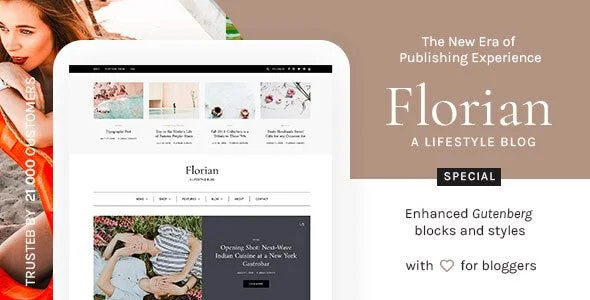
Florian Responsive Personal WordPress Blog Theme Overview & Editorial Publishing Architecture
Florian is a responsive personal WordPress blog theme engineered for independent writers, photographers, and lifestyle publishers who need a Gutenberg-native editorial platform without page-builder overhead. The package targets a structural bottleneck common to legacy blog themes: admin option panels that bypass the WordPress Customizer and template output that ignores block editor rendering behavior, producing visual inconsistency between the editing canvas and the published page. In production workflows, it operates as a self-contained publishing foundation for photography, fashion, food, travel, and news content, deployable through a one-click demo import that reconstructs the full preview site, including demo posts, pages, and preconfigured widgets.
Technical Specifications & Deployment Matrix
| Engineering Metric | Deployment Specification |
|---|---|
| Base Technology / Framework | WordPress theme (PHP, HTML, CSS files) built on a Bootstrap 3 responsive grid with retina-ready asset handling |
| Runtime / Language Requirements | WordPress 4.9.x through 6.x; WordPress 7.x support added in v1.5.1; PHP 8 compatibility introduced in v1.5 |
| Compatibility Layer | WooCommerce 6.x to 9.x shop integration; WPML multilingual support; Slider Revolution and Master Slider compatibility |
| Front-End / Engine Dependencies | Restyled Gutenberg blocks, 650+ integrated Google Web Fonts, 10 bundled theme-enhancement plugins, JetPack Infinity Scroll and Tiled Galleries support |
| Persistence / Data Footprint | Native WordPress schema; 5 widgetized sidebar areas (Left, Right, Footer Light, Footer Dark, WooCommerce) with per-page sidebar assignment |
Gutenberg Block Styling, Layout Engine & Rendering Pipeline
Florian’s rendering pipeline routes every inbound request through the standard WordPress template hierarchy, then applies restyled Gutenberg block output at both the editor canvas and front-end layers. Because the block styles are registered against the core editor, post markup authored in Gutenberg renders with matching typography, spacing, and color tokens on the public site, closing the preview-to-production gap that drives cumulative layout shift. Configuration is centralized in the Customizer, where theme options registered through the native API synchronize with the live preview pane in real time, letting developers observe header, menu, footer, and color mutations before committing a save. The options framework itself was relocated from the theme root into a dedicated plugin at version 1.3, which isolates settings persistence from theme file replacement during upgrades.
The layout engine exposes seven distinct blog listing architectures: Default, 2 Column, 2 Column Advanced, List, Advanced List, Masonry, and Chronology. Each variant restructures the post loop’s DOM without requiring template file edits, and every combination can be paired with three menu positions (top, header, footer), dark or light top-menu styling, sticky or transparent header states, and multiple footer configurations including a shortcode block and an HTML block with background image support. Ten predefined color skins ship in the package, and the Customizer exposes the underlying token set so unlimited palettes can be constructed from the same variables.
Architectural & Functional Highlights
- Editorial curation pipeline: Editor’s Picks blocks, a Popular Posts carousel driven by view counts, a Worth Reading block assignable per post, related post queries, a reading progress bar on single post views, and promo boxes for recent or trending content give publishers programmatic control over content discovery paths.
- Featured content slider: A native posts slider operates in Fullwidth or Boxed mode with configurable layouts, while the custom slider layer accepts Slider Revolution and Master Slider output for agencies needing motion-heavy hero sections.
- Distribution and conversion layer: Instagram feed widgets and galleries, MailChimp newsletter capture, social share and social follow integrations, lightbox and lightbox gallery handling for in-post images, plus an advanced popup, message, and toast management system with email signup support.
- Commerce and format coverage: WooCommerce support includes a dedicated widget area and shop features, while post formats for Gallery, Video, Audio, Quote, Link, and Status extend the template hierarchy for mixed-media publishing.
For writers evaluating standalone alternatives within the same platform, Souje – Personal WordPress Blog Theme represents a separate minimalist codebase that cannot be merged into this architecture, though it serves as a useful comparison point for storytellers prioritizing simplicity over layout density.
Production Implementation & Operational Resilience
Deployment follows a low-friction path: a one-click demo import loads all preview content and page configurations, and the included video installation guide plus step-by-step documentation covers environment setup, plugin activation, and option configuration without requiring CSS or HTML knowledge for baseline operation. The codebase ships PageSpeed-optimized asset loading and reports a 90/100 Google Page Speed score as documented by the vendor, with responsive breakpoints maintained across Chrome, Firefox, Edge, Safari, and Opera. To push Core Web Vitals further on content-heavy installations, layering WP Rocket adds static page caching, delayed JavaScript execution, and automated CSS optimization on top of the theme’s existing asset strategy.
Operational boundaries are explicitly defined. Upgrade routines instruct administrators to add new files and replace changed files per release, a process simplified by the plugin-based options framework that preserves settings across theme file swaps. Per-post and per-page overrides include dedicated sidebar management (Left, Right, or Fullwidth), custom image headers with a transparent variant, a narrow content-width mode, and a global or per-post toggle that disables featured images on single post views. A built-in advertising management system handles banner placement, and the JetPack integration surface enables infinite scroll and tiled galleries for long-form archives. Multilingual deployments rely on WPML compatibility, and commercial storefronts bind directly to WooCommerce’s template outputs through the dedicated shop sidebar region.
Frequently Asked Questions
Can third-party sliders replace the built-in featured posts slider?
Yes — the theme’s custom slider support covers Slider Revolution and Master Slider, so agencies can substitute motion-heavy hero sections while retaining the native Fullwidth and Boxed featured posts slider for standard editorial deployments.
Does the theme run on PHP 8 hosting environments?
Yes — PHP 8 support was introduced in version 1.5, and subsequent releases through v1.5.1 bundle updated plugin versions, allowing the package to operate on modern hosting stacks without legacy interpreter fallbacks.
Can featured images be suppressed on individual articles without disabling them globally?
Yes — the theme provides a per-post toggle alongside a global setting, so publishers can hide featured images on single post views selectively while keeping them active in listing layouts, sliders, and widget-driven carousels.
-
1.5.1 LatestOct 26, 2026