Flip The Bottle | Balancing Arcade Game (Construct)
Flip The Bottle Overview & Runtime Architecture
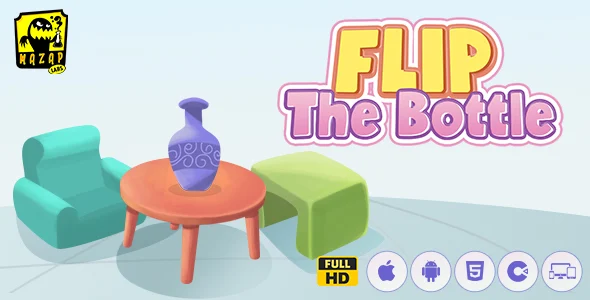
Flip The Bottle is a Construct 3 HTML5 balancing arcade game, engineered for web publishers and mobile developers to deploy a timing-based physics challenge across browsers and native Webview containers. The package removes the core bottleneck of prototyping a charge-and-release jump mechanic from scratch by shipping an editable .c3p project file alongside a published HTML5 build, so a studio can either reskin the artwork or upload the runtime output directly to its own web server. Within an agency delivery pipeline, the codebase functions as a ready-to-brand arcade asset for gaming portals, kid-focused entertainment platforms, and mobile app portfolios.
Technical Specifications & Deployment Matrix
| Engineering Metric | Deployment Specification |
|---|---|
| Base Technology / Framework | Construct 3 event-sheet engine; editable .c3p project format |
| Runtime / Language Requirements | HTML5 canvas runtime built from JavaScript, JSON, and HTML export files |
| Browser Compatibility | IE10, IE11, Firefox, Safari, Opera, Chrome, Edge |
| Input Layer | Touch, mouse, and keyboard events handled concurrently |
| Asset Resolution | Full HD layered PNG graphics at 1920×1080 |
| Persistence / Deliverables | No server database; includes editable .c3p file, published build files, and game documentation |
Charge-and-Release Physics Loop & Execution Pipeline
The gameplay engine converts press duration into vertical jump force applied to a bottle sprite. At runtime, the Construct 3 event sheet listens on three parallel input channels: touch events for mobile and tablet displays, mouse events for desktop sessions, and keyboard triggers for accessibility-oriented play. When a player presses and holds the bottle, the engine accumulates a charge value; on release, that value dispatches a jump impulse whose magnitude maps directly to hold time. The bottle must then land on incoming objects whose spawn positions are spaced according to distance parameters, and successful landings register coin pickups tracked by the client-side session state. All of this executes inside the canvas render loop, which redraws the 1920×1080 layered PNG sprite stack each frame while scaling output to the active viewport.
Because the entire game state lives in the browser session, no server round-trips occur during play. The asset preloading pipeline pulls the layered PNG graphics into memory before the first frame renders, preventing mid-game texture pop-in on slower mobile connections. Studios assembling a broader HTML5 arcade catalog for the same portal slots can evaluate Shape Patterns as a parallel Construct 2/3 title aimed at the same kid and learning segment.
Core Technical Capabilities of Flip The Bottle
- Tri-channel input dispatch: Touch, mouse, and keyboard listeners run concurrently in the event sheet, so a single published build serves phone, tablet, laptop, and desktop audiences without separate code branches.
- Editable event-sheet source: The included .c3p project opens directly in the Construct 3 editor, exposing jump-force variables, spawn distances, and coin logic as adjustable event parameters rather than hard-coded engine internals.
- Full HD layered asset pipeline: Graphics ship as 1920×1080 layered PNG files, allowing designers to swap individual sprite layers during a reskin without touching runtime code or re-exporting the whole sprite atlas.
- Client-side coin economy: Coin collection and scoring operate entirely in local session memory, keeping the published build dependency-free and deployable on any static file host.
Production Implementation & Operational Resilience
Deployment follows a static-file model: the published HTML, JavaScript, and JSON files upload to any web server or CDN-backed host, and the game runs in the browser without backend services, database connections, or authentication infrastructure. This architecture keeps the operational surface small for agency staging environments, since there are no server-side failure points, no cross-origin API calls to configure, and no CORS preflight handling to debug. The published build also carries no framework dependencies beyond the Construct 3 runtime it exports with, which reduces version-conflict risk when the game is embedded in existing portal layouts.
Reskinning is a designer-level task rather than a development task. Because the graphics arrive as layered PNG assets and the gameplay parameters sit in the visual event sheet, no coding knowledge is required to change characters, backgrounds, or difficulty tuning; a developer is only needed when altering engine-level behavior. Teams planning multi-title arcade portals on the same hosting pattern can benchmark Space Odyssey as a second Construct 3 deployment candidate with an identical static-upload workflow. Operational boundaries to plan around: the package ships without a leaderboard, register/login flow, or persistent cloud save system, so any account-based feature set would require separate engineering outside the included deliverables. Memory footprint stays modest since all assets are preloaded 2D PNG layers rather than streaming media.
Frequently Asked Questions
Can the published build run on my server without a Construct 3 subscription?
Yes. The published HTML, JavaScript, and JSON files execute as a self-contained HTML5 build in any compatible browser, and only editing the .c3p project file requires access to the Construct 3 editor.
Is programming knowledge required to change the artwork and difficulty?
No. Graphics ship as layered PNG files and gameplay parameters are exposed through the visual event sheet, so a designer can complete a full reskin by swapping sprite layers and adjusting event values without writing code.
Will the game function in older browsers such as Internet Explorer 10?
Yes. Compatibility is documented for IE10 and IE11 in addition to Firefox, Safari, Opera, Chrome, and Edge, which covers legacy corporate and educational environments still running older browser versions.
Does the game store player coins or progress on a remote database?
No. Coin collection and scoring are handled entirely within the client-side browser session, and the package includes no server database, no cloud persistence layer, and no account system in its shipped form.