FlexiBlog – React Gatsby Multipurpose Blog Theme
FlexiBlog Overview & Static Publishing Architecture
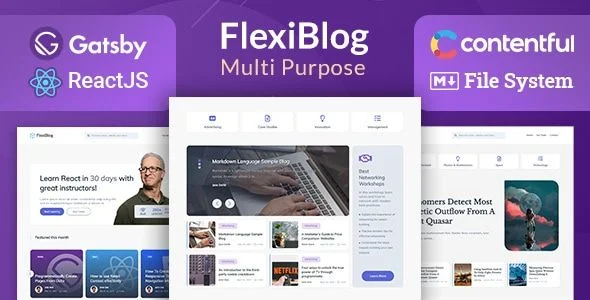
FlexiBlog is a React and GatsbyJS v5 multipurpose blog theme, engineered for front-end developers and content agencies to ship statically generated, SEO-oriented publishing sites on top of headless content back-ends. The package removes the single-source constraint of local-only Markdown builds by normalizing five content pipelines — Contentful, Strapi v4, Netlify CMS, Sanity, and filesystem Markdown with MDX support — behind a unified GraphQL data layer. In agency delivery workflows, it operates as a monorepo starter kit: each pre-built vertical template (agency, education, medical, personal, fashion and beauty, science, news/magazine, plus two minimal variants) scaffolds a fresh site from a single terminal command.
Technical Specifications & Deployment Matrix
| Engineering Metric | Deployment Specification |
|---|---|
| Base Technology / Framework | Gatsby.js v5.x static site generator with a React component runtime |
| Runtime / Language Requirements | Node.js build pipeline managed through Yarn Workspaces in a monorepo layout |
| Data Exchange / Communication Protocols | GraphQL data layer sourcing from Contentful, Strapi CMS v4, Netlify CMS, Sanity, and file-system Markdown with MDX |
| Front-End / Engine Dependencies | Theme-UI styling library, FontAwesome icon set, MDX rendering pipeline |
| Database / Persistence Footprint | None at runtime — content is compiled into static HTML, CSS, and JS assets deployable to Netlify, Vercel, GitHub, Firebase, Amazon S3, or conventional hosting |
Content Pipeline & Execution Flow
At build time, Gatsby source plugins pull structured entries from the connected headless CMS or local MDX files, normalize them into a typed GraphQL schema, and feed that graph into page-generation routines that emit pre-rendered HTML for every route. This execution model is what produces the final artifact: a fast, indexable static bundle with no server-side rendering cost per visitor request.
Because the codebase is modular React, pages are assemblies of presentation components — reusable chunks of JavaScript, CSS, and markup that can be shared and recombined. Developers are therefore not confined to the shipped layouts; the included UI library permits mixing components into new template arrangements. Styling flows through the Theme-UI library, so token overrides (colors, typography) propagate consistently instead of scattering hard-coded values across stylesheets. For personal-brand publishing outside the Gatsby build chain, Info exists as an independent Next.js codebase rather than an extension of this theme.
Core Technical Capabilities of FlexiBlog
- Multi-source content normalization: One theme consumes Contentful, Strapi v4, Netlify CMS, Sanity, or MDX files, letting teams swap editorial infrastructure without rewriting page templates.
- Component Shadowing: Following conventions recommended by the Gatsby team, any page or component in the theme can be overridden from the consuming site, keeping the core package updatable while customizations remain isolated.
- Yarn Workspaces monorepo: All packages follow a clear, distinctive naming convention, removing the complexity of juggling multiple remote package registries during development.
- Integrated third-party services: Algolia powers live search over indexed post data, Disqus handles reader discussion threads, and Mailchimp manages newsletter capture — all wired through free API tiers.
- Pre-built page inventory: Multiple homepage layouts, several article layouts, author profiles, team member pages, category and tag archives, an about page, a contact form page, and a 404 route ship out of the box.
Production Implementation & Operational Resilience
Deployment targets are deliberately broad because the build output is plain static assets. Netlify, Vercel, GitHub Pages, Firebase, and Amazon S3 all serve the bundle directly from CDN edge storage, and traditional FTP-based hosting works identically since no PHP interpreter or database daemon is involved. This eliminates an entire class of runtime failure modes — no query-layer bottlenecks, no database connection pooling, no plugin-conflict surface — because validation and content resolution happen once, at build time, rather than on every request.
Operational boundaries worth planning around: content updates require a rebuild before they appear publicly, so editorial velocity is tied to the build pipeline rather than a live admin write path (headless CMS webhooks typically trigger this). The Theme-UI override system defines the sanctioned customization boundary — design tokens, font swapping across the bundled Google Fonts (Inter, Fira Sans, Spectral, Karla, Libre Baskerville, Hind), and unlimited color combinations can be adjusted without losing styling consistency. Dark mode, adaptive image handling, page transition animations, table-of-contents widgets, related-article modules, and post slideshows are all included as composable features. Where transactional commerce is the goal, Bigdeal operates as a separate React and GraphQL storefront bundle rather than a module that merges into this blog codebase.
Frequently Asked Questions
Does FlexiBlog require a PHP and MySQL server stack like a traditional WordPress theme?
No. The package compiles into static HTML, CSS, and JavaScript at build time, so it deploys to Netlify, Vercel, GitHub, Firebase, Amazon S3, or any conventional host without a server-side scripting runtime or database.
Can a new site be initialized from a pre-built template without manual file assembly?
Yes. Every pre-made template ships with its own Gatsby starter, so a working blog site is scaffolded with one single command executed in the terminal, after which components and tokens can be adjusted.
Are the pre-made templates restricted to the industries they are named for?
No. The documentation explicitly states the templates can serve other purposes, and the React component UI library lets developers assemble entirely custom layouts instead of accepting the shipped page compositions.