FlashText – AI Content Writing Platform for Web & Android & iOS (SaaS)
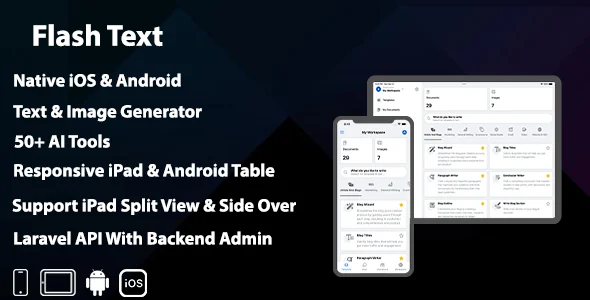
FlashText AI Content Writing Platform Overview & Cross-Platform SaaS Architecture
FlashText is a React Native SaaS content-writing platform backed by a PHP Laravel API, engineered for agencies and independent developers to deploy AI-assisted copy generation across iOS, Android, and the web. The package addresses the core bottleneck of multi-platform AI delivery: one codebase serving app stores while a shared Laravel layer administers tool definitions, billing, and generated content persistence. In production workflows it functions as a turnkey SaaS foundation — operators configure the backend, connect OpenAI provider credentials, enable payment gateways, and publish branded clients to both app stores and the web without rebuilding the generation stack per channel.
Technical Specifications & Deployment Matrix
| Engineering Metric | Deployment Specification |
|---|---|
| Base Technology / Framework | React Native mobile client; PHP (Laravel) backend API; React + Laravel web platform and admin panel |
| Runtime / OS Requirements | iOS 14–15; Android 10.0–12.0; iPad side-by-side and split view layouts supported |
| Data Exchange / Communication | REST endpoints returning JSON; OpenAI GPT-3 provider calls brokered server-side |
| Front-End / Engine Dependencies | React (web), React Native (mobile), external OpenAI API credential |
| Source Artifacts Included | PHP, JavaScript/JSON, .java, .kotlin, .swift, .plist, .apk |
| Monetization / Persistence | Stripe, PayPal, Flutterwave, PayHere, PayStack, In-App Purchase; user content stored and reusable |
Laravel API Pipeline & AI Generation Execution Flow
FlashText routes every generation request through a Laravel API that brokers OpenAI GPT-3 calls. On the client side, the React Native application serializes user input — tool selection, prompt text, and generation parameters — into JSON payloads and dispatches them over REST to the Laravel backend. Laravel validates each payload, resolves the tool definition authored in the admin Prompt Builder, and forwards the composed prompt to the AI provider. Returned completions are deserialized, persisted against the user account, and rendered through the shared interface on iOS, Android, or the React-based web client.
Because tool definitions live server-side, the 50+ prebuilt writing tools act as data records rather than hardcoded client features: an operator can register a new tool, define its input schema, and every connected device receives it through the next API handshake. Long-form sessions assemble 2000–3000 word articles through iterative generation passes, and the uncapped variant system lets users request alternative completions for any segment without re-issuing the entire brief. The bundled image generator follows the same pipeline, returning assets into an integrated editor for post-processing before export. Real-time analysis passes then surface optimization suggestions directly against the drafted text.
For teams that publish AI drafts into an existing content site, pairing FlashText with WorDroid closes the loop from AI drafting through to a native WordPress reading experience on Android devices.
Core Technical Capabilities of FlashText
- Unified multi-platform client: A single React Native codebase compiles to iOS 14–15 and Android 10–12 targets, with iPad split-view handling, Android tablet layouts, light/dark theming, and multi-language string tables managed in the shared UI layer.
- Prompt Builder tool engine: Administrators define unlimited custom AI tools inside the React and Laravel web admin; definitions are stored server-side and consumed through the REST API, decoupling tool rollout from app store release cycles.
- Long-form and unlimited variants: The generation pipeline supports 2000–3000 word article assembly and enforces no cap on variant requests per prompt, bounded only by the connected provider’s quota.
- Image generation with editing: An integrated image generator feeds an onboard editor, so visual assets are produced and adjusted inside the same working session as the copy.
- SaaS billing and team collaboration: Stripe, PayPal, Flutterwave, PayHere, PayStack, and native In-App Purchase gateways cover web and mobile monetization, while shared workspaces let multiple editors review, save, and reuse content.
Production Implementation & Operational Resilience
Deployment centers on the Laravel API layer: the host must run a PHP environment sized for sustained outbound HTTPS calls to the AI provider and payment gateways, with credentials for OpenAI and each enabled gateway configured before launch. Cross-origin traffic from the React web client is governed at the Laravel layer, which terminates REST requests, validates JSON payloads, and returns normalized error responses that the mobile clients surface as inline messaging rather than silent failures.
Client-side release engineering follows standard store pipelines. The Android package ships .java and .kotlin sources plus a compiled .apk for direct device testing, while the iOS artifact carries .swift classes and a .plist that must be re-signed against the target team’s provisioning profile. Minimum OS thresholds — iOS 14 and Android 10 — should be verified against store analytics before finalizing deployment targets.
Secondary development stays within declared boundaries: the Prompt Builder handles new tool creation without code changes, and the included source files permit deeper modification of both client and API layers. For agencies scoping an additional web-only AI product line alongside a FlashText deployment, Writebot supplies a React-based SaaS front-end template that shortens the initial build phase for that parallel delivery.
Frequently Asked Questions
Does FlashText impose a cap on generation variants or article word count?
Yes, long-form sessions support 2000 to 3000 word articles, and variant generation is uncapped, so a single prompt can return multiple alternative drafts without hitting any per-request variant ceiling enforced inside the application logic, provided the connected OpenAI account holds sufficient quota.
Are both Android and iOS native source projects included in the download package?
Yes — the bundle ships Android sources in .java and .kotlin alongside a compiled .apk for direct testing, plus an Xcode project containing .swift classes and a .plist configuration file, giving developers full store-ready build control across both platforms.
Can FlashText generate content without an active OpenAI API credential configured in the backend?
No — every generation request is brokered server-side through the OpenAI GPT-3 endpoint, so a valid API key with available quota must be provisioned in the Laravel configuration before any text or image generation call returns usable results.
Does the web admin allow new AI tools to be added without modifying client code?
Yes — the Prompt Builder inside the React and Laravel web admin lets operators compose new tool definitions centrally, and every connected mobile client receives them through the API without requiring a new App Store or Play Store submission cycle.
Is iPad split view and Android tablet layout support handled natively by the React Native build?
Yes — the React Native interface ships adaptive layout logic for iPad side-by-side and split view plus Android tablet viewports, while light and dark mode plus multi-language strings are toggled directly in the client settings panel.