Find Path Animal – HTML5 Game, Construct 3
Find Path Animal Overview & Browser-Native Puzzle Engine
Find Path Animal is a Construct 3 HTML5 puzzle game engineered for web studios, casual-game publishers, and agency delivery teams to deploy a rotation-based pathfinding title on any static web host. The build removes the operational overhead of server-side processing, database provisioning, and browser plugin dependencies by running every gameplay system client-side. Within a production workflow, the package behaves as a drop-in HTML folder: rename the directory, push it to the host over FTP, and the title is immediately playable for desktop and touch audiences.
Technical Specifications & Deployment Matrix
| Engineering Metric | Deployment Specification |
|---|---|
| Base Technology / Framework | Construct 3 project exported to a self-contained HTML5 build |
| Runtime / Language Requirements | HTML5-capable web browser (Firefox verified); no server-side scripting engine needed |
| Data Exchange / Communication Protocols | Static file delivery over HTTP/HTTPS; no documented external API calls or webhook traffic |
| Front-End / Engine Dependencies | None beyond the browser — the export ships its own runtime, with keyboard and touch input layers included |
| Database / Persistence Footprint | Zero database layer; all puzzle logic executes inside the browser session |
Rotation-Driven Path Construction & Execution Pipeline
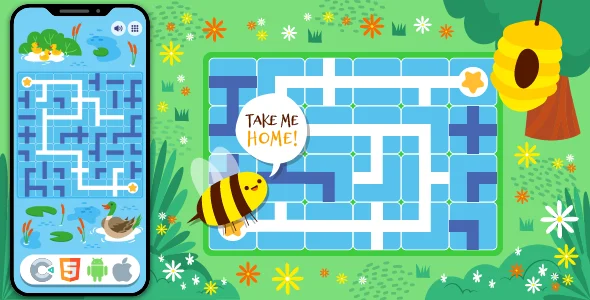
The core mechanic routes every puzzle through a grid of square blocks that players rotate until a continuous path links a blue star block to a white star block. Each tap or keypress dispatches an input event to the engine, which applies a rotation transform to the targeted block and re-evaluates connectivity across the entire grid. The win condition is validated only when both star blocks join a single unbroken path, at which point the animal is routed home and the next, more demanding layout loads. Early levels introduce simple block arrangements, while later grids demand planning several rotations ahead, since one wrong orientation can sever connections already established elsewhere on the board.
Studios assembling a broader browser arcade lineup can position Treasure Girl as a separate Construct-built title occupying a parallel slot in the same static-hosting pipeline.
Core Technical Capabilities of Find Path Animal
- Dual input dispatch: Touch gestures and physical keyboard controls map to the same rotation handler, so a single build serves mobile browsers and desktop sessions without forking the codebase.
- Incremental rotation transforms: Every orientation change triggers an immediate re-render of the affected tile, letting players watch path fragments form and break in real time as they test rotation sequences.
- Connectivity-based win evaluation: Level completion is determined by graph continuity between the two star blocks rather than a fixed move count, which leaves every solvable grid open to multiple valid rotation orders.
- Escalating grid complexity: Level progression increases board density and block variety, shifting the cognitive load from isolated rotations toward multi-step spatial planning and visualization of the resulting path.
Production Implementation & Operational Resilience
Deployment follows a deliberately minimal pipeline. Rename the exported HTML5 folder to any preferred name — avoiding spaces and special characters — then upload the entire directory to the target host through its FTP interface. Because the build references only the assets bundled inside its own folder, no CORS header configuration, rewrite rules, or reverse-proxy directives are required at the hosting layer. Shared hosting, a staging subdomain, or a dedicated static file bucket all qualify as valid targets.
Runtime failure points are correspondingly narrow. Since no database writes, authentication round-trips, or third-party API calls occur, a stable session depends on exactly two prerequisites: a modern HTML5-capable browser and a complete folder transfer — a partially uploaded directory is the primary cause of blank-screen incidents on freshly deployed copies. On the customization side, the included Construct 3 source project opens directly in the editor, giving developers a sanctioned path to adjust level layouts, swap animal artwork, and modify event logic before exporting a fresh build. For teams broadening a Construct 3 arcade catalog, Toss the Guy HTML5 Premium Game Construct 3 ships as an independent export with the same friction-free deployment profile.
Frequently Asked Questions
Does the package ship with editable Construct 3 project files in addition to the compiled HTML5 build?
Yes. The download contains the compiled HTML5 export alongside the editable Construct 3 source project, so level layouts, block artwork, and event logic can be modified directly inside the Construct 3 editor before re-exporting a fresh build.
Can the exported game folder be renamed prior to upload without breaking the build?
Yes. Renaming the HTML5 folder before deployment is an expected step; the only constraint is naming hygiene, since spaces and special characters must be avoided, so use lowercase letters, numbers, and hyphens for a trouble-free upload.
Is a PHP runtime, database, or backend server required to host the game?
No. The game ships as a static HTML folder that runs entirely in the visitor’s browser. Any host that can serve files over standard FTP qualifies, since all rendering, input handling, and puzzle logic execute client-side.