Fiesta of Fortune – HTML5 Game
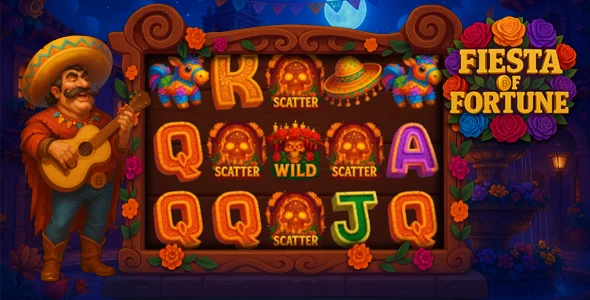
Fiesta of Fortune Overview & Browser-Native Slot Engine
Fiesta of Fortune is a Construct 3–built HTML5 slot machine game, engineered for game studios and web publishers who need a casino-style title that runs directly inside the browser. The package resolves the recurring cross-platform distribution bottleneck by compiling the reel engine, Wild and Scatter logic, and a Day of the Dead themed asset set into a single HTML5 runtime that behaves consistently across desktop and mobile environments. Within production workflows, it operates as a self-contained playable asset suited to static hosting, iframe embedding on content sites, or Webview wrapping for native mobile shells.
Technical Specifications & Deployment Matrix
| Engineering Metric | Deployment Specification |
|---|---|
| Base Technology / Framework | Construct 3 engine exported to HTML5 |
| Runtime / Language Requirements | JavaScript-capable browser: IE11, Chrome, Firefox, Safari, Opera, Edge |
| Input Layer | Unified mouse and touch event handling |
| Front-End / Engine Dependencies | None beyond the browser runtime; no plugins or server components |
| Database / Persistence Footprint | None; ships as static HTML output with no server-side storage layer |
Event-Driven Reel Execution Pipeline
The engine executes as a Construct 3 event-driven loop rendered into an HTML5 canvas. Each spin dispatches symbol-selection events across a five-position reel grid decorated with skulls, marigolds, and festival icons, and the runtime resolves win lines synchronously before animating results back to the player. Because the entire game state machine — idle, spinning, evaluation, and payout presentation — lives inside the exported JavaScript bundle, no backend round-trips are required during play.
Symbol evaluation follows the classic slot grammar: Wild symbols substitute for standard paytable icons to complete winning combinations, while Scatter symbols land independently of fixed paylines and trigger their own reward events. This division keeps the evaluation logic deterministic and readable inside the Construct 3 event sheet, which matters for studios auditing payout behavior or rebalancing the paytable during a reskin.
Agencies assembling multi-title arcade or casino sections often deploy this build alongside other standalone browser games; for decoupled implementations needing a hyper-casual counterpart, Bridge Runner occupies the same static-hosting footprint without any server dependency.
Core Technical Capabilities of Fiesta of Fortune
- Cross-platform HTML5 runtime: one export target covers PC, mobile browsers, Android, and iOS, eliminating separate per-platform builds during agency delivery.
- Wild and Scatter event logic: substitution and scatter-based reward events are handled inside the engine’s event sheet, keeping payout evaluation self-contained in the client bundle.
- Reskin-ready asset layer: sprite graphics can be swapped inside the Construct 3 project, allowing the Day of the Dead visual theme to be rebranded for a different client without touching game logic.
- Compact build size: the exported package keeps its file footprint small, which reduces load time and bandwidth cost when embedded on high-traffic pages.
- Dual input handling: mouse and touch events route through a single control layer, so desktop and mobile sessions share identical interaction code.
Production Implementation & Operational Resilience
Deployment requires nothing more than a static file host or CDN slot: upload the exported HTML directory and point a page, iframe, or native Webview container at the entry file. Because there is no database layer and no API dependency, the failure surface is limited to asset delivery and browser runtime support. Teams should validate rendering across the full documented matrix — including IE11 — before client handover, since legacy engines enforce stricter JavaScript and canvas behavior than evergreen browsers. When assets are served from a separate CDN domain, standard CORS header configuration on the asset bucket prevents canvas texture load failures. The high-resolution output means layout tests should confirm viewport scaling on small phone screens as well as desktop monitors.
Secondary development is bounded by the Construct 3 project structure: visual rebranding sits in the sprite and layout layer, while paytable and symbol-frequency adjustments live in the event sheet. Studios building a broader casino catalogue on the same static hosting pattern can run this title in parallel with an independent table-game build such as Roulette Royale, which occupies a comparable zero-backend footprint for players who prefer wheel mechanics over reels.
Frequently Asked Questions
Does the deliverable include the source HTML5 files and written documentation?
Yes, the package ships with the exported HTML5 files plus documentation covering setup and deployment, giving developers both the runnable build and the reference material needed to host it correctly on a static server.
Can the visual theme be replaced without modifying the slot logic?
Yes, the graphics are designed for easy reskinning inside the Construct 3 project, so studios can swap the skull and marigold sprite set for a custom theme while leaving the Wild, Scatter, and reel evaluation events untouched.
Do the controls work on both desktop and touchscreen devices?
Yes, the runtime implements a unified mouse and touch input layer, meaning the same interaction code drives spins on a desktop workstation and on an Android or iOS browser session without a separate control build.
Is the game playable on mobile operating systems as well as desktop browsers?
Yes, the HTML5 export runs on Android and iOS platforms in addition to PC, and browser support spans IE11, Firefox, Safari, Opera, Chrome, and Edge, giving the build wide out-of-the-box reach.