Explore – Maps & Navigation App 2.3
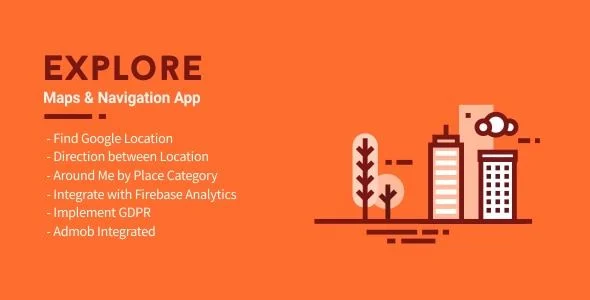
Explore Maps & Navigation App Overview & Native Android Location Engine
Explore Maps & Navigation App is a native Android source template engineered for mobile studios and independent developers to deploy location search, place discovery, and direction-rendering experiences on Google’s mapping stack. The package removes the engineering overhead of wiring Maps rendering, Places API queries, GPS acquisition, and local persistence into one project by shipping pre-connected modules written in Java with XML layouts, built through Android Studio and Gradle. Within agency and production workflows, it operates as a deployment-ready foundation for travel, city-guide, and near-me discovery applications, updated to Target SDK 35 in version 2.3.
Technical Specifications & Deployment Matrix
| Engineering Metric | Deployment Specification |
|---|---|
| Base Technology / Framework | Native Android development in Java with XML layouts; Android Studio project with Gradle build system |
| Runtime / Language Requirements | Android 9.0 through 12.0 runtime coverage; Target SDK 35 (version 2.3); documented compatibility tracing back to Android ICS 4.0 |
| Data Exchange / Communication Protocols | Retrofit REST client consuming Google Maps and Places API endpoints with JSON serialization; request timeout handling added in v1.1 |
| Front-End / Engine Dependencies | Google Play Services mapping and Places engines, Android Universal Image Loader, Material Ripple library |
| Database / Persistence Footprint | Realm database storing favorite places locally on-device; no external backend required |
Google Places Discovery & Execution Pipeline
The execution pipeline centers on Places API queries dispatched through a Retrofit REST client and rendered onto a live Google Maps surface. At launch, an animated splash screen transitions into the main map activity, where the device GPS position is acquired and used as the anchor point for every subsequent query. Fast search input dispatches network requests through Retrofit, which serializes responses into place objects populated with imagery loaded by the Universal Image Loader. The Around Me and Near Me modes let users browse places by category within a dynamic radius adjustable up to 50 kilometers, and the direction module calculates routes from the current position or between selected locations.
Persisted state flows through Realm: when a user saves a place, the record is written to the local Realm database and surfaced later through the favorites module inside the Material drawer menu, so saved locations survive app restarts without any server round-trip. The interface layer applies Material Design components, ripple touch feedback, parallax scrolling, and activity transition animations, while an enter-app animation and an organized splash sequence frame the startup path. Version 2.3 migrates the project to current libraries and Gradle tooling after removing the Firebase Analytics dependency that earlier releases carried.
Architectural & Functional Highlights
- Dynamic Radius Discovery: The Around Me engine queries categorized places within a radius the user can scale up to 50 km, with results rendered as map markers and detail cards in a single pass.
- Realm-Persisted Favorites: Saved places are serialized into the on-device Realm store, giving the favorites drawer offline-readable data with zero backend infrastructure.
- AdMob Monetization Layer: Banner and interstitial ad units are integrated through the current AdMob library, with GDPR consent handling implemented since the 1.2 release cycle.
- Theming & Color Customization: The Material palette is centralized for easy color swapping, letting studios rebrand the blue and red base scheme without touching layout XML structure.
- Native Performance Envelope: Because the codebase is pure Java rather than a cross-platform wrapper, map rendering, list scrolling, and GPS updates execute directly on the Android runtime.
Studios assembling a portfolio of native Android utilities beyond mapping will find that Filo – Smart File Manager & Media Explorer Android App follows the same Android Studio source distribution model, functioning as a standalone second product for a device-tools lineup.
Production Implementation & Operational Resilience
Before release, the build requires three external credentials: a Google Maps API key tied to the application package name, an enabled Places API configuration, and AdMob unit identifiers for the banner and interstitial slots. If the map surface renders blank, the cause is almost always an API that has not been activated for the configured key, and the bundled project documentation walks through the activation sequence required to restore tile rendering. Because the Google Maps API key is bound to the package signature, release builds must be signed with the same keystore used when generating the key, or map tiles will silently fail in the signed APK while working in debug builds.
Network resilience is handled at the Retrofit layer, where the v1.1 update introduced request timeout values so stalled Places queries fail fast instead of blocking the UI thread indefinitely. GPS acquisition logic was also reworked in that cycle to improve location delivery across varied device hardware. All gradle dependencies were refreshed in the June 2025 update, meaning teams compiling against older Android Studio versions should synchronize their IDE before the first build attempt. For organizations targeting a dual-platform release strategy, World Explorer – Complete iOS App Template provides an independent SwiftUI codebase for geography apps on Apple devices, existing entirely outside this Android stack as a parallel product rather than a shared module.
Frequently Asked Questions
Does the deliverable include a demo APK in addition to the source code?
Yes, the package ships with the full Android source code project, the accompanying project documentation, and a demo APK, allowing teams to evaluate runtime behavior on physical devices before committing to any build configuration work.
Is Firebase Analytics still included in version 2.3?
No, the 11 June 2025 update explicitly removed the Firebase integration while upgrading libraries, Gradle tooling, and Target SDK 35. Teams requiring usage analytics must now wire a tracking solution into the codebase independently.
Can users leave ratings and reviews for places inside the app?
Yes, the version 1.1 update added a user rating and review feature, alongside improved place-type translations for the Around Me module, so place detail views can surface community feedback retrieved through the Places API.
Does the app display third-party open-source libraries in its credits?
Yes, the About dialog exposes credit entries for Material Ripple, Android Universal Image Loader, and Retrofit, the three external libraries the project documents as foundations of its rendering and networking layers.
World Explorer – Complete iOS App Template | SwiftUI | In-App Purchase | Quiz Game | Geography

Space Explorer Unity Complete Project(100 Levels)
GPS Route Finder – Maps Navigation & Directions(Android 13 + SDK 34)