Eventure – Startup Business Company Profile Website Elementor Template Kit
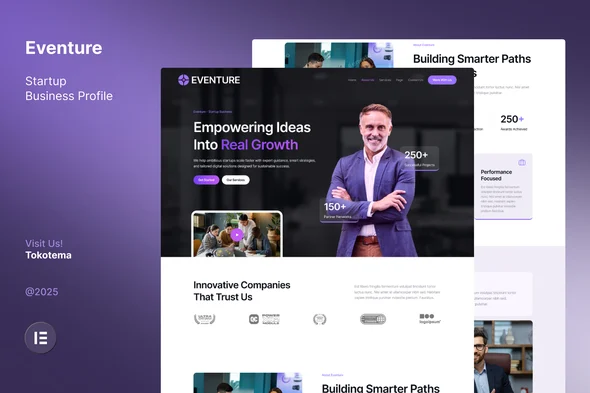
Eventure Overview & Startup Presence Architecture
Eventure is a Startup Business Company Profile Elementor Template Kit engineered for startup teams, agencies, and consulting firms to publish a credibility-driven corporate website without writing code. The kit addresses a specific delivery bottleneck: converting a validated business identity into ten structured, conversion-oriented pages — including service details, case studies, pricing, and team profiles — through pre-built JSON layout data rather than theme-level development. In agency production workflows, the package functions as an importable design layer that operates on top of most Elementor-compatible themes, letting builders skip layout assembly and move directly to content replacement and brand-token configuration.
Technical Specifications & Deployment Matrix
| Engineering Metric | Deployment Specification |
|---|---|
| Base Technology / Framework | Elementor page builder, version 3.10.x |
| Runtime / Import Requirements | WordPress installation with the Envato Template Kit Import plugin, or direct import through the Elementor editor |
| Data Exchange Format | Serialized JSON layout structures imported into the Elementor rendering engine |
| Front-End / Engine Dependencies | Jeg Elementor Kit (header builder), Metform (form engine), The Plus Add-On (extended widgets) |
| Persistence Footprint | No database schema of its own; layout data is stored as Elementor page records once imported |
Design Token System & Page Assembly Pipeline
The core mechanism is a token-driven import pipeline: layout JSON is parsed by the Elementor engine and materialized as editable container structures. Inbound page templates arrive as nested Flexbox and Grid container hierarchies, each bound to global typography and color variables defined at kit level. Builders can retune the entire visual system from a single global controls panel, or override tokens on individual elements when a specific section demands deviation — a two-tier approach that keeps multi-page consistency intact while permitting localized adjustments. Because the kit ships as design data rather than a theme, no template hierarchy overrides or backend logic are involved at any stage of the pipeline.
Architectural & Functional Highlights
- Complete page inventory: Ten pre-built templates cover the full corporate narrative — Homepage, About Us, Services, Service Details, Case Studies, Pricing, Team, FAQs, 404, and Contact Us — so no section scaffolding is built from scratch.
- Global design token governance: Fonts and colors are centralized as kit-wide variables, so a single token edit propagates across every imported page, keeping brand consistency measurable and auditable.
- Metform-based capture layer: Contact forms run through the Metform engine; imported form block templates are attached to page containers via the Elementor Navigator, giving a repeatable, widget-level wiring sequence for every form instance.
- Jeg Elementor Kit header routing: Header and footer templates are assigned through the Jeg Elementor Kit plugin with an All-Site display condition, decoupling chrome design from the underlying theme and making it editable as ordinary Elementor layouts.
- Responsive container behavior: Flexbox and Grid container architecture reflows each layout across viewport sizes without per-breakpoint CSS authoring, maintaining the fast-loading footprint the kit is built around.
For agencies evaluating parallel kit-based routes within the same builder ecosystem, Darcy applies an equivalent JSON-import architecture to creative agency portfolios, which is useful when a client’s brand sits closer to studio positioning than corporate consulting.
Production Implementation & Operational Resilience
Deployment begins by installing the Envato Template Kit Import plugin on the target WordPress instance, then pulling each page template into the Elementor editor individually. During import, WordPress unpacks the JSON payload into editor-ready containers, a process that benefits from an adequately configured wp_memory_limit on the hosting environment so larger page structures load without truncation in the editor session. Elementor Pro subscribers can skip the Metform installation entirely and discard the bundled form blocks, while the Jeg Elementor Kit plugin remains the routing layer for site-wide header assignment — Add New Header, set the All-Site condition, then insert the header template from the My Templates library. Error surfaces in this workflow are mostly environmental: mismatched Elementor versions below 3.10.x, disabled container features, or memory-constrained hosts can interrupt import, so staging validation before client delivery is the standard precaution. Customization boundaries are style-level by design: builders override tokens, swap demo imagery, and restructure containers visually, but the kit exposes no hooks or extension APIs — it is a layout deliverable, not a programmable framework. Demo images ship from Envato Elements collections and require separate licensing before production use, or replacement with owned assets. For decoupled implementations outside the template-kit import workflow entirely, Fastland operates as a full Startup and SaaS WordPress theme, a distinct delivery model where theme-level files govern rendering instead of imported layout data.
Frequently Asked Questions
Is Eventure a standalone WordPress theme?
No, the package is an Envato Template Kit containing Elementor design data only. Layouts are imported via the Envato Template Kit Import plugin or directly through Elementor, and the kit runs on top of most Elementor-compatible themes.
Does the kit require Elementor Pro to function?
No, the kit works with the standard Elementor builder and uses Metform for forms plus Jeg Elementor Kit for headers. Elementor Pro users can skip Metform and manage headers through Theme Builder instead.
Can the bundled demo images be used directly on a live client site?
No, the demo images originate from Envato Elements and require a separate license for production use. Builders can either license those assets or substitute owned imagery during content replacement.