Event Management WordPress Theme
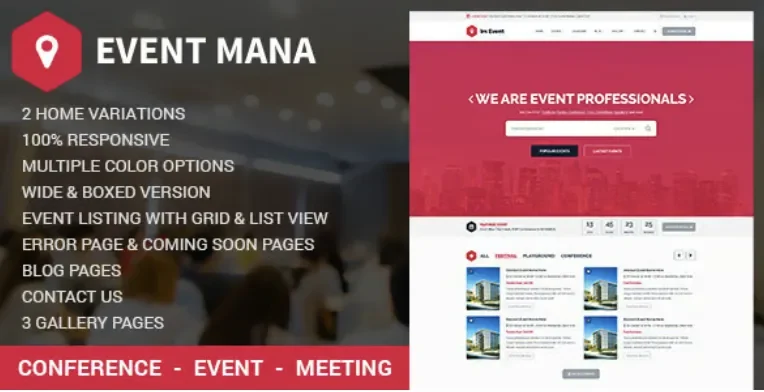
Event Management WordPress Theme Overview & Architectural Role
Event Management WordPress Theme is a responsive WordPress theme package engineered for event agencies, conference producers, and exhibition organizers to publish, schedule, and monetize multi-event programs. The codebase resolves the recurring bottleneck of assembling registration forms, ticket checkout, schedule tables, and countdown displays from disconnected plugins by consolidating them into one template hierarchy backed by a bundled event engine. In production delivery, it operates as a self-hosted presentation and commerce layer in which WooCommerce drives transactions while dedicated event templates render archives, single event pages, and categorized schedules.
Technical Specifications & Deployment Matrix
The matrix below consolidates the verifiable runtime parameters documented for version 1.9.8, giving release engineers a pre-installation checklist before the package enters a staging environment.
| Engineering Metric | Deployment Specification |
|---|---|
| Base Technology / Framework | WordPress 5.0.x through 6.8.x; PHP, HTML, CSS, and JS file bundle |
| Browser Runtime Support | IE9, IE10, IE11, Firefox, Safari, Opera, Chrome, Edge |
| Page Builder Engine | WPBakery Page Builder (Visual Composer), bundled at version 8.7.2 |
| Commerce & Form Layer | WooCommerce 5.x through 9.x; Contact Form 7 form rendering |
| Front-End Dependencies | Bootstrap, OwlCarousel2, FontAwesome 4.7, Google Font API, Google Maps widgets |
| Localization & Persistence | .po/.mo translation files, RTL stylesheets, widget-ready sidebars |
Event Lifecycle Engine & Execution Pipeline
The core mechanism routes front-end requests through WordPress template hierarchy overrides rather than generic archive templates. When a visitor lands on an event archive, the engine selects among list, grid, upcoming, and past event page templates, each pulling post data registered by the bundled Event Management plugin. Category taxonomy terms feed the filter shortcodes, and a sort parameter lets administrators reorder query output without editing PHP. Name and category search runs against the same data layer, keeping retrieval logic centralized instead of duplicated across page variants.
The countdown widget operates client-side with hour and minute granularity, added in version 1.7.3, while timezone correction applied in version 1.7.5 keeps displays aligned to the venue clock rather than server time. Media sections aggregate photos, videos, and blog output into widget regions, with Google Maps embeds handling venue wayfinding. Paid registration flows through the standard WooCommerce cart and payment gateway pipeline, so order data, receipts, and inventory inherit native WooCommerce behavior. For teams needing deeper calendar tooling beyond the bundled schedule modules, deploying EventoZilla on the same WordPress install extends recurring-calendar rendering without custom query code.
Core Technical Capabilities of Event Management WordPress Theme
- WPBakery layout composition: Drag-and-drop modules at version 8.7.2 reduce direct PHP template editing, and two prebuilt home variations ship as deployment starting points.
- WooCommerce ticketing pipeline: Paid ticket and registration checkout inherits the WooCommerce 5.x–9.x order flow, gateways, and cart state without a parallel commerce layer.
- Timezone-correct countdown and scheduling: The timer accepts hour and minute values and applies timezone normalization, preventing drift between server clocks and venue-local displays.
- Multi-view event retrieval: List, grid, upcoming, and past templates share one data layer with name and category search, category filtering, and sortable output.
- One-click demo deployment: The demo importer plus Google Font API connectivity shortens staging-to-production setup by preloading content and typography configuration.
Production Implementation & Operational Resilience
Configuration runs through the native WordPress Customizer rather than a proprietary options panel: unlimited color values, wide or boxed layout mode, and per-page or per-post layout assignment are all adjustable without file edits. RTL stylesheets, corrected in the 1.7.2 revision, allow right-to-left locale deployment, and the documented browser matrix reaches back to IE9 for legacy enterprise audiences. A dedicated 404 template plus a contact page wired to Contact Form 7 supply graceful fallback paths for failed routes and lead capture. The HTTPS popup video defect resolved in version 1.8.4 removed a mixed-content failure mode that previously broke media lightboxes on TLS-secured installs.
Operational boundaries deserve attention before launch. CSS and JavaScript ship as discrete files, so carousel, countdown, and builder scripts can fragment the render path and inflate Largest Contentful Paint on media-heavy event pages; routing static page caching and delayed JavaScript execution through WP Rocket mitigates that blocking behavior. The package is explicitly not Gutenberg-optimized, meaning block editor workflows are unsupported and layout construction must remain inside the WPBakery paradigm. For secondary development, child themes and the .po/.mo translation catalogs define the sanctioned extension surface, while the bundled HTML template offers an independent static prototyping path for decoupled front-ends outside the WordPress runtime.
Frequently Asked Questions
Is a static HTML version of the design included alongside the WordPress files?
Yes, the deliverable bundles a matching HTML template covering the same layout system. Developers can use it as a lightweight prototype or as a front-end starting point for decoupled implementations that sit outside the WordPress runtime entirely.
Is the theme optimized for the Gutenberg block editor?
No, the documentation explicitly lists the package as not Gutenberg-optimized. All layout composition runs through the bundled WPBakery Page Builder engine, so agencies should plan editorial workflows around classic builder modules rather than native blocks.
Can Eventbrite handle ticketing instead of WooCommerce?
Yes, the theme supports the embedded Eventbrite plugin as an alternative booking route. Organizers can push registration and ticket inventory through Eventbrite while the WordPress installation continues handling presentation, content, and event archive rendering.
-
1.9.8 LatestNov 6, 2026
-
1.9.2September 25, 2026