EVdriveX – Electric Vehicle & Charging Station Elementor Template Kit
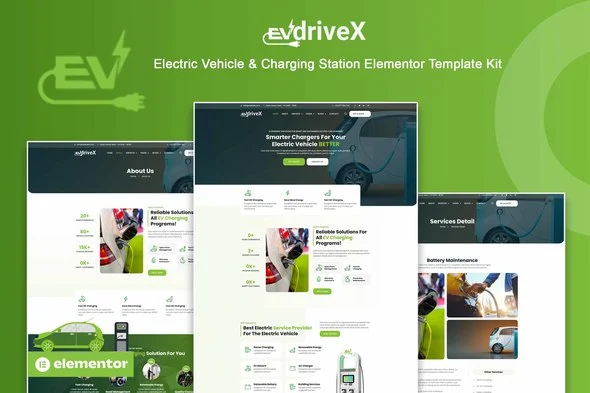
EVdriveX Electric Vehicle & Charging Station Elementor Template Kit: Overview & Ready-to-Deploy Design Layer
EVdriveX is an Elementor Pro Template Kit engineered for EV charging station operators, electric vehicle suppliers, and green-tech marketing agencies to launch a production website without writing code. The package removes the layout engineering bottleneck by shipping 15+ pre-built pages — two homepage variants, service and product listings with detail views, team rosters, career archives, blog feeds, FAQ, gallery, search results, a coming soon screen, and a 404 state — as importable Elementor layouts. Inside an agency delivery pipeline it operates as a plug-in design layer on the Elementor 3.10.x page builder running under the Hello Elementor theme, ready for content substitution and publication.
Technical Specifications & Deployment Matrix
| Engineering Metric | Deployment Specification |
|---|---|
| Base Technology / Framework | Elementor 3.10.x page builder on the Hello Elementor theme; Envato Template Kit distribution format |
| Runtime / Version Requirements | WordPress with the Envato Elements plugin activated; Elementor Pro upgrade required for certain templates and features (not bundled) |
| Data Exchange / Import Protocol | Kit ZIP uploaded via Elements > Installed Kits; Global Kit Styles imported before individual templates |
| Front-End / Engine Dependencies | Elementor Pro; ElementsKit Lite installed alongside the kit |
| Persistence / Storage Footprint | None beyond Elementor’s Saved Templates library; imported layouts carry no separate persistence layer |
| Rendering Targets | 100% responsive layout, retina-ready output, cross-browser compatibility |
Declarative Layout Engine & Template Assembly Pipeline
The core mechanism is declarative JSON layout data imported into Elementor’s visual editor, where every page renders through the builder’s container model rather than hand-written markup. Because each template is a native Elementor document, the import sequence determines runtime integrity: the Global Kit Styles file must be loaded first so typography and color tokens propagate sitewide before individual pages enter the Saved Templates library. Assembly then follows a fixed flow — a new page is created, Edit with Elementor opens the canvas, the gear icon sets Elementor Full Width and suppresses the page title, and the gray folder icon inserts the chosen layout from the My Templates tab. From that point forward, all edits happen through drag-and-drop manipulation of containers, widgets, and global token values, with no file-system or FTP access required.
For studios managing parallel client builds in the electric mobility sector, Voltera offers a sibling kit covering the same EV and charging-station vertical, which keeps the toolchain consistent across multiple concurrent engagements.
Core Technical Capabilities of EVdriveX
- Global Theme Style token system: A central styles panel defines sitewide typography and color values, so a single token edit cascades across every imported page without per-widget overrides.
- 15+ page template inventory: The kit covers the full site map — two homepages, about, contact, team list and detail, career list and detail, service list and detail, product list and single, blog archive and single post, testimonials, FAQ, gallery, search results, coming soon, and 404.
- Drag-and-drop visual assembly: Every section is a native Elementor container, allowing structural reordering, duplication, and deletion inside the editor with zero coding skills involved.
- ElementsKit Lite widget layer: The bundled plugin extends the builder’s widget set at import time, loaded automatically when the Install Requirements action runs.
- Responsive and retina-ready output: Layouts are built on a 100% responsive grid and tested across major browsers, with image assets prepared for high-density displays.
Production Implementation & Operational Resilience
Before importing, verify that PHP memory (wp_memory_limit) is raised on the hosting environment — 256 MB or higher is a practical floor — because the kit’s larger page documents consume editor memory during parsing and rendering. The import routine surfaces an orange banner at the top of the Installed Kits screen; clicking Install Requirements loads the plugins the layouts depend on, and any orange warning on an individual template typically flags a missing Elementor Pro dependency rather than a corrupt file. Imports should be executed one template at a time to keep each request within execution limits on shared hosting, and a staging-first deployment lets token changes be validated before propagation to the live domain.
Customization boundaries sit at the style and content level. Color and typography changes flow through the Global Theme Styles panel, while structural edits happen at the container level inside the editor. Demo images originate from Envato Elements and must be acquired separately or substituted with your own assets before launch. The current V2.0 release (04/07/2025) layers bug fixes and additional pages onto the original structure. For charging-network brands that outgrow a kit workflow and want a standalone theme architecture instead, Electrician exists as an independent theme-based path for electricity-services presentation sites, maintained outside the Elementor kit runtime.
Frequently Asked Questions
Does installing the kit require a paid Envato Elements plan?
No — the free Envato Elements plugin can be activated from Plugins > Add New and used to upload the kit file directly; the optional Connect Account route exists only for automated imports through a linked account.
Can the demo images be used on a live production site?
No — placeholder visuals are pulled from Envato Elements, so each asset must be acquired through that marketplace or substituted with your own photography and graphics before the site is published.
Can site headers and footers be edited after import?
Yes — with Elementor Pro active, global header and footer regions become editable under Theme Builder, allowing sitewide chrome to be restyled once and applied across every imported page template.