Essential Phrases – Multi-Language Travel iOS App Template
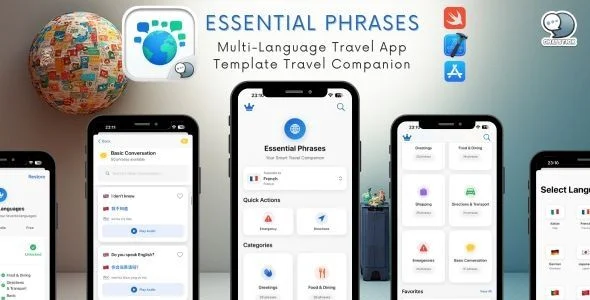
Essential Phrases Overview & Multi-Language Phrasebook Architecture
Essential Phrases is a SwiftUI-based iOS app template engineered for indie developers and agencies to ship a monetizable, multi-language travel phrasebook without assembling the underlying pipeline from scratch. The package addresses the operational bottleneck of combining offline phrase persistence, audio pronunciation playback, and in-app purchase flows into a single deployable codebase targeting iPhone devices. Within agency delivery workflows it functions as a white-label foundation: studios rebrand the interface, swap the bundled phrase datasets, and submit the compiled result to the App Store under their own developer account.
Technical Specifications & Deployment Matrix
| Engineering Metric | Deployment Specification |
|---|---|
| Base Framework | SwiftUI with MVVM separation of concerns |
| Language & Toolchain | Swift 5.7+, Xcode 14.0+ required to build |
| Minimum Deployment Target | iOS 15.0+ (iPhone form factors) |
| Persistence Layer | Core Data local storage plus bundled JSON phrase files |
| Monetization Protocol | StoreKit 2 in-app purchase integration |
| Audio Subsystem | AVFoundation text-to-speech synthesis |
| External Dependencies | None — pure Swift/SwiftUI codebase |
Data Flow & Phrase Retrieval Execution Pipeline
The core mechanism is a locally resolved retrieval pipeline: phrase content ships as JSON datasets under the PhraseData directory, is loaded into typed models, and persists through Core Data so every interaction survives without network connectivity.
When the app launches, SwiftUI views bind to view models that query the local store, and the MVVM structure keeps rendering logic separated from data access. A user selecting a language or category triggers a filtered fetch against the persisted phrase set; results render in category grids, detail views, or search result lists. Audio pronunciation routes through the AudioManager module, which invokes AVFoundation speech synthesis on demand rather than bundling pre-recorded audio files, keeping the binary lean while supporting 15+ target languages including Spanish, Japanese, Arabic, Hebrew, Thai, and Hindi. Search queries traverse the same local dataset with suggestion filtering and recent-lookup history, while favorites and recent searches write back into Core Data for session-to-session continuity.
Core Technical Capabilities of Essential Phrases
- Offline-First Persistence: Core Data handles favorites, recent searches, and phrase state locally, so the app remains fully operational in airplane-mode scenarios common to international travel.
- StoreKit 2 Monetization Layer: The IAPManager module manages product loading, purchase transactions, restore-across-devices flows, and free-trial entitlements for language packs, category unlocks, and all-access tiers using Apple’s modern async purchase API.
- Centralized Configuration & Theming: AppConfig.swift and Theme.swift act as single points of mutation for branding strings, color tokens, and product identifiers, which reduces reskin effort to a bounded file-level edit instead of a codebase-wide search.
- Modular Component Architecture: Reusable SwiftUI components in dedicated directories allow individual UI elements — category cards, phrase rows, playback controls — to be replaced or restyled without touching view model logic.
- Zero Dependency Footprint: The absence of third-party package managers removes dependency-resolution conflicts during Xcode builds and simplifies long-term maintenance against future Swift toolchain releases.
For studios weighing platform strategy, this template occupies the iOS lane exclusively; a separate Android track such as Language Translator App operates as an independent multi-language translation implementation on the Android stack and cannot share this codebase. Teams needing location utilities for decoupled implementations outside the iOS phrasebook scope can likewise evaluate GPS Route Finder as a standalone maps and navigation project targeting Android 13 with SDK 34.
Production Implementation & Operational Resilience
Deployment begins by opening the Essential Phrases Xcode project file, replacing the bundle identifier, and attaching signing credentials from an Apple Developer account. Because no external dependencies exist, build failures from package resolution are structurally eliminated, and the codebase compiles against Xcode 14.0+ with Swift 5.7 toolchains. Runtime resilience rests on the local persistence layer: when the device lacks connectivity, Core Data reads and AVFoundation synthesis continue uninterrupted, and no network fallback path is required for core phrase lookup.
For in-app purchase hardening, product identifiers defined in IAPManager.swift must mirror the products configured in App Store Connect, and StoreKit testing in Xcode allows transaction simulation — purchases, restores, and trial conversions — before submission. Restore-purchases handling synchronizes entitlements across devices signed into the same Apple ID, which covers device-migration scenarios agency clients frequently encounter. Secondary development stays bounded by design: the modular Views and Components directories accept new SwiftUI screens, PhraseData JSON files accept additional languages and categories without schema changes, and the centralized theming system constrains visual overrides to token-level edits rather than per-screen style surgery. Error surfaces are minimized because text-to-speech failures degrade to silent no-ops on unsupported locales rather than crashes, and the layout engine adapts to all current iPhone viewport sizes through native SwiftUI responsive primitives.
Frequently Asked Questions
Does the app function without an internet connection?
Yes, the template is fully operational offline. Phrase content persists through Core Data and bundled JSON files, and audio pronunciation runs through the local AVFoundation speech engine, so no network request is needed for lookup or playback.
Are third-party SDKs or package managers required to build the project?
No. The codebase is written in pure Swift and SwiftUI with zero external dependencies, meaning builds require only a valid Apple toolchain — Xcode 14.0 or newer with Swift 5.7 — and no CocoaPods or SwiftPM resolution step.
Can in-app purchases be tested before App Store submission?
Yes. Once product identifiers in IAPManager.swift match the entries configured in App Store Connect, Xcode’s built-in StoreKit testing environment simulates purchases, restores, and trial behavior locally before the binary enters Apple’s review pipeline.
Is rebranding limited to a single configuration file?
Yes. App name, color tokens, and branding values are centralized in AppConfig.swift alongside the Theme.swift design system, so a white-label reskin requires editing a small set of configuration files rather than traversing every view.
Shrimad Bhagvad Geeta – Geeta Saar – Bhagvad Geeta Mahatmya – Bhagvad Geeta with Three Languages
Flags Quiz Guess the flag multi languages
Multi language Translator Text, Chat, Camera, Voice, Photos With Admob and Facebook Ads