ePathsala – Online Education Elementor Template Kit
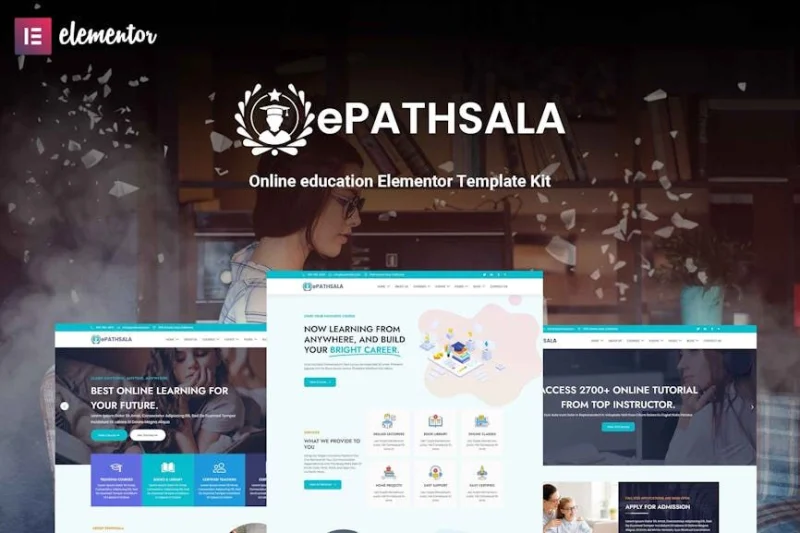
ePathsala Overview & Front-End Layout Architecture for E-Learning Delivery
ePathsala is an Elementor Template Kit engineered for educators, training centers, and independent tutors to publish course catalogs, instructor profiles, and enrollment pathways inside WordPress without writing code. The kit resolves the operational bottleneck of assembling a conversion-oriented e-learning storefront from blank Elementor containers, supplying pre-structured layouts for Home, About Us, Courses, Course Details, Instructors, and Contact pages. Within agency delivery workflows, it functions as an importable layout baseline that a designer re-tokenizes, restyles, and deploys as a client-ready educational site in a fraction of a manual build cycle.
Technical Specifications & Deployment Matrix
| Engineering Metric | Deployment Specification |
|---|---|
| Base Technology / Framework | Elementor page builder running on a WordPress installation |
| Runtime / Language Requirements | WordPress host with Elementor activated; no custom PHP development required |
| Data Exchange / Communication Protocols | JSON template definitions imported through the Elementor Kit import workflow |
| Front-End / Engine Dependencies | Elementor container widgets, global typography and color tokens |
| Database / Persistence Footprint | None beyond standard WordPress content storage; layouts render as page data, not as separate schema |
JSON-Driven Layout System & Page Composition Pipeline
The core mechanism is a JSON layout payload that Elementor parses into container-based page structures on import. Each template in the package ships as a structured definition file: when a user runs the Kit import sequence, the Elementor engine reads the JSON, reconstructs nested Flexbox and Grid containers, maps widget instances into their designated drop zones, and writes the resulting layout into standard WordPress page records. Because the entire composition pipeline executes at the layout layer rather than the server layer, no template hierarchy overrides, SQL migrations, or backend logic are involved at any stage.
Design consistency across the kit is governed by global theme styles rather than per-page declarations. Colors and typography are registered as site-wide tokens inside the Elementor Kit settings panel, so adjusting a single token value propagates the new visual identity across every imported page simultaneously. This token-driven approach means a school rebranding exercise—shifting a palette from one institutional color scheme to another—can be completed from one control surface instead of editing individual widgets across six or more page layouts.
Conversion flow is mapped deliberately through the page set. The homepage directs attention toward course discovery, the Courses listing presents catalog breadth, and Course Detail pages carry the information a prospective student evaluates before committing, including instructor attribution that links through to dedicated instructor profile pages. This traversal sequence is pre-wired into the navigation and section ordering, sparing information architects from re-planning the funnel from scratch.
Core Technical Capabilities of ePathsala
- Zero-Code Drag-and-Drop Editing: Every section is composed of Elementor widgets and containers that designers rearrange visually, eliminating PHP template editing from the customization loop.
- Global Design Token System: Site-wide color and typography variables centralize brand identity control, enabling a single-panel restyle of all imported pages without per-widget overrides.
- Responsive and Retina-Ready Output: Layouts are built with viewport-adaptive container behavior, rendering correctly on desktop, tablet, and mobile breakpoints with sharp imagery on high-density screens.
- Performance-Conscious Asset Strategy: The kit ships lightweight assets, keeping the page payload small so loading times stay short and visitor experience is not degraded by template weight.
- Modular Page Inventory: The six core templates—Home, About Us, Courses, Course Details, Instructors, and Contact—cover the complete enrollment funnel, allowing teams to launch a full site structure from one import operation.
Production Implementation & Operational Resilience
Deployment begins on a staging or fresh WordPress installation with Elementor activated. Before running the kit import, administrators should verify that the wp_memory_limit directive is raised to at least 256M; JSON kit imports with multiple page definitions and image attachments are memory-intensive operations, and a constrained PHP memory allocation is a common cause of interrupted or partial imports on shared hosting. Hosting that meets standard WordPress requirements will handle the workflow without additional server configuration.
Because the package is a layout kit rather than an application, its operational boundaries are deliberately narrow. It contains no learning management backend, no course delivery engine, and no enrollment transaction logic—those functions belong to whichever LMS or commerce layer the site operator deploys separately. For institutions that require a full course-delivery runtime on a different stack, eDash – Moodle 4+ Education LMS Theme exists as an independent Moodle-based option, and Wellern – Coach Online Courses PHP Template serves as a separate custom-code path for decoupled implementations outside WordPress. These are parallel solutions, not components that merge into the kit’s architecture.
Secondary development within the kit itself is confined to style overriding and asset replacement. Designers swap imagery, adjust global tokens, and restructure containers through the visual editor; any behavior beyond front-end presentation—payment capture, student accounts, or course progress tracking—must come from adjacent tooling. Cross-device verification during staging remains the final resilience check before client handover, since responsive behavior is verified at the layout layer rather than enforced server-side.
Frequently Asked Questions
Does ePathsala include a learning management backend for hosting course content and student progress?
No. The kit delivers front-end page layouts only; it contains no LMS engine, course delivery system, or student data layer, so course hosting logic must be handled by separate platform tooling.
Is any enrollment payment or booking logic bundled with the templates?
No. The package provides presentation-layer layouts that guide visitors toward enrollment, but no transaction processing, checkout, or booking mechanics are embedded in the template definitions themselves.
Do imported layouts create separate database tables or custom schema?
No. Imported pages persist as standard WordPress content records; the JSON definitions are parsed into Elementor layout data, leaving no additional schema footprint on the site’s database.