Emoji Maker – Self Stickers Maker | ADMOB Support
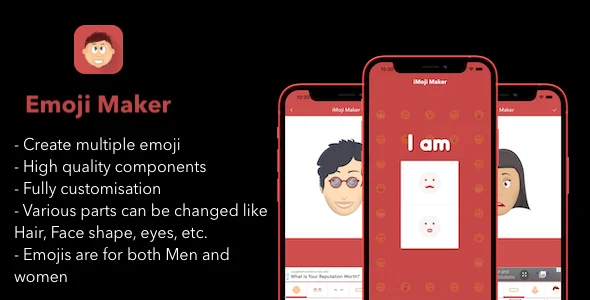
Emoji Maker Self Stickers Maker Overview & Native iOS Sticker Engine
Emoji Maker Self Stickers Maker is a native Objective-C iOS application source code, engineered for mobile developers and agencies to ship a personalized emoji sticker creation app with integrated AdMob monetization. The package resolves the asset-compositing bottleneck of building avatar-style emoji editors from scratch by supplying prebuilt part libraries — hair, face shapes, eyes, eyebrows, mouths, and eyewear — that render as animated emoticons on devices running iOS 12 or later. Within production delivery workflows, it operates as a deployable base: restyle the interface, bind ad units, compile in Xcode, and submit the binary to the App Store.
Technical Specifications & Deployment Matrix
| Engineering Metric | Deployment Specification |
|---|---|
| Base Technology / Framework | Native iOS (Cocoa Touch) application stack |
| Runtime / Deployment Requirements | iOS 12 minimum software version; Xcode compilation pipeline |
| Source Deliverables | Paired .h/.m implementation files plus .xib/.nib interface definitions |
| Monetization & Communication | AdMob SDK ad-serving support; iOS share sheet dispatch for outbound stickers |
| Database / Persistence Footprint | Local device gallery storage for saved emojis; no external database layer specified |
Composable Emoji Rendering & Execution Pipeline
The engine assembles each emoji by compositing user-selected part assets onto a gender-scoped face template. Gender selection at session start determines which part catalogs the pickers expose, so hair, eyebrow, and accessory options load contextually instead of as one undifferentiated library. The chosen face shape becomes the base layer; each subsequent selection — mouth, eyes, eyebrows, goggles or spectacles — replaces its own slot in the active emoji state while previously committed layers remain untouched. A preview step renders the full composite for inspection, and tapping done moves the session from composition state to export state, where the finished sticker is either written to the device gallery or dispatched through the share sheet to any installed media channel. Because every emoticon in the catalog is animated, the rendering path reconciles part substitutions with expression playback cycles — smiles, sadness, surprise, and heart eyes among them — so swapping a component does not interrupt the ongoing animation.
Core Technical Capabilities of Emoji Maker Self Stickers Maker
- Layered part compositing: discrete slots for face shape, hair, eyes, eyebrows, mouth, and eyewear replace one visual layer at a time while the rest of the emoji state stays intact, enabling iterative visual tuning.
- Dual-gender asset scoping: part libraries branch by gender at session start, serving distinct male and female emoji configurations through a single compositing pipeline.
- Animated emoticon catalog: documented expressions — happy, sad, angry, surprised, heart-eyed — all carry animation, so output stickers ship with motion rather than static bitmaps.
- Preview-and-commit workflow: the composition state is rendered for verification before the done action fires, separating assembly from export and preventing accidental partial saves.
- AdMob monetization support: ad-serving wiring ships inside the package, so revenue configuration happens during the build phase instead of a post-launch retrofit.
For studios evaluating separate standalone iOS deliverables on the same platform, Snow Rush for iOS operates as an independent game template outside this sticker engine and cannot be merged into its codebase.
Production Implementation & Operational Resilience
Deployment begins in Xcode: the delivered .h and .m implementation files compile against the iOS 12 SDK baseline, while the .xib/.nib interface definitions load directly into Interface Builder for visual adjustment without touching view-layout code. Because the application runs entirely on-device and the documentation defines no external backend, no server provisioning, CORS header configuration, or networked persistence layer is required before submission — the only outbound traffic is AdMob ad requests and user-initiated share dispatches. The persistence footprint is correspondingly small: finished emojis are written to the local gallery, and no database engine is specified, so storage scaling reduces to device capacity. Resilience boundaries worth planning around: the part catalog is fixed to the documented categories (hair, face shape, eyes, eyebrows, mouth, goggles or spectacles), so extending the library means adding new asset entries and registering them with the compositing slots rather than reconfiguring a remote content system. Teams comparing cross-platform AdMob launches will find that Magic Cube Puzzle 3D Game with AdMob Ads Android runs as a fully decoupled Android project — a parallel monetization path, not an extension of this iOS package.
Frequently Asked Questions
Is the source package written in Swift?
No, the implementation is written in Objective-C: paired .h and .m files define behavior, while .xib/.nib files carry the interface layouts, all compiled against the iOS 12 baseline in Xcode.
Can users produce more than one emoji within the application?
Yes, multiple emoji characters can be created, each assembled through its own gender selection, part configuration, preview, and export cycle, so a single install supports an ongoing library of custom stickers.
Is a published reference build available to evaluate behavior before compiling?
Yes, a live App Store build is published, allowing developers to verify the compositing flow, animated expression playback, and sharing behavior on real hardware before investing compilation and reskinning effort.
Can finished emoji stickers leave the application without a third-party exporter?
Yes, finished emojis can be saved directly to the device gallery or shared across media channels from inside the application, with no external exporter required in the fully documented workflow.
2 App Template | Rental Car Booking App | Self Driving Rental Car | Rent a Car App | Car on Rent
Neon LED Light Keyboard – RGB and Emoji Light Keyboard – RGB Themes – LED Keyboard – LED Light Type
Full Battery Alert- Anti Theft Alarm – Pocket Alert, Intruder Selfie(android13 + SDK 34)