Echo Voice Recorder – Voice Recording – Voice Memos – Easy Voice Recorder – Music Recorder
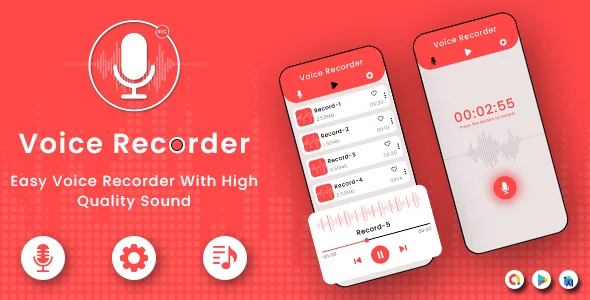
Echo Voice Recorder Overview & Mobile Audio Processing Architecture
Echo Voice Recorder is a native Android audio recording application, engineered for mobile developers and app publishers to ship an echo-effect voice memo and music recorder without building the signal-processing layer from scratch. The package resolves a concrete engineering bottleneck: applying a controllable echo treatment — with adjustable pitch, gain, sample, and speed parameters — onto recorded voice or music, while supporting overlapping instant playback of a single take. Within an agency delivery pipeline, it functions as a store-ready tools app codebase that can be reskinned from included layered design sources and compiled directly into a distributable APK.
Technical Specifications & Deployment Matrix
| Engineering Metric | Deployment Specification |
|---|---|
| Base Technology / Framework | Native Android application built from Java source (.java) with XML layout resources (.xml) |
| Runtime / OS Requirements | Android 9.0, 10.0, 11.0, and 12.0, plus additional compatible platform targets |
| Compiled Artifacts | .apk installer, .dex bytecode, .so native libraries, and .dat packaged assets |
| Database / Persistence Footprint | Local .db storage for saved recordings written under user-defined filenames |
| Design Deliverables | Layered PSD and Layered PNG source files for full UI reskinning |
| Validation Asset | Standalone demo APK for on-device behavior verification prior to source modification |
Real-Time Echo Signal Pipeline & Recording Execution Flow
The engine captures microphone input, routes it through a toggleable echo processing stage, and delivers the processed buffer to immediate playback. When a recording session begins, incoming voice or music audio is written into the app’s capture flow; once the take is complete, playback can be triggered instantly and repeated as often as needed. The defining mechanic is stacked replay: pressing replay while audio is already playing launches a second playback pass over the top of the active one, allowing a single recorded take to accumulate into dense, layered echo textures. A reset control discards the current take when the result is unsatisfactory, returning the session to a clean capture state instead of forcing edits on unwanted audio. The echo stage itself is switchable — with the effect off, recordings play back dry; with it on, the pitch, gain, sample, and speed parameters reshape the duplicated signal into slowed, deepened, or accelerated voice variants. Finished recordings persist under filenames chosen at save time, and the resulting audio files can be shared with other users through the platform’s standard share mechanisms. For teams assembling a broader Android utility portfolio, AiVision Powered By Gemini, Video Input, Image Input covers multimodal voice-chat input as a separate Android app package.
Core Technical Capabilities of Echo Voice Recorder
- Toggleable Echo Processing Stage: An explicit on/off option governs whether the echo layer is injected into the playback chain, so the same take can be auditioned dry or treated without re-recording the source audio.
- Pitch, Gain, Sample & Speed Adjustment: With echo active, four independent parameters reshape the duplicated signal, exposing fine-grained voice-change behavior — from slowed, deepened takes to accelerated, pitched-up variants — directly through the recorder interface.
- Stacked Replay Mechanism: Triggering replay during active playback layers a new pass over the running audio rather than replacing it, producing compound echo builds from one recorded take.
- Reset & Re-record Control: A reset action discards an unsatisfactory take and returns the recorder to capture mode, preventing unwanted sessions from entering the save pipeline.
- Named Save & Share Pipeline: Recordings persist under user-chosen filenames, and saved audio files can be distributed to other users through the device’s standard sharing channels.
Production Implementation & Operational Resilience
Deployment starts with the bundled .apk, which lets QA teams validate recording, echo, and replay behavior on physical devices running Android 9.0 through 12.0 before any source changes. Because .java and .xml files ship alongside compiled .dex, .so, and .dat artifacts, the codebase can be opened, modified, and rebuilt inside a standard Android toolchain, while the .db component defines the local persistence footprint for saved recordings. Design work is handled by the layered PSD and PNG sources, which permit pixel-level reskinning of the interface without touching layout XML — the practical customization boundary for this package is UI theming, parameter defaults, and save/share flow adjustments within the existing Java architecture. One operational boundary deserves explicit QA attention: pitch, gain, sample, and speed parameters influence playback only while the echo toggle is enabled, so test passes should cover both the dry and treated playback paths, plus stacked replay under multiple simultaneous passes. For decoupled implementations outside Android — such as a WordPress site that needs streaming audio rather than local recording — VOX Radio – Online Radio Streaming operates as an independent web-based alternative on a separate runtime.
Frequently Asked Questions
Can replay be triggered while a previous playback is still running?
Yes — pressing replay during active playback starts another pass over the top of the running audio instead of stopping it, which produces layered echo builds from a single recorded take.
Are editable design source files included alongside the code deliverables?
Yes — layered PSD and layered PNG files ship together with .java and .xml sources plus compiled .apk, .dex, .so, .dat, and .db artifacts, giving designers and developers full reskinning capability before release.
Does the echo effect apply to every recording by default?
No — the echo stage is governed by an on/off option; when switched off, recordings play back without the effect, and when switched on, pitch, gain, sample, and speed parameters become adjustable.
Can finished recordings be shared with other users?
Yes — after a take is saved under a user-chosen filename, the audio file can be shared with everyone through the device’s standard sharing channels, making distribution part of the core workflow.