Duoland – HTML5 Game – Construct 3
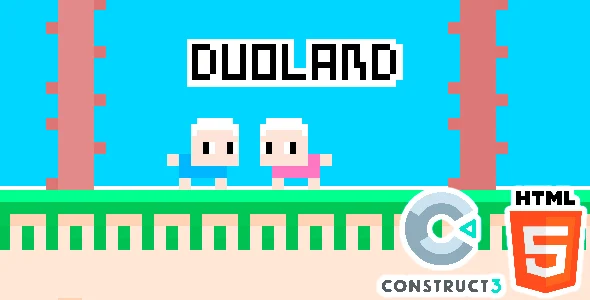
Duoland Overview & Dual-Character Escape Platformer Architecture
Duoland is a Construct 3 HTML5 puzzle-platformer built for developers and publishers who need a two-character, turn-based game running on both desktop and mobile browsers. It resolves the coordination problem of controlling two siblings by assigning each a fixed color identity — pink or blue — that gates which gems and chests that character can interact with. In production, it functions as a reskinnable, AdMob-ready game shell for arcade portals and Webview-wrapped mobile builds.
Technical Specifications & Deployment Matrix
| Engineering Metric | Deployment Specification |
|---|---|
| Base Technology / Framework | Construct 3 engine, distributed as a c3p project file targeting editor release r321 |
| Runtime / Language Requirements | HTML5 and JavaScript; exported as HTML plus JS files for static hosting |
| Input Protocols | WASD keyboard mapping on desktop; on-screen touch buttons on mobile; dedicated character-change button |
| Front-End / Engine Dependencies | Construct 3 Canvas runtime; no external frameworks required |
| Persistence Footprint | Session-scoped game state; no server database or backend calls |
| Monetization Layer | AdMob support for mobile builds wrapped in native containers |
Turn-Based Character Switching & Progression Pipeline
Duoland’s core mechanism is a turn-based active-character context that swaps control on demand. Keyboard input (WASD) and on-screen touch buttons feed a single shared input abstraction, so the Construct 3 event sheet processes movement, jumping, and wall traversal identically across desktop and mobile runtimes. Each frame is then drawn through the engine’s Canvas-based rendering loop, which keeps the 2D scene, collision solids, and UI layers synchronized during play.
Level progression is enforced through a staged validation chain. The player must collect every coin in a level before chest interactions become available. Each sibling carries a fixed color identity: the pink character collects pink diamonds and opens the pink chest, while the blue character handles the blue equivalents. Chest events verify the active character’s identity and collected-gem count before firing their unlock logic. The exit condition applies a final gate — both siblings must board the boat at the island’s end — so the level cannot close while either character’s collection quota is unmet. Wall traversal adds a timing layer: climbing between opposing walls requires the jump button to be pressed repeatedly, with each press re-anchoring the active sprite against the opposite wall surface.
Core Technical Capabilities of Duoland
- Dual-State Character Controller: A character-change button toggles the active sibling, transferring input focus while the idle sibling retains its physics position, collected gems, and level state until the next switch.
- Color-Gated Collectible Validation: Gem pickup events check the actor’s color identity before incrementing counters; mismatched pickups are rejected, and chest unlocks fire only after the matching gem and coin quotas are satisfied.
- Shared Input Abstraction Layer: Desktop keyboard mapping and mobile touch controls dispatch to the same movement and jump handlers, removing the need for separate per-platform event logic.
- Wall-to-Wall Traversal Mechanics: Repeated jump presses drive wall anchoring during shaft climbs, a behavior tuned through collision-box configuration in the event editor.
- AdMob-Ready Mobile Surface: Documented AdMob support lets wrapped mobile builds serve ad units once identifiers are configured at the container stage.
Developers comparing dual-character switching against single-hero platformer structures can benchmark Ninja’sReturn, a Construct 3 title whose event architecture contrasts with Duoland’s cooperative control model.
Production Implementation & Operational Resilience
Deployment starts from the c3p source file, which must be opened in Construct 3 release r321; earlier editor builds may fail to load the project, and newer builds can apply automatic migrations to the event sheets. Agencies should archive the original c3p before modification and record the pinned editor version in delivery notes so client teams can reproduce the build environment.
The documented re-skin workflow targets sprite replacement inside the Construct editor: swapping character, gem, coin, chest, and background objects while leaving collision boxes and event logic in place. Because the asset is not marked high resolution, teams targeting retina-class displays should re-export artwork from larger source files before publishing.
Persistence is session-scoped: the game issues no server-side database writes, so a page refresh resets level state. Hosting is static — exported HTML and JavaScript files served from any web root — which keeps cross-origin concerns limited to the asset domain and removes backend maintenance from the delivery scope.
Distribution splits by platform. Browser builds run across Chrome, Edge, Firefox, Safari, Opera, and legacy IE6 through IE11, covering arcade portals on older enterprise baselines. For app-store distribution, the HTML5 build wraps inside a native Webview container, where AdMob units are activated. Portals needing both cooperative puzzle and one-touch arcade formats can run Duoland alongside Top Jump under the same static hosting pattern.
Frequently Asked Questions
Does the Duoland c3p project require a specific Construct 3 editor release?
Yes. The project file must be opened in Construct 3 release r321. Earlier releases may fail to parse the event-sheet syntax, while later releases can trigger an automatic project migration, so pin the editor version before any re-skin work.
Can both siblings be controlled at the same time?
No. Control is turn-based: the character change button transfers input focus to the other sibling, and only the active character responds to commands. Level puzzles depend on this alternation because gem colors and chests are gated per sibling.
Are high-resolution (retina) assets included in the package?
No. The listing marks the asset as not high resolution, meaning sprites ship at standard 2D resolution rather than retina-scale source files. Projects targeting high-DPI displays should budget for artwork re-export during the re-skin phase.
Is AdMob monetization supported in mobile builds?
Yes. AdMob support is documented, so mobile exports wrapped in a Webview or Cordova container can serve ad units once the publisher’s ad identifiers are configured at the wrapping stage rather than inside the event sheet.
Does Duoland run in legacy browsers such as Internet Explorer?
Yes. The compatibility matrix lists IE6 through IE11 alongside Chrome, Edge, Firefox, Safari, and Opera, which covers arcade portals on older enterprise baselines; operators scaling beyond one title can source an Action Games Bundle for multi-game deployments.