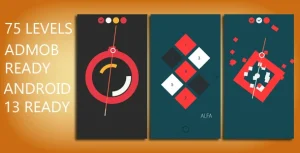
Duo Fall (Unity Game+Admob+iOS+Android)
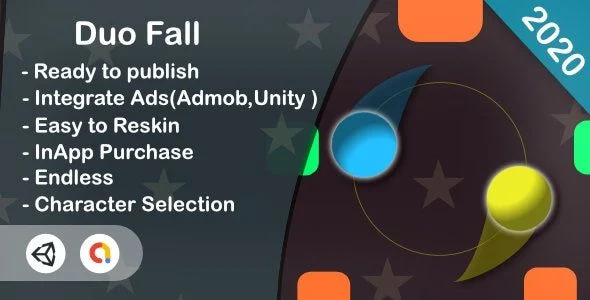
Duo Fall Overview & Mobile Game Source Architecture
Duo Fall is a Unity-engineered ultra-casual arcade source package, built for mobile studios and indie publishers to compile, reskin, and ship a tap-controlled endless faller on both Android and iOS. The project resolves the common bottleneck of monetization-ready game templates by shipping with AdMob and Unity Ads SDK wiring, a rewarded-video flow, and a daily reward loop already implemented in C# alongside the gameplay core. Within a production pipeline, the codebase functions as a deployable starting point: studios import it into Unity 2019.2.9f1 or later, swap art assets through the included layered sources, configure ad units, and export store-ready binaries.
Technical Specifications & Deployment Matrix
| Engineering Metric | Deployment Specification |
|---|---|
| Base Technology / Framework | Unity engine, project authored for Unity 2019.2.9f1 or later |
| Runtime / Language Requirements | C# gameplay scripts; Android target range spans versions 5.0 through 9.0 |
| Data Exchange / Communication Protocols | AdMob and Unity Ads SDK ad requests; Unity Services integration for analytics |
| Front-End / Engine Dependencies | Unity Editor (free download); Mac with Xcode required for iOS compilation |
| Database / Persistence Footprint | On-device only: .db and .dat runtime artifacts; .dex and .so native Android components |
| Included Source Deliverables | .apk, .java, .xml, layered PSD, and layered PNG files |
Tap-Jump Gameplay Loop & Monetization Execution Pipeline
The engine dispatches a single screen tap to a jump event that lifts the ball away from falling obstacles. Because the control scheme reduces input to one touch, the input layer stays shallow: touch events are captured each frame, translated into an upward impulse on the ball’s physics body, and validated against the active obstacle pattern before the next collision check executes. Obstacles spawn procedurally in an endless sequence, so difficulty scales through spawn-rate and pattern variables rather than authored level data, and each collision triggers a run-termination state that resets the score counter and primes the next session. This endless loop is what gives the package its retention profile as a rotor-and-tap arcade format.
Monetization events ride on top of this update loop without interrupting its frame timing. The rewarded-video gate is invoked at defined moments — claiming the daily reward or recovering a run — and the ad request routes through whichever network SDK has been activated in the build configuration. For teams evaluating separate standalone casual titles on a browser-first engine, Animal Discovery Kids Educational Construct 3 HTML5 Game follows an independent Construct 3 path that cannot share this C# codebase.
Core Technical Capabilities of Duo Fall
- Rewarded Ad Gate: A rewarded-video callback unlocks in-run benefits, tying monetization directly to player intent rather than interstitial interruptions mid-gameplay.
- Dual-Network Ad Layer: AdMob and Unity Ads SDK wiring coexist in one project, letting publishers bind their own ad unit identifiers and switch networks without rewriting the request logic.
- Daily Reward Loop: A scheduled reward claim runs entirely on-device, requiring no backend endpoint, server-side session validation, or remote content fetch.
- Editor Scripts & Reskin Pipeline: In-editor helpers accelerate configuration, while layered PSD and PNG sources allow artists to modify character, obstacle, and UI artwork without reconstructing sprite sheets.
- Cross-Platform Export: A single project compiles to Android 5.0–9.0 targets and to iOS through Xcode, keeping one C# logic layer across both storefronts.
Production Implementation & Operational Resilience
Deployment starts by opening the project in Unity 2019.2.9f1 or later and following the recorded setup walkthroughs that cover project initialization, AdMob unit binding, and Unity Services activation. Android coverage spans OS versions 5.0 through 9.0, so publishers should cross-check that bracket against their store analytics before locking minimum SDK thresholds for release. iOS output requires a Mac running Xcode, since Unity’s iOS target emits an Xcode project that must be signed and archived through Apple’s toolchain prior to App Store submission.
The architecture runs fully on-device: no backend service, remote configuration endpoint, or networked persistence layer participates at runtime, which removes CORS handling, token refresh, and server-outage failure modes from the operational scope. Resilience attention therefore concentrates on ad-SDK behavior — publishers testing on low-end hardware should confirm how the reward flow behaves when a video fill is unavailable — and on verifying touch responsiveness across differing device refresh rates. Secondary development stays within defined boundaries: graphical identity is replaced through the layered PSD and PNG sources plus the editor scripts, while gameplay tuning happens through exposed variables in the structured C# scripts. For casual-game products that must live inside a WordPress site rather than native app stores, Wordly operates as a separate plugin outside the Unity runtime and shares no build pipeline with this package.
Frequently Asked Questions
Are layered design source files included for graphical reskinning?
Yes, the deliverables contain layered PSD and layered PNG files, so artists can edit character, obstacle, and UI artwork directly in Photoshop and re-export sprites without rebuilding the visual hierarchy from scratch.
Can rewarded video ads run on both AdMob and Unity Ads from the same project?
Yes, both SDKs are wired into the codebase, and the rewarded placements plus daily reward flow reference them; publishers substitute their own ad unit identifiers before generating store builds for each platform.
Does the download include a prebuilt APK for testing before recompilation?
Yes, a compiled .apk ships alongside .dex, .so, .dat, and .db artifacts plus .java and .xml sources, allowing publishers to verify baseline behavior on an Android device before modifying the Unity project.
Do the included editor scripts reduce manual configuration work inside Unity?
Yes, editor scripts expose in-editor helpers that streamline project setup and reskin tasks, cutting the volume of hand-edited inspector work needed to reach a customized, export-ready build.