Drop Ball
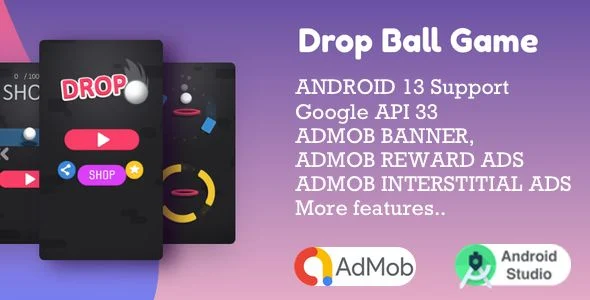
Drop Ball Overview & Mobile Game Template Architecture
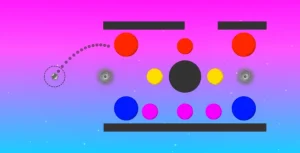
Drop Ball is a Kotlin-based Android Studio hyper-casual game template, engineered for indie developers and mobile studios to publish arcade-style drop-and-jump gameplay on Google Play with monetization wired in from the first build. The package addresses a concrete production bottleneck: assembling an Android game with AdMob banner, interstitial, and rewarded video placements normally requires integrating ad SDKs, lifecycle handlers, and store-ready signing pipelines from scratch. This codebase collapses that workload into a reskinnable template, distributed with layered PSD and PNG assets plus a dedicated RESKIN utility, so a studio can swap characters, sounds, and iconography and export a signed APK ready for store submission.
Technical Specifications & Deployment Matrix
| Engineering Metric | Deployment Specification |
|---|---|
| Base Technology / Framework | Kotlin 1.x on Android Studio, built on a cocos2dx/Buildbox engine layer |
| Runtime / Language Requirements | Android 9.0 through Android 13 (Android 12.0 and 11.0 verified) |
| Monetization Protocol | AdMob banner, interstitial, and rewarded video ad units; Facebook Ads support noted for extended configurations |
| Front-End / Engine Dependencies | Layered PSD and layered PNG source graphics, JS/CSS asset pipeline, HTML packaging |
| Deliverable Footprint | .apk, .dex, .so, .dat, .db, .java, .xml, PSD, PNG, JS, CSS, PHP and HTML files included in the distribution |
Monetization Pipeline & Reskin Execution Flow
The execution path runs from import to store export in a fixed, repeatable sequence. A developer imports the project into the latest Android Studio release, updates the application name, launcher icon, and package identifier, then replaces the default AdMob unit IDs with their own banner, interstitial, and rewarded video identifiers directly inside the IDE. Google Play Games service IDs, cross-promotion “More Games” links, and rate prompts are configured through the same declarative XML layer. The bundled RESKIN software then applies the visual overhaul — characters, backgrounds, and UI graphics — against the included layered PSD and PNG sources, after which a signed APK is exported for upload. The engine layer, built on cocos2dx/Buildbox, drives frame rendering with smooth transitions and battery-conscious draw cycles, and the template ships with multiple selectable characters tied to the rewarded-video loop, giving players an unlock incentive that feeds ad impressions.
Architectural & Functional Highlights
- Triple Ad-Unit Integration: Banner, interstitial, and rewarded video AdMob placements are pre-wired, so monetization logic — impression timing, reward granting, and unit ID routing — requires configuration rather than SDK implementation.
- Character Unlock Economy: Multiple characters are gated behind reward video views, coupling progression state to ad engagement without custom persistence code.
- RESKIN Utility & Layered Assets: The included reskin tool operates against layered PSD and PNG masters, enabling complete graphic replacement while keeping the underlying game logic intact.
- Store-Ready Build Chain: The template’s Gradle project structure supports direct signed APK export from Android Studio, mapped to Google Play and secondary store requirements.
- Broad Android Reach: Runtime compatibility spans Android 9.0 through Android 13, covering the majority of the active device base at publication time.
Production Implementation & Operational Resilience
In a production deployment, the operational boundary is deliberately constrained: the template’s source code is intended to remain unmodified, with customization limited to graphics, sounds, ad identifiers, package naming, and service configuration. This boundary keeps the engine’s rendering loop, ad mediation calls, and character-state handling in their tested form, which reduces regression risk when pushing successive reskins to market. Studios shipping publicly must differentiate each release — renaming the app, replacing the logo, audio, and imagery — so that distinct builds derived from the same template do not register as duplicate or spam submissions under Google Play policy. The un-watermarked PNG assets give a reskin team full creative latitude, and the same discipline applies to ad configuration: swapping in your own AdMob publisher IDs is a prerequisite before any store upload, since shipping with template identifiers routes impressions to the wrong account. For teams validating the finished APK ahead of submission, side-loading the exported build onto physical devices across the supported Android range confirms rendering and ad behavior on real hardware. The 2D engine layer is documented as battery-efficient, which matters for retention in hyper-casual segments where session frequency drives ad revenue. For studios exploring separate standalone alternatives on the iOS side, TikTok, IG, Shorts Saver provides a comparable native source-code starting point in the Swift ecosystem, useful when a portfolio strategy calls for parallel App Store builds outside this Android pipeline.
Frequently Asked Questions
Does the package include editable graphic source files for reskinning?
Yes. The distribution contains layered PSD and layered PNG files alongside the runtime assets, and a dedicated RESKIN software utility is bundled so graphics can be replaced to match an original design direction.
Can rewarded video ads be monetized with my own AdMob account?
Yes. Banner, interstitial, and rewarded video unit IDs are replaced inside Android Studio before export, routing all ad impressions to the developer’s own AdMob publisher configuration.
Is the game engine source code itself modifiable?
No. The intended customization surface covers images, sounds, identifiers, and package configuration; core engine logic is expected to remain intact to preserve the tested rendering and ad-dispatch behavior.
Are Facebook ad placements supported alongside AdMob?
Yes. Facebook Ads compatibility is documented as part of the template’s monetization surface, with full utilization tied to an extended-license configuration.