Dream Sports – Turf/ Ground/ Venues and Coaches Finder Booking Html Bootstrap Template
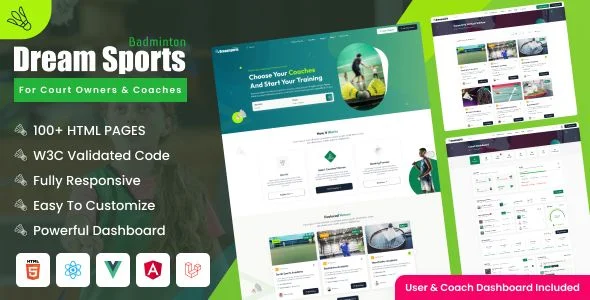
Dream Sports Overview & Static Booking Front-End Architecture
Dream Sports is a Bootstrap 5 HTML template engineered for sports academies, turf operators, and web agencies to publish court, ground, and coach booking interfaces without authoring layout markup from scratch. The package targets a persistent front-end bottleneck: reservation platforms for badminton courts, football turfs, and coaching centers demand dense scheduling interfaces, coach profile pages, and venue listing grids that generic templates rarely model. In production workflows, it operates as the presentation layer that a developer wires to a booking backend of their choosing, shortening delivery timelines for sports facility clients.
Technical Specifications & Deployment Matrix
| Engineering Metric | Deployment Specification |
|---|---|
| Base Technology / Framework | Bootstrap 5.x, HTML5, CSS3, SCSS preprocessor sources |
| Runtime / Language Requirements | Static hosting only — any Apache or Nginx web root, object storage bucket, or CDN; no PHP, Node.js, or interpreter required |
| Data Exchange / Communication Protocols | None bundled at runtime; the markup is front-end only and connects to booking APIs through developer-implemented HTTP requests |
| Front-End / Engine Dependencies | Modular JavaScript files, compiled CSS output derived from SCSS sources, reusable UI component markup |
| Database / Persistence Footprint | Zero — no database, ORM, or storage layer ships with the package; reservation state must be supplied by an external service |
Venue & Coach Booking Execution Pipeline
The package renders sports booking interfaces as prebuilt static documents assembled on Bootstrap 5 layout primitives. Each page — venue listings, coach profiles, and court detail layouts — is authored in semantic HTML5, so search crawlers can parse heading hierarchy, landmark regions, and listing content without executing application logic. Styling is compiled from an SCSS source tree in which spacing, color, and typography values are exposed as variables; a rebrand reduces to editing that token layer and recompiling, rather than patching flat stylesheet output. The JavaScript files ship as modular, reusable UI components that attach behavior to markup, keeping the front end decoupled from any server framework. Because the markup follows framework-agnostic conventions, it can be ported into Angular 14 component trees or ReactJS JSX structures, matching the compatibility profile documented for this package. For teams that prefer a WordPress runtime over static hosting, Aktive exists as an independent theme-level path for sports and fitness storefronts.
Core Technical Capabilities of Dream Sports
- W3C-validated semantic structure: Every document passes W3C markup validation, giving crawlers a parseable heading hierarchy and landmark regions that support indexing of venue and coach listing content.
- SCSS token architecture: Color, spacing, and typography values are centralized as variables, so a rebrand requires editing the token file and recompiling instead of hunting through compiled CSS for scattered declarations.
- Bootstrap 5 responsive grid: Layouts scale from single-column mobile views to 4+ column desktop arrangements, adapting to phone, tablet, and desktop viewports without authoring custom breakpoint rules.
- Reusable UI components: Behavior is attached through modular JavaScript files mapped to markup components, allowing booking widgets and listing cards to move between pages without refactoring dependent code.
- Cross-browser rendering parity: Output is verified across Chrome, Firefox, Safari, Edge, and Opera, letting deployment targets standardize on any mainstream browser without vendor-specific stylesheet branches.
Production Implementation & Operational Resilience
Deployment requires only a static file host — an Apache or Nginx web root, an object storage bucket, or a CDN edge — because the codebase carries no PHP runtime, Node process, or database dependency. The deliverable consists of HTML documents, compiled CSS, JavaScript bundles, and image placeholders, keeping the asset footprint small enough for aggressive edge caching and fast first paint across agency staging and client production environments.
Since no reservation engine ships with the package, transactional responsibilities — slot availability checks, payment capture, and booking persistence — must be delegated to a backend service the developer selects. When that service is consumed from the browser, its API origin must return permissive CORS response headers; otherwise cross-origin requests issued by the static pages will be rejected before reaching application logic. Client-side form checks deliver immediate feedback, yet server-side validation remains mandatory because static markup can always be bypassed by direct API calls.
Secondary development is bounded by design: overrides should target the SCSS variable layer and component markup rather than compiled CSS, which would be discarded on the next recompile. Placeholder images must be replaced with licensed assets before launch. For operators extending reservation-heavy properties beyond sports — campgrounds or RV parks — WildNest runs as a standalone WordPress booking theme on a parallel track, not a mergeable codebase.
Frequently Asked Questions
Are the demo images shipped inside the downloadable package?
No. Images displayed in the demo exist for preview purposes only; the downloadable package ships image placeholders instead, and production deployments must source and license their own photography and graphics before go-live.
Does the download include SCSS source files alongside the compiled CSS?
Yes. The deliverable contains HTML files, CSS files, JavaScript files, and SCSS sources, so the styling layer can be modified at the variable level and recompiled, eliminating manual overrides against compiled stylesheet output.
Is setup and customization documentation included with the template files?
Yes. Documentation ships in HTML format and covers setup and customization procedures, giving developers a reference for directory structure, asset replacement, and style recompilation without reverse-engineering the codebase independently.