Dilicious – Pizza Fast Food WordPress Theme
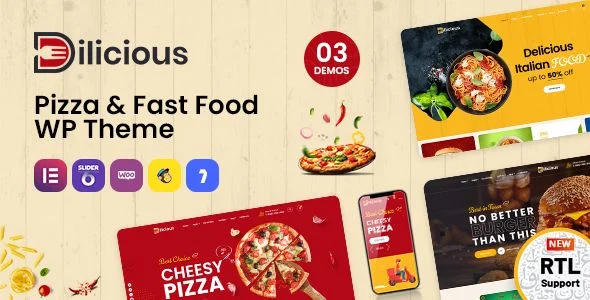
Dilicious Pizza Fast Food WordPress Theme Overview & Restaurant Storefront Architecture
Dilicious – Pizza Fast Food WordPress Theme is an Elementor-driven restaurant template system built for pizzeria operators and food-sector agencies that need menu presentation, WooCommerce ordering flows, and crawl-friendly markup in one self-hosted package. It targets the recurring bottleneck of assembling a quick-service food storefront — menus, specials, promotions, and multilingual delivery pages — without hand-coding template files from scratch. Within agency delivery pipelines, the codebase functions as a pre-structured foundation that installs through a demo-content setup wizard and then adapts per client through Live Customizer options, child-theme overrides, and a widget-ready sidebar layer.
Technical Specifications & Deployment Matrix
| Engineering Metric | Deployment Specification |
|---|---|
| Base Technology / Framework | WordPress 6.8.x – 7.0.x on Bootstrap 5.x grid and component layer |
| Runtime / Language Requirements | PHP 7.4 through PHP 8.4.x (v1.2 release notes extended PHP 8.2 handling) |
| Commerce & Data Exchange Layer | WooCommerce 8.x / 9.x cart, checkout, and product taxonomy integration |
| Front-End / Engine Dependencies | Elementor page builder, Slider Revolution v6.7.58, Swiper testimonial carousel |
| Localization & Persistence Footprint | WPML with ACF meta-field translation, POT language file, RTL theme options, child theme package |
Template Hierarchy, Elementor Rendering & Content Execution Pipeline
The engine routes every inbound request through the standard WordPress template hierarchy, then delegates body composition to Elementor widgets rather than static PHP partials. Restaurant content types — menu items, portfolios, testimonials — are registered as custom post types with dedicated Elementor elements, and v1.7 introduced Ajax-based sortable category options across all of these CPT elements, meaning category reordering persists server-side without a full page reload. Header presentation is governed by two selectable header templates plus per-page slider meta options, with v1.8 adding a Show Sticky Header in Mobile toggle so fixed navigation on small viewports becomes a per-site configuration flag instead of a CSS patch. Design tokens are centralized: custom typography and an unlimited color scheme are driven from a backend color picker, so font families, weights, and palette values propagate through the stylesheet without touching source code. This architecture keeps the DOM tree predictable across menu, category, and product views, which constrains layout shift during rendering — a direct factor in CLS scoring under Core Vitals measurement. For studios weighing parallel WordPress-theme routes in the same food vertical, Grill and Chow occupies a comparable quick-service niche with its own menu and checkout template set, serving as an alternative reference implementation rather than an add-on to this codebase.
Architectural & Functional Highlights
- Elementor-native composition layer: Layout assembly happens inside the Elementor editing surface, and v1.9 added WPML automatic translation support for Elementor elements, so translated widget content is generated without duplicating templates per locale.
- WooCommerce commerce binding: Cart quantity and price recalculation — corrected in v1.7 — flows through Ajax updates, while v2.1 resolved design regressions on WooCommerce-related pages, keeping shop, cart, and checkout views consistent with the parent design system.
- Child-theme extension boundary: A bundled child theme isolates function and style overrides from parent updates, allowing agencies to ship client-specific modifications that survive version bumps up to the current v2.3.
- RTL and multilingual state handling: v2.0 updated sortable logic and theme options for RTL support, and v1.8 fixed portfolio detail title rendering in Arabic, confirming bidirectional layout integrity for right-to-left locales.
- SEO-structured output: Markup is generated with crawl and indexing practices in mind, and customizable meta tags and descriptions let each page target the commercial keywords a restaurant actually competes on.
Production Implementation & Operational Resilience
Deployment begins with the dilicious-theme-setup-wizard (updated to v2.0 in the December 2025 release), which imports demo content and configures post types, widgets, and slider instances in a guided sequence. The package ships as PHP, CSS, and JS files with high-resolution assets, so a standard WordPress hosting stack running PHP 7.4+ is sufficient; no exotic server modules are documented as prerequisites. Two operational boundaries deserve attention before go-live. First, demo imagery is licensed separately and excluded from the download package — imported demo data substitutes free images or placeholders, so production staging must source original food photography. Second, GDPR readiness is declared at the theme level, meaning data-handling compliance still depends on the plugins and analytics stack an operator layers on top. Resilience is evidenced by the release cadence: the Slider Revolution dependency has been patched repeatedly up to v6.7.58, a removed third-party share-button plugin was stripped after its discontinuation, SVG support was added in v1.5, and the mobile browser dash-bar color was bound to the global theme color for consistent chrome rendering. Bug fixes — cart quantity refresh, empty search-term result pages, testimonial Swiper behavior — were each addressed within tracked point releases rather than left as open regressions. For decoupled implementations outside WordPress theming altogether, Pizzamio exists as an independent Elementor Template Kit path for pizza storefronts that follows a kit-based workflow instead of a full theme install.
Frequently Asked Questions
Are the images shown in the live demo included in the downloaded package?
No. Demo photography is replaced with free images or placeholders inside the demo-content import data, so any imagery visible on the preview site must be licensed and supplied separately before a production launch.
Is the theme optimized for the Gutenberg block editor?
No. The compatibility matrix explicitly lists Gutenberg Optimized as not supported; layout construction is handled through the Elementor page builder engine, including the CPT elements and header templates described in the architecture above.
Does the codebase function correctly with right-to-left languages such as Arabic?
Yes. Version 2.0 updated sortable logic and theme options for RTL support, version 1.8 fixed portfolio detail title rendering in Arabic, and an updated POT file plus WPML support — including ACF meta-field translation configured in v2.2 — covers multilingual delivery.
-
2.1 LatestOctober 3, 2026