Digimax – Digital Marketing Agency Elementor Pro Template Kit
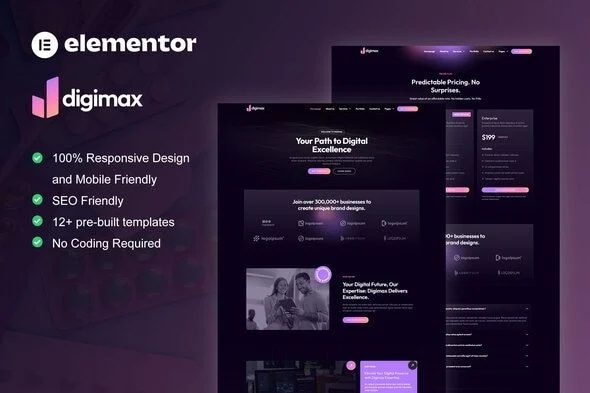
Digimax Digital Marketing Agency Template Kit Overview & Modular Elementor Layout System
Digimax Digital Marketing Agency Template Kit is an Envato Elementor Pro template kit built for digital agencies, freelance designers, and marketing studios that need to deploy client websites without hand-coding layouts. The package resolves the bottleneck of assembling agency landing pages, service archives, and portfolio views from a blank canvas by supplying pre-structured layouts that import directly into the Elementor editor. Within a production workflow, it operates as a reusable layout foundation, allowing teams to clone, restyle, and publish sites across marketing, SEO, web development, and graphic design niches through drag-and-drop editing instead of template-file development.
Technical Specifications & Deployment Matrix
| Engineering Metric | Deployment Specification |
|---|---|
| Base Technology / Framework | Envato Elementor Template Kit built with Elementor Pro |
| Runtime / Language Requirements | WordPress with the free Elementor plugin plus premium Elementor Pro (not bundled); adequate wp_memory_limit recommended for zip ingestion |
| Data Exchange / Communication Protocols | JSON layout structures parsed by the Template Kit Import plugin from an unzipped-archive upload |
| Front-End / Engine Dependencies | Hello Elementor theme (optimal), ElementsKit Lite, Skyboot Icons |
| Database / Persistence Footprint | Templates persisted under Elementor Templates > Saved Templates; no separate persistence layer outside the WordPress content store |
Elementor Layout Architecture & Import Execution Pipeline
The kit operates as a collection of JSON layout definitions that the Template Kit Import plugin parses into Elementor page structures. During ingestion, the compressed archive is uploaded intact through the Dashboard > Tools > Template Kit screen, and the importer surfaces any missing runtime dependencies through an orange banner that triggers the Install Requirements action. Importing the Global Kit Styles record first propagates shared design tokens — typography scales and the color palette — across every subsequent template, so restyling one record cascades through all eighteen layouts instead of requiring per-page edits. Individual templates then persist under Templates > Saved Templates, where editors attach them to freshly created pages via the My Templates tab after configuring the page to Elementor Full Width and suppressing the native title. Header and footer regions are governed through the Elementor Pro Theme Builder, which overrides the host theme’s rendering for those regions, while the homepage binding is handled by selecting a static front page under Settings > Reading. For agencies also delivering education-sector projects, the same import pipeline applies to Xtudee, a separate course-focused kit occupying the identical Elementor runtime.
Architectural & Functional Highlights
- Global design token cascade: The Global Kit Styles record centralizes typography and color definitions, so a single token update restyles all imported pages without per-template rewrites.
- Eighteen-page layout inventory: The archive spans four homepage variants, About Us, Contact Us, blog archive, Single Post, Error 404, FAQ, Our Team, Portfolio Detail, Pricing Plan, Services, and Single Service templates.
- Header and footer overrides: Elementor Pro’s Theme Builder governs global chrome regions, decoupling navigation and footer rendering from the host theme’s native template output.
- Bundled widget extensions: ElementsKit Lite and Skyboot Icons install alongside the kit, extending the editor’s widget inventory and icon library for the prebuilt sections.
- Responsive layout coverage: Every template ships 100% responsive and mobile-friendly, with structures that adapt to handheld viewports without additional breakpoint authoring.
Production Implementation & Operational Resilience
In agency staging environments, the deployment sequence matters: activate the host theme and Elementor plugins first, then run the importer, install the flagged requirements from the orange banner, and only then import the Global Kit Styles ahead of individual templates. Skipping the global-styles-first order forces manual token realignment across every page. Memory allocation on the WordPress host should accommodate archive ingestion; insufficient wp_memory_limit headroom is the most common cause of stalled imports on shared hosting tiers. The architecture degrades predictably outside its optimal environment — although the package targets the free Hello Elementor theme, its layouts render on most themes supporting Elementor, since sections and tokens live in the builder layer rather than the theme layer. Asset replacement forms the primary customization boundary: the demo imagery originates from Envato Elements and must be acquired separately or substituted with owned media, while structural changes stay confined to drag-and-drop section editing rather than code modification. For teams that prefer a theme-driven stack instead of a kit-plus-builder composition, Seorun exists as a standalone onepage digital marketing theme occupying a parallel deployment path. Troubleshooting and editor-level guidance remain reachable through the Elementor > Get Help menu inside WordPress once the kit is live.
Frequently Asked Questions
Can the kit run on a theme other than Hello Elementor?
Yes. The package is optimized against the free Hello Elementor theme, yet the layouts remain importable on most themes that support Elementor rendering, since the design tokens and section structures live inside the builder rather than the theme layer.
Is Elementor Pro bundled inside the kit archive?
No. Elementor Pro is a premium plugin that the templates and Theme Builder features depend on, and it must be installed and activated on the target WordPress environment separately; the archive carries layout records and two helper plugins only.
Do the bundled demo images arrive cleared for production use?
No. Demo imagery is drawn from Envato Elements and must be acquired under that platform’s terms or substituted with owned assets before a client site goes live; the archive ships placeholder references rather than cleared production media.