
 My Account

DentiCare Pro: Technical Overview & Core Architecture
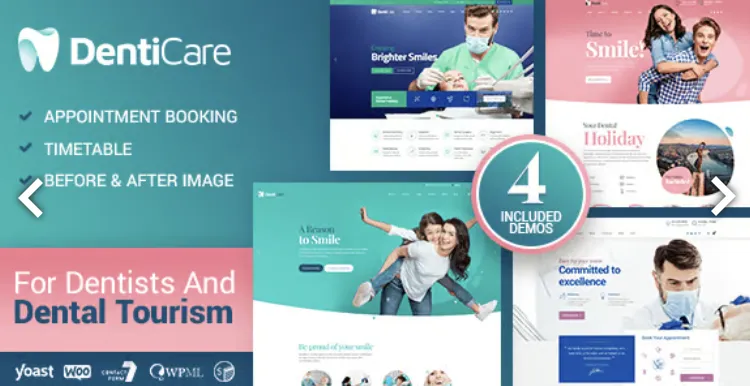
DentiCare Pro – Medical & Dentist WordPress Theme is an enterprise-grade dentist WordPress theme engineered for private dental practices, multi-location orthodontic clinics, and oral surgery centers requiring structured clinical scheduling and HIPAA-conscious data collection. The theme architecture eliminates structural DOM overhead by selectively compiling asset bundles, bypassing redundant CSS framework inclusions, and minimizing script execution during initial rendering. Front-end booking widgets query localized REST endpoints asynchronously to validate staff availability and commit appointment records without triggering document-level page reloads.
Page layouts assemble via strict hook-driven template inheritance integrated into the Elementor rendering pipeline, allowing rapid layout composition across header, body, and footer template tiers. The centralized administrative customizer exposes controls for global typography stacks, dynamic doctor timetable schemas, service duration buffer logic, and WooCommerce transaction endpoints without requiring manual edits to the parent stylesheet or functions file.
Key Functional Features of DentiCare Pro for Modern Deployments
- Asynchronous Clinical Appointment Engine: Front-end calendar controls bind directly to internal scheduling tables via AJAX, parsing doctor availability matrices, calendar dates, and service time intervals to populate appointment windows instantaneously.
- Modular Elementor Dental Widgets: Custom-built widgets in DentiCare Pro feed into Elementor’s visual editor, providing dedicated UI nodes for before-and-after clinical comparators, practitioner credential displays, and service rate tables without third-party library overhead.
- WooCommerce Healthcare Integration: The transaction pipeline standardizes payment gateway hooks for medical retail operations, processing orders for preventative dental packages and oral health products under standard merchant protocols.
- Responsive Mobile UI Normalization: Breakpoint triggers render mobile-specific navigation drawer states, touch-calibrated appointment tap targets, and responsive SVG asset scaling across compact screen widths.
Real-World Deployment Scenarios
- Multi-Provider Dental Clinic: Operating as a unified dentist WordPress theme deployment, the framework manages four discrete practitioner schedules, synchronizing room availability and routing incoming patient registration data to specific departmental email inboxes.
- Cosmetic Dentistry & Orthodontic Portfolio: The system deploys dual-axis image comparison sliders and categorized procedure catalogs, driving consultative lead generation across high-resolution desktop and tablet viewports.
- Hybrid Dental Care and Product Store: Integrating catalog display alongside transactional eCommerce modules, the deployment handles post-procedure oral hygiene inventory while simultaneously capturing routine cleaning appointments.
Technical Architecture & Compatibility Standards
Server environments running PHP 8.1 through PHP 8.3 maintain native compatibility with the template codebase, utilizing strict type declarations and standardized error-handling routines. The rendering pipeline optimizes Core Web Vitals, achieving First Contentful Paint (FCP) intervals under 1.2 seconds and preserving Cumulative Layout Shift (CLS) ratings below 0.05 on standard production server stacks through preemptive container dimensioning.
Third-party software interoperability is maintained across standard WordPress ecosystems, including Yoast SEO, Rank Math, WPML for multilingual localized terminology, and Redis object caching layers. Dynamic scripts enqueue strictly when designated component shortcodes or Elementor blocks exist on the target URL, preventing payload bloat across non-booking content pages.
Frequently Asked Questions About DentiCare Pro
Q: Does the appointment system require external calendar software subscriptions?
A: No, the built-in appointment module functions entirely within the local WordPress database, managing time slots, practitioner assignments, and form submissions natively without third-party SaaS dependencies.
Q: How does the codebase maintain fast page loads with visual page builders?
A: The template deploys conditional asset loading, executing Elementor widget assets and stylesheet fragments only when their corresponding elements are declared in the page structure.
Q: Can the template support multi-language patient forms and medical documentation?
A: Yes, the codebase provides full gettext compliance and tested compatibility with WPML and Polylang, allowing clinicians to translate form labels, schedules, and clinical descriptions into multiple locales.




NovaRider
Drafts and reviews keep prod safe.
SilentVerse
Granular rights kept us confident.