Cute Cat Jigsaw Puzzle [ Construct 3 , HTML5]
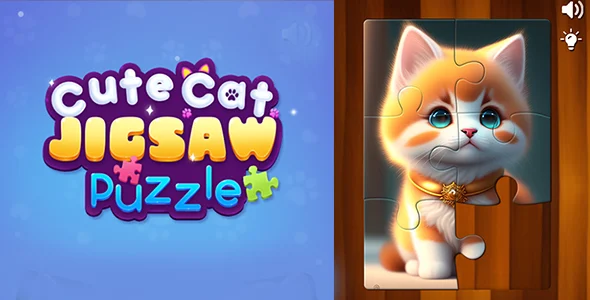
Cute Cat Jigsaw Puzzle Overview & Canvas Game Source Architecture
Cute Cat Jigsaw Puzzle is a Construct 3 HTML5 puzzle game source package, engineered for casual-game studios and web publishers to deploy a 15-level feline-themed jigsaw experience across desktop browsers and native mobile shells. The package removes the recurring engineering burden of hand-writing piece-slicing logic, touch gesture handling, and difficulty progression by shipping a pre-built event system in which players tap and drag fragments until each illustration resolves. Within studio and agency delivery workflows, it functions as a drop-in HTML5 export that is ready to upload, while the full .c3p project remains available for continued iteration and re-export.
Technical Specifications & Deployment Matrix
| Engineering Metric | Deployment Specification |
|---|---|
| Base Technology / Framework | Construct 3, delivered as editable .c3p project files |
| Runtime / Language Requirements | HTML5 / JavaScript canvas runtime executing in modern desktop and mobile browsers |
| Data Exchange / Communication Protocols | Self-contained HTML export; no server-side API, backend service, or external data feed is required |
| Front-End / Engine Dependencies | Canvas rendering layer driven by a single-touch, tap-and-drag input model |
| Database / Persistence Footprint | None documented; gameplay state lives only within the active browser session |
Piece-Binding Execution Pipeline & Level Progression Architecture
The core mechanic is a canvas-driven piece-binding pipeline: tap-and-drag gestures reposition jigsaw fragments until each locks into its correct place within the target illustration. Construct 3 dispatches pointer input through its runtime abstraction layer, which normalizes mouse, touch, and stylus signals into one gesture channel — the property that makes single-touch play viable across Android and iOS WebView containers. Because normalization occurs at the engine layer rather than per platform, a single event sheet governs every target device and no per-OS input code has to be authored.
Level progression follows a 15-stage difficulty curve. Early stages present simpler fragment geometry so placement validates quickly and beginners can complete rounds without friction; later stages increase fragmentation, demanding finer positional accuracy, longer solution paths, and sharper spatial reasoning. Each stage carries one unique cat illustration, which keeps the content layer asset-driven: artwork is bound to sprites rather than to the interaction logic, so visual iteration never requires touching the input pipeline. The runtime loads image assets before interactive frames begin, following standard Construct 3 export behavior, which prevents mid-drag texture stalls while pieces are in motion. For studios assembling a Construct 3 puzzle catalog, this package can be deployed alongside Rainbow Word Search, an HTML5 word-puzzle source built on the same engine runtime for parallel publishing tracks.
Architectural & Functional Highlights
- Single-touch input model: One tap-and-drag gesture moves one piece at a time, with desktop mouse input routed through the same normalized pointer channel, so no keyboard, controller, or multi-touch handler is needed.
- 15-level difficulty curve: Fragmentation escalates stage by stage, translating directly into longer solve times and higher placement precision without any configuration switches.
- Asset-driven content layer: Every level binds one distinct cat illustration to the sprite layer, allowing artwork iteration decoupled from the gesture and placement logic.
- Dual deliverable format: The package ships both an upload-ready HTML5 export for immediate web publication and the editable .c3p project for continued in-editor development and mobile re-export.
Production Implementation & Operational Resilience
Deployment is deliberately minimal: the HTML5 build can be placed on any static host and served as-is, since the export contains its own runtime and bundled assets with no backend calls, no database writes, and therefore no cross-origin request surface to configure. This local asset bundling also removes CORS preflight concerns that frequently complicate remotely hosted media in WebView environments. For mobile distribution, the documented easy-export path targets Android and iOS, where the single-touch model maps directly onto native touch screens inside WebView-based store builds. WordPress operators who prefer embedding a plugin-managed arcade title instead of hosting a standalone HTML5 build can treat Fortune Alligator Slots as an independent, plugin-side delivery path on that platform.
Because the deliverable includes the editable .c3p project, secondary development is bounded by the Construct 3 editor itself: sprite replacement, level adjustments, and re-export are the sanctioned modification routes, while the shipped HTML output serves as the reference build for regression comparison. Studios standardized on the earlier Construct 2 runtime rather than Construct 3 will find Alien Bridge positioned as a separate, physics-based bridge-game template on that older engine. Before production release, verify the target host serves the HTML export over HTTPS and test drag responsiveness on low-end Android WebView versions, since canvas throughput varies with device GPU class.
Frequently Asked Questions
Does the download include both the editable project source and a browser-ready export?
Yes. The deliverable set contains the Construct 3 .c3p project files together with an HTML5 export build that can be uploaded directly to any static web host, allowing both immediate publication and continued in-editor development of the same codebase.
Can this source be packaged as a native Android or iOS application?
Yes. The engine supports export to Android and iOS, and the single-touch input model maps directly to native touch screens, so the game runs inside WebView-based store builds without requiring additional per-platform input code.
Is multi-touch or external controller input required to complete puzzles?
No. The interaction model is single-touch only: one tap-and-drag gesture moves one piece at a time. Desktop mouse input routes through the same normalized pointer channel, so neither a keyboard, a controller, nor multi-touch handling is needed.
Can the included cat illustrations be replaced with custom artwork?
Yes. All level artwork resides inside the editable .c3p project as sprite-level assets, so studios can substitute custom illustrations and re-export the build without modifying the underlying gesture, placement, or progression logic.