Creativio – Blogger & Entrepreneurs Elementor Template Kit
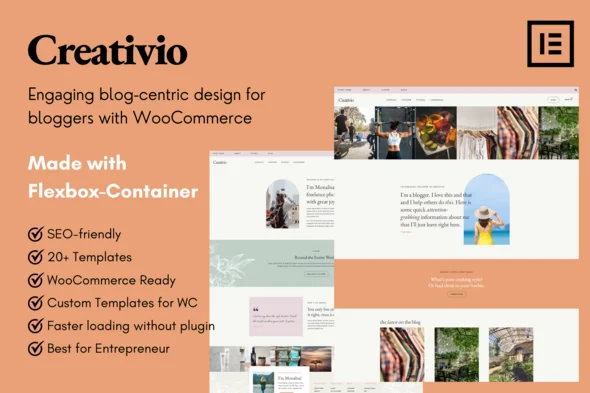
Creativio Blogger & Entrepreneurs Elementor Template Kit Overview & Flexbox-Driven Design System
Creativio Blogger & Entrepreneurs Elementor Template Kit is an Envato-format Elementor design package engineered for bloggers, authors, creatives, and online entrepreneurs to publish content and sell products without hand-coding layouts. The package removes the bottleneck of assembling page structures from a blank canvas by shipping prebuilt JSON layout data — Home, About, Start Here, Guides, Contact, Coming Soon, Blog, and a complete WooCommerce set — that imports through the Envato Elements plugin or directly inside Elementor. Within agency delivery and solo-creator production workflows, it functions as a drop-in visual foundation running on Elementor 3.10.x with Elementor Pro connected, so Theme Builder parts such as headers, footers, single posts, and storefront views deploy as editable container trees rather than static mockups.
Technical Specifications & Deployment Matrix
| Engineering Metric | Deployment Specification |
|---|---|
| Base Technology / Framework | Envato Template Kit — Elementor design data only, not a WordPress theme |
| Runtime Requirements | Elementor 3.10.x; Elementor Pro installed and connected; Hello Elementor theme active |
| Data Exchange Protocol | Zipped JSON template payloads imported via the Envato Elements plugin or Elementor’s template manager |
| Front-End Dependencies | Elementor Flexbox containers; WooCommerce for shop, product, cart, and checkout templates |
| Persistence Footprint | None native — imports persist as records in Elementor’s Saved Templates library; site content authored separately |
Flexbox Container Architecture & Template Execution Pipeline
The kit’s core mechanism is a central design token layer: Global Kit Styles define typography and color values once, and every imported template inherits those settings. Import order matters operationally. The Global Kit Styles file must be imported first because it establishes the site-wide settings that subsequent templates consume; skipping this step leaves later pages referencing unresolved font and color tokens. Each remaining template — Home, About, Start Here, Guides, Contact, Coming Soon, Blog, Shop, and the full Theme Builder set — then imports individually and lands in the Elementor Saved Templates library, where every record becomes a reusable payload rather than a one-off page.
From there, page assembly follows Elementor’s standard flow: a new page is created, configured as Elementor Full Width with the page title hidden, and the target template is inserted from the My Templates tab before content edits begin. For image-dominant presentation work where photography grids drive the layout, Nexframe runs through the same import pipeline as an alternative kit inside the identical runtime. WooCommerce coverage is where this package reaches beyond typical blog kits. Instead of relying on plugin-default markup, dedicated Theme Builder templates override the native product detail, product archive, and category archive views, while separate My Account, Cart, and Checkout templates replace the standard storefront flow with structures a merchant can adjust container by container inside the editor.
Core Technical Capabilities of Creativio
- Flexbox container layout system: Pages are composed with Elementor’s Flexbox containers rather than legacy section/column widgets, reducing DOM nesting depth and supporting faster render paths for content-heavy blog and shop views.
- Global Kit Styles token management: Fonts and colors are centralized in one panel; a single token change propagates across every imported template without per-page edits.
- Complete WooCommerce Theme Builder coverage: Product detail, product archive, category archive, My Account, Cart, and Checkout templates ship prebuilt, replacing plugin-default storefront markup with editable container structures.
- Full site chrome set: Header, footer, a popup slider serving as the mobile menu, a 404 error page, single post, and post category templates complete the Theme Builder parts required for consistent rendering across every traffic path.
Production Implementation & Operational Resilience
Deployment follows a defined pre-flight sequence. Permalinks must be set to Post Name, the Hello Elementor theme must be active, and both Elementor and the Envato Elements plugin must sit at current versions before any import begins. Because the package requires Elementor Pro, that installation must be present and connected to its account prior to uploading the kit zip; the file itself stays zipped, and Safari users need the ‘Open safe files after downloading’ preference disabled to prevent automatic extraction. An orange banner inside the Installed Kits screen flags missing plugin dependencies, and selecting Install Requirements resolves them before the first template loads.
Two environmental boundaries deserve attention. First, importing multiple full-page JSON payloads in one session is memory-intensive; hosts should carry a comfortable wp_memory_limit allocation so large Flexbox container trees deserialize without fatal errors mid-import. Second, the kit ships design data only — demo images originate from Envato Elements and must be authorized there or replaced with owned assets, and no blog posts or product records are bundled. WordPress needs at least six authored posts for layouts to populate correctly, and WooCommerce must be configured with real products before shop, archive, and checkout templates render any content. Content editors should treat each template as a layout shell whose nodes accept direct substitution, while structural restyling routes through the Global Kit Styles panel rather than scattered per-widget overrides. For agencies running parallel client builds on the same runtime, Runda imports through the identical Envato Elements pathway, allowing teams to standardize one delivery checklist across multiple niches.
Frequently Asked Questions
Does Creativio function as a standalone WordPress theme?
No. The package contains Elementor design data only — it requires the Hello Elementor theme, Elementor 3.10.x with Elementor Pro connected, and the Envato Elements plugin to import and render its templates.
Are demo images, blog posts, and WooCommerce products included in the kit?
No. Demo images originate from Envato Elements and require separate authorization or replacement, no post or product content ships with the kit, and at least six WordPress posts plus configured WooCommerce products are recommended before layouts display correctly.
Can the shop, cart, and checkout pages be restyled without touching code?
Yes. Dedicated templates for product detail, product archive, My Account, Cart, and Checkout import into Elementor’s Theme Builder, so every container, typography rule, and color token is editable directly inside the visual editor.