Cotto – Bike Store Shopify Theme
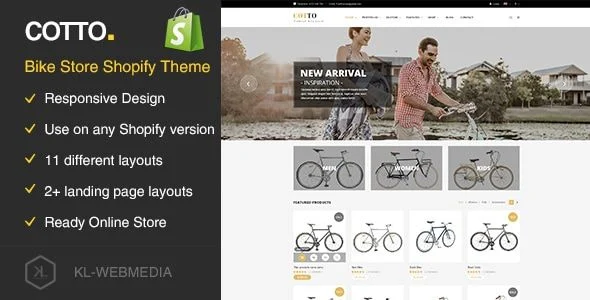
Cotto Bike Store Shopify Theme Overview & Liquid Storefront Architecture
Cotto Bike Store Shopify Theme is a Shopify Online Store 2.0 storefront package engineered for bicycle, motorcycle, and sporting-goods retailers to launch a production storefront without commissioning custom front-end development. The package addresses the recurring bottleneck of hand-coding layered product filtering, cart-drawer state handling, and mega-menu navigation for cycle and vehicle catalogs by shipping these mechanisms as pre-built Liquid sections and jQuery-enhanced components. Within agency delivery workflows, it operates as a drop-in visual foundation that a developer installs in minutes, configures through native theme settings, and refines via Sass variables, background patterns, and color choosers before client handover.
Technical Specifications & Deployment Matrix
| Engineering Metric | Deployment Specification |
|---|---|
| Base Technology / Framework | Shopify Online Store 2.0 platform, Bootstrap 3.x front-end framework |
| Runtime / Language Requirements | PHP files, HTML files, CSS files, and JS files compiled through the Shopify theme stack |
| Data Exchange / Communication Protocols | Ajax cart requests, wishlist synchronization, and multi-currency price updates |
| Front-End / Engine Dependencies | jQuery enhancements, Sass CSS, Google Fonts, FontAwesome icons, HTML5/CSS3 |
| Browser Compatibility Footprint | IE10, IE11, Firefox, Safari, Opera, Chrome, Edge; responsive high-resolution layout |
Liquid Section Rendering & Commerce Execution Pipeline
Cotto renders storefront pages through Shopify’s Liquid template engine, composing 11 page layouts and 3 homepage variations from reusable section blocks. When a shopper requests a collection URL, Liquid parses the JSON template definition, resolves the assigned section blocks, and hydrates them with product data from the store catalog. jQuery-driven components then extend the rendered DOM: the Ajax add-to-cart routine dispatches asynchronous line-item payloads that update the header drop-down cart without a full page reload, while the wishlist module records product selections in parallel with cart state.
Merchandising logic is handled at the template layer. Automatic price change recalculates displayed totals when variants or currencies switch, and the multi-currency module re-frames the price filter bounds so shoppers in different regions see coherent ranges. “New”, “Hot”, and “Sale” labels attach to product cards through conditional Liquid tags driven by inventory metadata. Collection pages expose three rendering modes — grid, list, and masonry — with a sidebar filter that posts layered attribute queries back to the collection endpoint.
Core Technical Capabilities of Cotto Bike Store Shopify Theme
- Ajax Cart & Wishlist Synchronization: Asynchronous cart mutations update the header drop-down drawer and wishlist state without page refreshes, preserving scroll position and reducing perceived checkout latency on mobile sessions.
- Advanced Layered Navigation & Currency-Aware Price Filtering: The collection sidebar filter dispatches attribute-based queries while the price filter recalculates its range against the active currency, keeping filter bounds consistent with displayed prices.
- Built-in Mega Menu & Dual Navigation Models: Drop-down and sidebar navigation structures render through configurable menu assignments, supporting deep category trees for bicycle components and motorcycle accessories.
- Three Shop Rendering Modes & Product Media Handling: Grid, list, and masonry collection layouts ship alongside a built-in product zoom, related product blocks, and a testimonial slider assembled from the same section system.
For merchants in adjacent verticals evaluating parallel Shopify storefront options, Asport – Sports Wear & Accessories Responsive Shopify Theme targets apparel and accessories catalogs with a comparable responsive section architecture.
Production Implementation & Operational Resilience
Deployment on the Shopify 2.0 runtime follows the documented five-minute installation path: upload the theme package, assign navigation menus, map collections to the pre-built layouts, and activate the homepage variant that matches the merchant’s merchandising strategy. The 4+ column grid system adapts across the documented browser matrix, including legacy IE10 and IE11 engines, which constrains which CSS features the compiled stylesheets can rely on — a relevant boundary when teams plan modern layout refactors. Because the package targets the Shopify platform exclusively, storefront logic cannot be ported into a WordPress or WooCommerce runtime; merchants running decoupled implementations outside Shopify require a separate platform-native theme. Extension work stays inside theme settings, shortcodes, header and footer style options, unlimited color configuration, and Sass source variables, which limits deep structural changes to developers comfortable editing Liquid templates and the Bootstrap 3.x markup they wrap. Demo preview images ship excluded from the download, so staging environments need licensed replacement photography before go-live.
Operators building tool-and-hardware retail verticals can similarly evaluate Aronic | Hardware Store, Handyman Shopify Theme as an independent storefront path on the same platform.
Frequently Asked Questions
Are the images shown in the live demo preview included in the downloadable package?
No. The documentation explicitly states that preview images are excluded from the download files. Credits for images, fonts, and external resources are listed in the included helpfile, so merchants must supply licensed replacement photography before launching a production storefront.
Does the theme build on Bootstrap 3.x rather than a newer framework version?
Yes. The compatibility listing specifies Bootstrap 3.x. Customizations that depend on Bootstrap 4 or 5 utility classes, grid tokens, or JavaScript components will not function without refactoring the markup and stylesheet layer to match the shipped framework.
Are customer account and checkout forms pre-built into the layouts?
Yes. Login, Register, and Checkout forms are included in the 11 page layouts, so the standard purchase flow — account creation, authentication, and order placement — is available immediately after theme installation without additional form development.