Construction – WordPress Theme
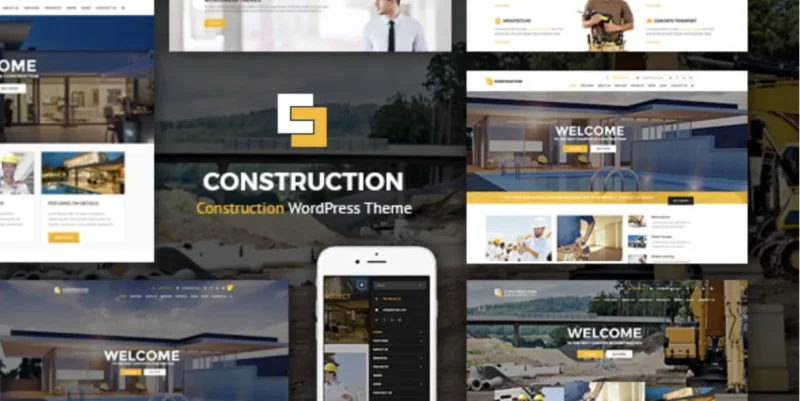
Construction WordPress Theme Overview & Front-End Delivery Architecture
Construction WordPress Theme is a WordPress theme package engineered for general contractors, civil engineering firms, and trade service providers to publish service overviews, project portfolios, and company credentials without hand-coding page templates. The package replaces developer-built static layouts with a WPBakery Page Builder composition layer, a Revolution Slider banner engine, and a one-click demo importer that provisions four complete reference sites in a single operation. Within agency delivery workflows, it functions as a deployable scaffold: teams import a demo, replace copy and imagery, adjust global settings through an options panel or the WordPress Customizer, and ship a production site for construction-sector clients.
Technical Specifications & Deployment Matrix
| Engineering Metric | Deployment Specification |
|---|---|
| Base Technology | WordPress theme package (PHP, CSS, and JS files) with basic Gutenberg editor support added in v1.2.9 |
| Runtime / Language Requirements | WordPress 4.9.x through 6.9.x; PHP 8.0 support introduced in v1.5.0; PHP 7.2+ support since v1.2.7 |
| Front-End / Engine Dependencies | Bundled WPBakery Page Builder and Revolution Slider; Font Awesome icon set; Contact Form 7 |
| Commerce Layer | WooCommerce template overrides compatible with versions 3.x through 9.x, including WooCommerce 10.1.0 support in v1.5.8 |
| Localization / Persistence Footprint | WPML and Loco Translate compatibility, RTL stylesheets, updated POT file; standard WordPress MySQL schema with no custom tables |
Page Composition Engine & Rendering Pipeline
Content rendering flows through the standard WordPress template hierarchy, with discrete template files (header.php, single.php, archive.php, index.php, footer.php) governing document structure while the anps-framework layer handles option storage, styling, and widget registration. WPBakery stores page compositions as shortcode-encoded post content, which the server parses and expands into front-end markup, meaning layouts travel with the database rather than as separate files. WooCommerce output is intercepted through a local template override directory, so cart, checkout, and account views inherit the theme layout without modifying the plugin core. Per-page option records sit on top of global settings, allowing individual pages to override header behavior, layout width, and sidebar assignments independently. The importer classes (AnpsImport, Dummy) read packaged demo archives, including per-demo slider bundles such as main-slider.zip, and restore widgets, menus, and content in one pass.
Architectural & Functional Highlights
- One-click demo provisioning: Four distinct demos import complete content, sliders, and widget assignments without secondary import steps, reducing initial setup to a single admin action followed by content replacement.
- Per-page option overrides: Page-level metadata controls settings individually, so a landing page can run fullwidth with a custom header while inner pages retain boxed layouts and sidebars.
- WooCommerce override layer: Native plugin templates are mirrored and restyled inside the theme, enabling commerce for products or service packages while remaining updatable through theme releases.
- RTL and multilingual stack: Dedicated RTL stylesheets (components-rtl.css, core-rtl.css) support right-to-left scripts, and WPML plus Loco Translate compatibility covers translated deployments.
- Unlimited sidebars and color control: The options panel generates sidebars and color schemes on demand, with four predefined schemes available as starting points and exportable settings for reuse across client builds.
For studios weighing parallel options in the same niche, Contio exists as an independent construction WordPress theme targeting building, architecture, and engineering firms, positioned as an alternative codebase rather than an extension of this one.
Production Implementation & Operational Resilience
Deployment follows conventional WordPress staging practice: install the package, activate the bundled plugins when prompted, run the importer, then verify PHP 8.0 compatibility on the target server. Theme updates are distributed through the Envato Market plugin; the in-panel updater was removed in v1.1.4, so update delivery depends on that plugin being installed and configured. One documented prerequisite is the Google Maps API key, which the theme surfaces through an admin notice with instructions for key generation, since embedded map sections depend on it. Maintenance history shows sustained corrective engineering: a theme options security fix in v1.5.8, optimized CSS and JavaScript output in v1.5.0, a JavaScript execution order fix preventing inconsistent rendering in v1.4.0, and repeated WooCommerce template synchronization across versions. Customization boundaries are well defined: child themes are supported for template overrides, the WordPress Customizer mirrors the options panel for teams preferring native administration, and custom CSS entered there links to the Additional CSS slot. Cross-browser validation extends from IE11 through current Chrome, Edge, Firefox, Safari, and Opera builds. For performance-sensitive industrial and plant-sector projects that sit outside this package’s scope, Brickox operates as a separate performance-tuned construction theme and cannot be merged into this codebase.
Frequently Asked Questions
Does the demo importer require any external API configuration before imported content renders fully?
Yes. The theme displays a Google Maps admin notice reminding administrators to insert a Google Maps API key, and documentation covers key generation; without it, embedded map sections on imported pages will not display correctly.
Can child themes be used for code-level customization without editing the parent package?
Yes. Child theme support is part of the architecture, with v1.1.6 explicitly fixing child theme issues, so template overrides persist through parent theme updates while custom CSS remains accessible via the Customizer.
Can the theme be deployed for right-to-left languages such as Arabic or Hebrew?
Yes. The package ships dedicated RTL stylesheets, an updated POT file for string extraction, and compatibility with WPML and Loco Translate, supporting multilingual right-to-left builds without custom stylesheet work.