Consilt – Business & Consulting Elementor Template Kit
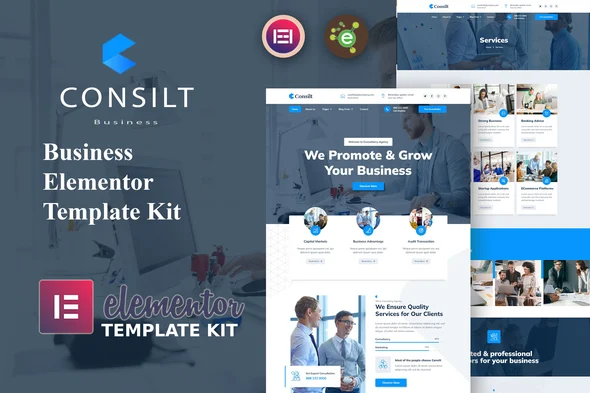
Consilt Business & Consulting Elementor Template Kit Overview & Content-Layer Architecture
Consilt Business & Consulting Elementor Template Kit is an Envato-format page-content package engineered for agencies and independent builders who need to deploy consulting, finance, insurance, accounting, and marketing websites without assembling Elementor layouts from scratch. The package removes the structural bottleneck of composing individual sections one by one by shipping 23 pre-arranged templates whose layout data imports as JSON node trees that materialize directly inside the Elementor editor. Within a delivery workflow, it operates as a drop-in content layer: global styles, headers, footers, and full page routes land in a WordPress install through the Envato Elements plugin and are then restyled to match each client’s brand system.
Technical Specifications & Deployment Matrix
| Engineering Metric | Deployment Specification |
|---|---|
| Base Technology / Framework | Envato Template Kit format for Elementor, compatible with Elementor 3.4.x through 3.10.x |
| Runtime Requirements | WordPress with Elementor Pro upgrade required for some templates and features; optimized for the free Hello Elementor theme |
| Required Plugin Stack | ElementsKit Lite, PowerPack Lite for Elementor, Essential Addons for Elementor |
| Data Exchange Protocol | Serialized JSON template payloads uploaded via the Envato Elements plugin or synced through a connected Elements account |
| Persistence Footprint | Imported templates stored under Elementor’s Templates > Saved Templates; no theme files or custom database structures written |
JSON Template Import & Design-Token Execution Pipeline
The kit’s core mechanism is JSON template import: every page and section arrives as a serialized layout payload that the Envato Elements plugin parses and converts into editable Elementor container trees. Deployment begins by installing and activating the Envato Elements plugin from the WordPress Plugins screen, then uploading the downloaded kit file without unzipping it. An orange banner inside the plugin flags missing dependencies, and a single click queues installation of the three required add-on plugins that power the kit’s advanced widgets.
Import order matters. The Global Kit Styles file must be loaded first because it seeds the token layer — global typography scales and color variables that propagate across every subsequently imported template. Once the tokens are registered, a single edit to a global font family or palette entry re-themes the entire site instead of forcing per-section edits. Each remaining template is then imported individually and parked under Saved Templates, from which pages are instantiated, set to Elementor Full Width, and stripped of their page titles through the builder’s page settings panel.
Core Technical Capabilities of Consilt
- Global Kit Styles token layer: Centralized design tokens govern typography and color across all 23 templates, with the Google Fonts framework expandable to roughly 600 families, giving brand restyling a single point of mutation.
- Elementor Pro Theme Builder binding: Header and footer templates map to the Theme Builder, allowing site-wide chrome replacement once the Pro upgrade is active on the install.
- Add-on widget dependency graph: Testimonial sliders, client carousels, stat counters, and newsletter blocks resolve to ElementsKit Lite, PowerPack Lite, and Essential Addons widgets, so all three plugins must remain active for the layouts to render intact.
- Full page-route coverage: The inventory spans Home, About Us, Services, Services Details, Team, Project, Blog, Blog Single, Contact, a plan comparison page, and an Error 404 route, supplemented by a section library covering hero, stats, projects, and contact blocks.
Production Implementation & Operational Resilience
Because this is a content package rather than a WordPress theme, the runtime surface stays small: layout data lives inside Elementor’s template store, and rendering is handled by the builder engine plus its add-on widgets. Before bulk imports on agency staging servers, confirm the wp_memory_limit is raised above WordPress defaults — multi-template JSON payloads and widget parsing consume more headroom than a bare page build, and exhausted memory aborts imports mid-parse. Importing one template at a time keeps each payload transaction isolated, so a failure flags a single file instead of the whole kit.
Asset replacement is the primary customization boundary. Demo photography originates from the Envato Elements library, so production deployments must secure separate usage rights for those files or swap in client-owned imagery before launch. Style overrides should stay at the token level first, falling back to section-level container edits only where a client brief demands deviation. No PHP layer is exposed, which keeps maintenance confined to the Elementor editor.
For consultancies whose positioning leans toward managed IT services rather than general corporate advisory, Risetech exists as an independent kit running through the same Envato Elements import pipeline. Agencies comparing corporate layout directions before committing to a single design system can likewise evaluate Bisco as a parallel consulting-vertical option without touching the Consilt install.
Frequently Asked Questions
Can the header and footer templates be customized without an Elementor Pro upgrade?
No. Site-wide header and footer customization routes through Elementor Pro’s Theme Builder, and a premium upgrade is required for some templates and features. That upgrade is sold separately and is not bundled inside the kit package itself.
Does the kit function as a standalone WordPress theme?
No. The package contains Elementor page content only. It is optimized for the free Hello Elementor theme and runs under most themes supporting Elementor, but it never replaces the active theme’s own template hierarchy or stylesheet.
Do the bundled demo images arrive cleared for production use?
No. Demo imagery is drawn from the Envato Elements library, so a live deployment must secure separate usage rights for those assets or replace them with client-owned photography before the site ships to production.