Colors separation – HTML5 Casual game
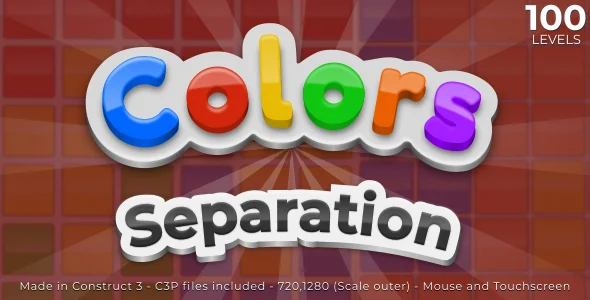
Colors Separation Overview & Casual Puzzle Engine
Colors Separation is a Construct 3 HTML5 casual game engineered for web publishers, advergame agencies, and indie developers who need a deployable color-sorting puzzle with fully editable project sources. The package resolves a recurring production bottleneck in casual game delivery: templates that ship only compiled runtime files force binary-level workarounds for every reskin or level adjustment. Because the complete Construct 3 (r308) project ships alongside the exported HTML5 output, this codebase slots directly into agency staging environments, marketing microsites, and browser-game portal submission workflows without reverse engineering.
Technical Specifications & Deployment Matrix
| Engineering Metric | Deployment Specification |
|---|---|
| Base Technology / Framework | Construct 3, release r308, exported to an HTML5 Canvas runtime |
| Runtime / Language Requirements | JavaScript (JS), HTML, and CSS executed natively in the browser; no server-side stack required |
| Engine Dependencies | None — built without third-party plugins or behaviors, keeping the event system native to the Construct 3 runtime |
| Target Resolution | Portrait orientation at 720 × 1280 with high-resolution assets |
| Input Systems | Dual mouse and touch controls covering desktop and mobile browser sessions |
| Browser Compatibility | IE9, IE10, IE11, Firefox, Safari, Opera, Chrome, and Edge |
| Included Deliverables | Documentation, Construct 3 source project files, and the compiled HTML5 game files |
Drag-and-Slot Sorting Mechanics & Execution Pipeline
The core loop dispatches pointer drag events that translate colored block sprites into their matching grid slots.
Each session runs against a five-channel palette — red, blue, green, yellow, and orange — where the Construct 3 event sheet listens for pointer-down, pointer-move, and pointer-up signals, maps the dragged block’s coordinates against slot hitboxes, and validates the placement by comparing color identifiers. A correct match locks the block into its slot; the engine then evaluates board state to determine level completion. Studios assembling a broader relaxation catalog on the same Construct 3 runtime can position Cute Animals Memory Challenge as a parallel title when a memory-recall mechanic is preferred over spatial sorting.
Architectural & Functional Highlights
- Five-color matching logic: The validation layer compares block and slot color identifiers across red, blue, green, yellow, and orange, producing a deterministic pass/fail outcome for every placement attempt.
- Pressure-free session model: The design contains no countdown timer and no fail-state pressure, and every level ships unlocked, letting players move between stages freely — a configuration well suited to relax-oriented and advergame contexts.
- Unified input abstraction: A single event layer handles both mouse and touch gestures, so the same exported build serves desktop browsers and mobile webviews without separate input codepaths.
- Portrait canvas architecture: The 720 × 1280 portrait layout maps cleanly onto mobile-first webview containers and embedded iframe placements on marketing landing pages.
- Native event system: With zero third-party plugins or behaviors, the entire interaction model lives inside the standard Construct 3 event sheet, which simplifies auditing, editing, and long-term maintenance.
Production Deployment & Implementation Considerations
Deployment requires only a static host capable of serving the exported JavaScript, HTML, and CSS files; no backend services, database connections, or server-side runtimes are involved, since the game executes entirely client-side in the browser. The documented browser matrix spans IE9 through Edge, plus Firefox, Safari, Opera, and Chrome, which covers legacy enterprise environments as well as current evergreen browsers — a relevant factor when the build is embedded in advergame campaigns that must render on older corporate machines.
Implementation boundaries are defined by the source architecture. The layout is fixed to a portrait 720 × 1280 resolution, so teams targeting landscape portals should restructure the layout inside the Construct 3 editor rather than stretching the canvas. Likewise, because no third-party plugins or behaviors are used, any external SDK integration must be added deliberately within the editor after purchase.
Customization scope is explicit: the asset pipeline supports an easy route for adding or replacing images, meaning reskins — new palettes, branded block art, or client-specific slot graphics — can be performed without rewriting event logic. Full access to the Construct 3 (r308) project means level designers can add stages, adjust the color set, or retune difficulty directly in the event sheet. Teams producing larger relaxation-focused catalogs can treat Destress Game as a reference point, though its eighty-plus mini-game scope addresses a different content strategy than this single-mechanic title.
Frequently Asked Questions
Are levels locked behind progression gates in the shipped build?
No. Every level in the package ships fully unlocked, allowing players to select and replay any stage freely. This configuration supports relaxed play sessions and gives advergame deployments immediate access to the full content without gating mechanics.
Does the gameplay enforce a timer or score-pressure mechanic?
No. The design intentionally contains no countdown and no pressure mechanics. Sessions run at the player’s own pace, which aligns the title with relax-oriented placements where engagement duration matters more than competitive scoring loops.
Can the visual assets be replaced without modifying the event logic?
Yes. The documentation describes an easy method for adding or replacing images, so reskinning the blocks, slots, and background art can be completed directly in the included Construct 3 project without touching the underlying drag-and-match event sheet.