Cliniva Hospital – Angular 21+ Medical Admin Dashboard Template For Doctors & Clinics
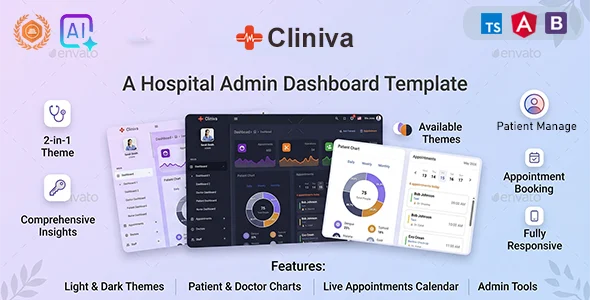
Cliniva Hospital Overview & Healthcare Frontend Foundation
Cliniva Hospital is an Angular 22+ medical admin dashboard template built on Angular Material 22 (Material 3) and TypeScript, engineered for development teams and healthcare SaaS builders to launch hospital management interfaces without months of layout engineering. The package removes the frontend bottleneck that typically stalls HMS, EHR, and telemedicine delivery by supplying pre-built administration, doctor, and patient portals spanning appointments, diagnostics, billing, HR, pharmacy, and emergency workflows. In production delivery, it operates as a self-hosted Angular source codebase that agencies theme, extend, and bind to their own REST backends prior to client staging and deployment.
Technical Specifications & Deployment Matrix
| Engineering Metric | Deployment Specification |
|---|---|
| Base Framework | Angular 22+ with Angular Material 22 (Material 3 design system) |
| Runtime / Language | TypeScript with RxJS; SASS-based theming pipeline |
| UI Dependencies | Zero jQuery, zero Bootstrap; Material components only |
| Rendering / Layout | Responsive across Chrome, Edge, Firefox, Safari, and Opera; vertical and horizontal menu variants |
| Data Exchange / AI Layer | Hybrid integration layer for Google Gemini (Flash/Pro) and OpenAI (GPT-4) |
| Persistence Footprint | None — frontend template only; backend, database, and API integrations excluded |
RBAC Portals, AI Pipeline & Execution Flow
The template’s execution model is organized around three role-isolated portal trees gated by an integrated AuthGuard. Route resolution flows through nested routing with lazy-loaded feature modules, so each domain — laboratory (LIS), radiology (RIS), operation theatre, pharmacy POS, insurance claims, ICU, and emergency triage — loads its bundle only when the corresponding route activates. RxJS streams coordinate state across these modules, while role-based access control restricts admin, doctor, and patient users to the branches their credentials authorize, preventing cross-portal data leakage at the routing layer.
On top of this structure sits a hybrid AI engine that can switch between Google Gemini and OpenAI providers. Thirteen clinical features consume this layer: triage advisory logic that computes Emergency Severity Index levels from vitals and symptoms, an ICU resource forecaster projecting inflow risk and staffing ratios, a clinical notes scribe that converts unstructured physician input into structured EMR records, prescription safety analysis for drug interactions, lab report interpretation with biomarker flagging, and a seven-day diet plan generator keyed to patient parameters. A draggable chat assistant persists across all pages, dispatching staff and clinical queries through the same provider abstraction.
Theming is handled through SASS variables rather than hard-coded styles, exposing light, dark, and RTL renderings alongside multiple background palettes and a glassmorphism variant with animated backdrops. Internationalization uses JSON language files, with English, German, and Spanish preconfigured. For teams shipping non-clinical SaaS control panels on the same runtime, Apzel – Angular App & Software Template exists as an independent Angular codebase covering generic admin and software product surfaces.
Core Technical Capabilities of Cliniva Hospital
- Role-Based Access Control with AuthGuard: Route guards partition admin, doctor, and patient portal trees, and nested routing keeps each role’s modules isolated so unauthorized branches never mount.
- Hybrid AI integration layer: Provider switching between Gemini Flash/Pro and GPT-4 feeds 13 clinical utilities — ESI triage scoring, ICU capacity forecasting, prescription interaction checks, discharge summary generation, and lab biomarker parsing.
- Lazy-loaded modular TypeScript architecture: RxJS-driven feature modules per hospital domain reduce initial bundle size and keep the codebase partitioned for parallel team development.
- SASS theming with directional support: Variable-level overrides drive light, dark, and RTL modes, glassmorphism styling, and palette swaps without touching component markup.
- Built-in application suite: Kanban board, file manager, calendar, email, chat, task manager, contacts, notes, and a ticket system ship as ready-to-mount modules.
Production Implementation & Operational Resilience
Because the package is a frontend template with no backend, database, or API layer, implementing teams must supply their own REST endpoints and bind them to the TypeScript services. Cross-origin behavior is therefore governed at the API gateway rather than inside the codebase — CORS headers must be configured on whatever backend serves the compiled SPA. AI provider credentials and endpoints are wired through the environment configuration, so staging and production builds can target different providers or models without code changes.
The build path follows the standard Angular CLI pipeline, where lazy loading and ahead-of-time compilation keep the initial payload controlled even with the full module inventory in place. Prebuilt 404 and 500 error pages, lock screens, two-factor authentication screens, and maintenance or coming-soon states cover staging and failover scenarios without additional design work. Styling customization stays within SCSS variable overrides and layout variants, while demo imagery must be replaced — the preview images are credited to Pexels and Freepik and are excluded from the download package. Documentation ships with the source files to guide module wiring and theming. For general-purpose analytics consoles where the healthcare domain layer adds no value, Crocs – Angular 18 Admin Dashboard ships as a separate standalone Angular 18 codebase with its own layout and theming system.
Frequently Asked Questions
Does the download package include backend services or a database?
No, the deliverable is a frontend Angular template only. Backend logic, database persistence, and API integrations are excluded and must be implemented by the development team deploying the codebase.
Are the demo images shown in the preview included in the package?
No, images used in the demo are excluded from the download package and are credited to Pexels and Freepik. Production deployments require separately sourced replacement assets for all visual media.
Can the interface render right-to-left languages without re-engineering layouts?
Yes, full RTL support ships alongside JSON-based internationalization with English, German, and Spanish preconfigured, allowing multilingual hospital deployments through language file replacement alone.
Does the template depend on jQuery or Bootstrap for its interface layer?
No, the entire interface is built on Angular Material 22 with Material 3 components. The codebase contains no jQuery and no Bootstrap dependencies, which reduces script conflicts and simplifies bundle auditing.