Chromatic Pathway – HTML5 – Construct 3
Chromatic Pathway Overview & Puzzle-Platformer Source Architecture
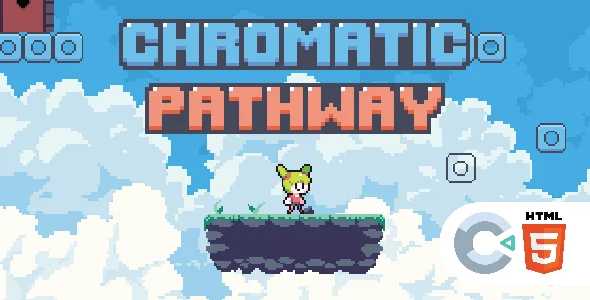
Chromatic Pathway is a Construct 3 HTML5 puzzle-platformer source package, engineered for indie developers and casual-game studios to deploy a color-shifting platform game across desktop and mobile browsers. The central engineering problem it addresses is environmental transformation: platforms change state as the player advances, so every jump must be timed against ground that shifts solidity mid-run. Within a production pipeline, the package functions as an editable foundation — a commented .C3P project paired with a ready-to-host HTML export for rapid reskin and deployment.
Technical Specifications & Deployment Matrix
| Engineering Metric | Deployment Specification |
|---|---|
| Base Technology / Framework | Construct 3 — native event/action system, no third-party plugins |
| Runtime / Language Requirements | HTML5 export; delivered as JavaScript JS, JSON, and HTML files |
| Compatible Browsers | IE10, IE11, Firefox, Safari, Opera, Chrome, Edge |
| Front-End / Engine Dependencies | Construct 3 runtime only; no custom JavaScript layer |
| Database / Persistence Footprint | None — fully client-side execution with no backend dependency |
| Display & Input Layer | High-resolution HD screen design; keyboard support plus mobile touch controls |
Event-Sheet Execution Pipeline & Transformation Mechanics
All gameplay logic executes inside Construct 3’s native event sheet system without custom JavaScript. On every engine tick, condition blocks are evaluated in order: input listeners read keyboard or touch state, the built-in platformer behavior resolves physics and collision response, and the level’s transformation logic re-evaluates which platforms currently count as solid ground. Because this color-state mechanic is the core puzzle variable, a mistimed jump against unstable ground is a deterministic outcome of event ordering rather than an arbitrary failure state — the property that gives the game its thinking-oriented difficulty curve.
The rendering path follows the standard HTML5 canvas pipeline. HD sprite assets are preloaded before scene activation, drawn each frame at native resolution, and updated in lockstep with the event sheet so that visual transformation and collision solidity never desynchronize. Input is normalized across device classes: desktop sessions receive keyboard bindings, while mobile sessions run through a touch layer corrected in revision 1.1, which resolved device-specific faults reported after the initial 1.0 release. For studios evaluating sibling archetypes built on the same engine conventions, Squicky demonstrates a comparable HTML5 platform-game structure for parallel portfolio expansion.
Core Technical Capabilities of Chromatic Pathway
- Zero-plugin event architecture: Every function is composed from Construct 3’s native events and actions, which removes dependency risk and keeps the project loadable in any unmodified Construct 3 editor.
- HD canvas rendering: Screen design targets high-resolution displays, with sprite drawing synchronized to the event loop so collision state and visuals stay aligned frame to frame.
- Dual input dispatch: Keyboard bindings serve desktop browsers while a touch overlay handles mobile sessions, with the 1.1 revision correcting device-specific input faults.
- Commented, editable source: The .C3P project ships with fully commented event sheets, shortening the learning curve for developers modifying mechanics or level layouts.
Production Implementation & Operational Resilience
Deployment is a static-hosting exercise: the exported HTML build runs entirely client-side, so any web server or CDN-capable host can serve it without server-side processing, database provisioning, or cross-origin negotiation beyond standard same-origin asset delivery. Since no data leaves the browser, the persistence footprint is effectively zero and there is no backend surface to harden. Operational resilience instead concentrates on the client: the package targets the full mainstream browser matrix (IE10 through Edge, plus Firefox, Safari, Opera, and Chrome), and the 1.1 revision specifically hardened mobile device behavior after real-device reports surfaced issues in the first release.
Secondary development stays inside the Construct 3 editor. Asset replacement is a direct image-swap workflow — new sprites inherit existing collision and event bindings — while deeper behavioral changes flow through the commented event sheets, keeping every modification traceable to a readable condition-action pair. Studios building a multi-title Construct catalog can treat this codebase as one production line among several; Tile Fruits CompleteTemplate Construct 3 (Desktop and Mobile) offers an independent casual-game foundation for teams broadening a desktop-and-mobile portfolio on the same engine.
Frequently Asked Questions
Do I need to write custom JavaScript to modify or extend the gameplay?
No. Every function is built from Construct 3’s native events and actions with no custom JS layer, so all mechanic changes are made directly inside the visual event sheets of the included .C3P project.
Can the visual assets be replaced without breaking the event logic?
Yes. Image replacement is a documented workflow — swapped sprites slot into the existing project structure and retain their event bindings, enabling full visual reskins without touching gameplay logic or collision behavior.
Have mobile device issues been addressed since the initial release?
Yes. Revision 1.1 specifically fixed issues affecting mobile devices reported after the 1.0 first release, so current builds ship with corrected touch-device behavior alongside the original desktop keyboard support.
Is a PDF documentation file included alongside the game source?
Yes. The package contains the .C3P source project, a PDF documentation file, and the exported HTML-ready game build, giving developers both the editable project and a deployable runtime artifact in one delivery.